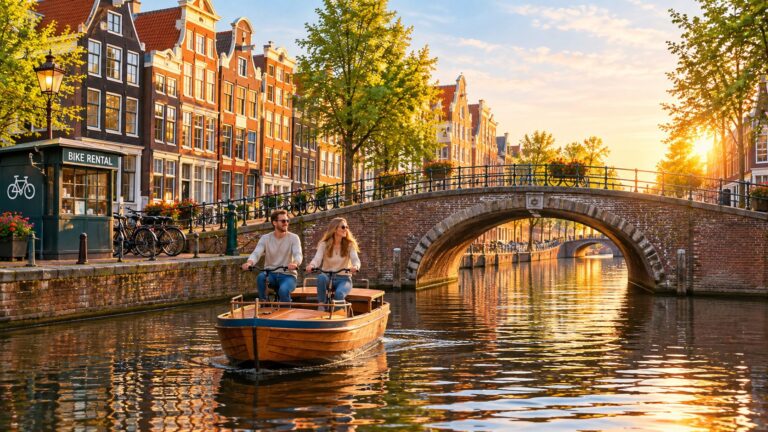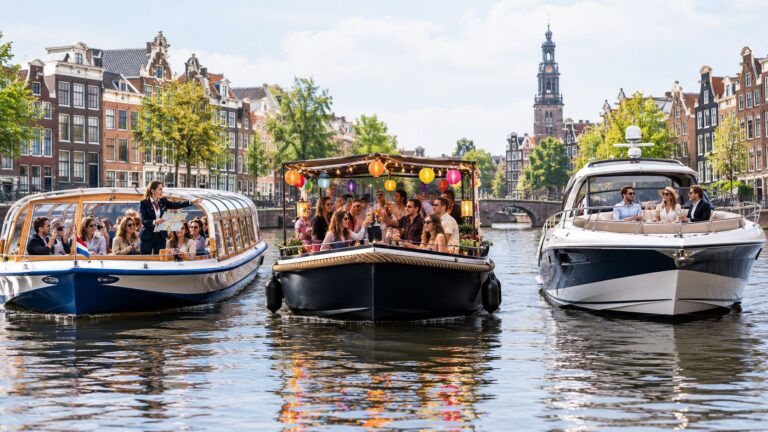
You've got one evening in Amsterdam, a group chat full of opinions, and a choice between booking a boat or trying to move everyone through several bars. A night canal cruise can look like the obvious answer, but the decision isn't about whether the views are attractive. It's whether your group wants a fixed social setting, bundled drinks, predictable timing, or the freedom to keep moving.
Amsterdam's canals make that choice unusually appealing. The city has 165 canals stretching across more than 100 kilometres, 1,281 bridges, and a Canal Ring recognised as a UNESCO World Heritage Site. Evening cruises use that heritage differently from daytime sightseeing, with illuminated bridges, darker water, quieter streets, and a pace that suits a first drink or a relaxed group start.
Table of Contents
- Why Amsterdam at Night Feels Different From the Daytime Canals
- What a Canal Cruise Night Amsterdam Actually Involves
- Shared Cruises, Private Charters, and Party Boats Compared
- Pricing, Inclusions, and What Is Usually Bundled
- Rules That Shape Every Night Cruise in 2025 and Beyond
- Cruise or Pub Crawl: Which Works for Your Group
- Booking Tips That Prevent the Most Common Mistakes
- Picking the Right Canal Night for Your Type of Group
Why Amsterdam at Night Feels Different From the Daytime Canals
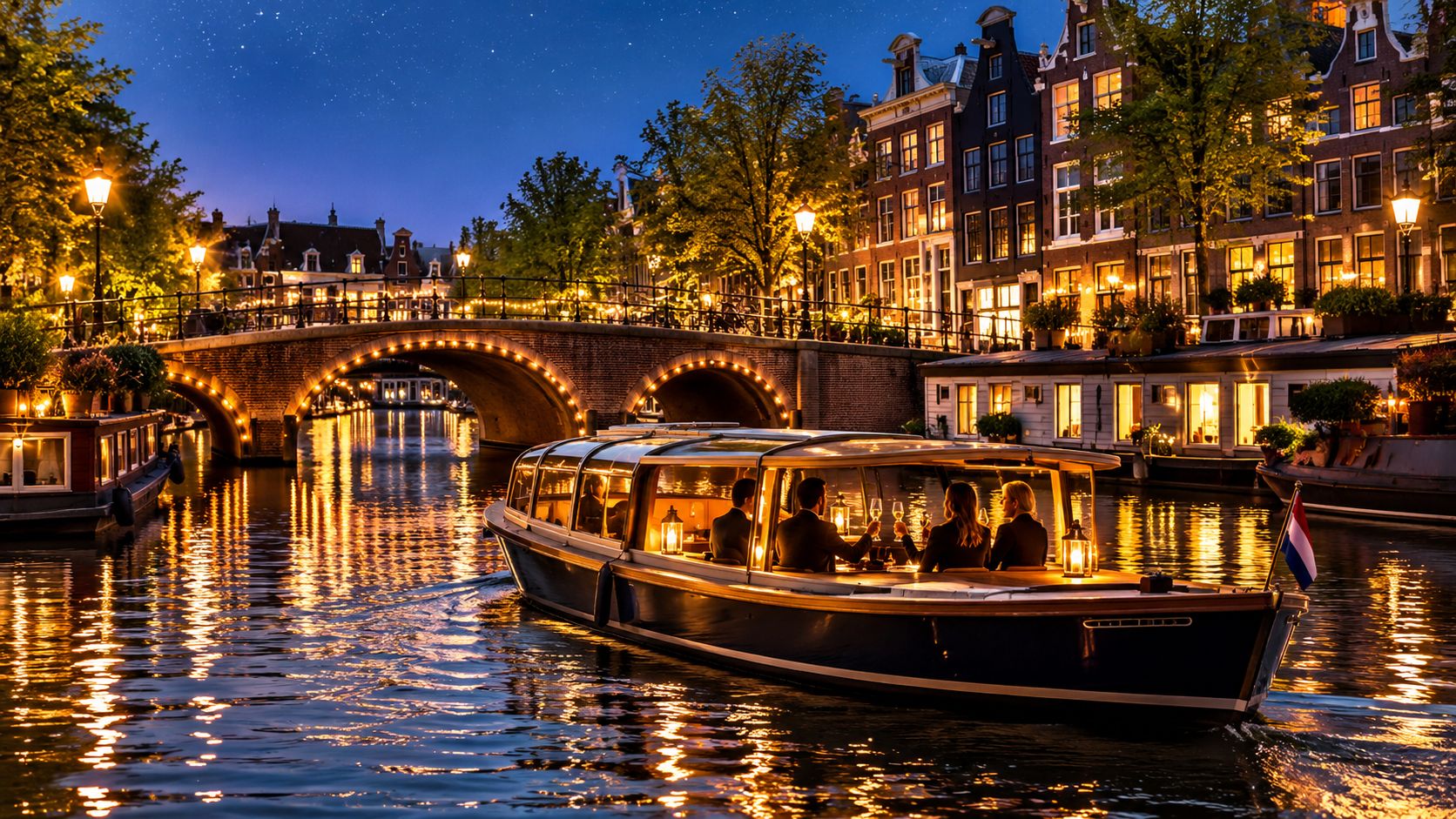
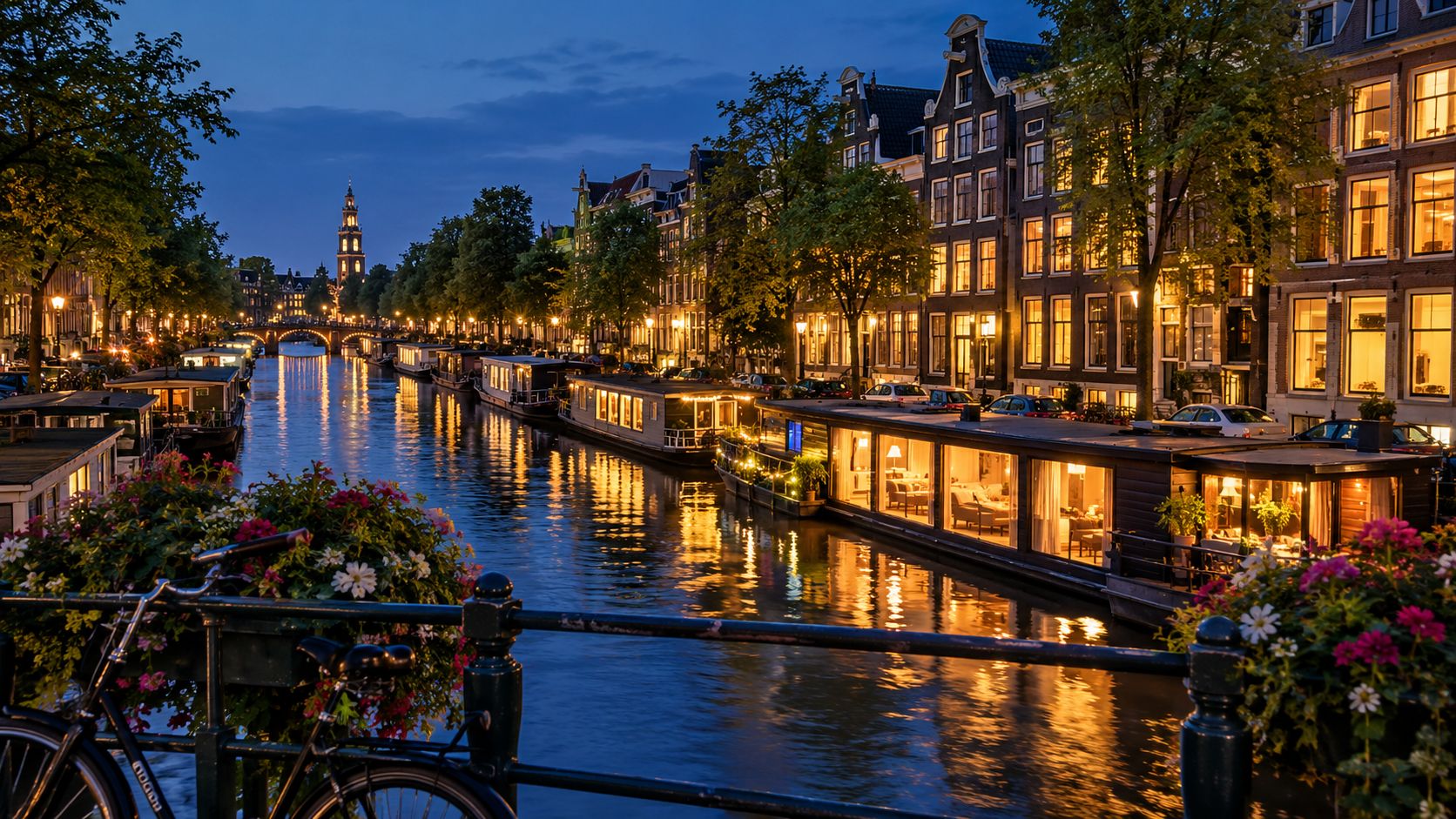
At around nine on a Friday evening, the canal belt has a different rhythm from the area around Centraal Station. Houseboats glow beneath warm lights, windows along the Herengracht reveal ordinary living rooms, and the water reflects bridges instead of the full movement of the daytime city. The air feels cooler, while the canals often seem calmer than the crowded streets nearby.
That change affects the experience from the moment a boat leaves the pier. In daylight, passengers usually focus on architecture, facades, and route landmarks. At night, lighting, reflections, and proximity to the bridges carry more of the atmosphere. A canal house doesn't need to be examined in detail to make an impression. Its outline, windows, and reflection do the work.
Why the route feels more intimate
Night operators have to treat sound and visibility differently. The canal belt contains dense residential frontage, so excessive noise carries further than many visitors expect. Amsterdam's boating guidance warns operators against amplified music and excessive noise, which makes low-volume hosting and controlled onboard sound more suitable than a loud open-air party.
Reduced traffic can also change the pace. Boats still need to follow the waterways carefully, but passengers often experience the route as less rushed because there's less visual competition from daytime activity. That slower feeling works well for couples, visitors arriving after dinner, and groups that want to talk while taking in the city.
The scale of the market matters too. Tourism sources report more than three million annual canal-cruise passengers, while another guide cites 5.5 million, with the difference reflecting varying estimates and definitions. The consistent conclusion is that canal cruising is a major Amsterdam visitor experience, not a niche evening extra.
Practical rule: Book a night cruise for atmosphere and shared time, not for the same level of detailed sightseeing that a bright daytime departure provides.
What a Canal Cruise Night Amsterdam Actually Involves
Most evening canal cruises use a compact format. Neutral Amsterdam guides describe standard trips as about 60 minutes, commonly ranging from 60 to 75 minutes, while some evening options extend to roughly 90 minutes. That makes the experience easy to place before dinner, after a walking tour, or at the start of a longer night out. Amsterdam cruise guidance also describes frequent evening departures, particularly during busy periods.
Boarding normally happens from a central canal-side pier. The exact location matters more than many first-time visitors realise, because a booking near one central landmark can still require a walk through busy streets, a tram connection, or a taxi transfer. Groups arriving from hotels or bars should build in time to find the pier, gather everyone, and complete boarding before the scheduled departure.
The route and boat style
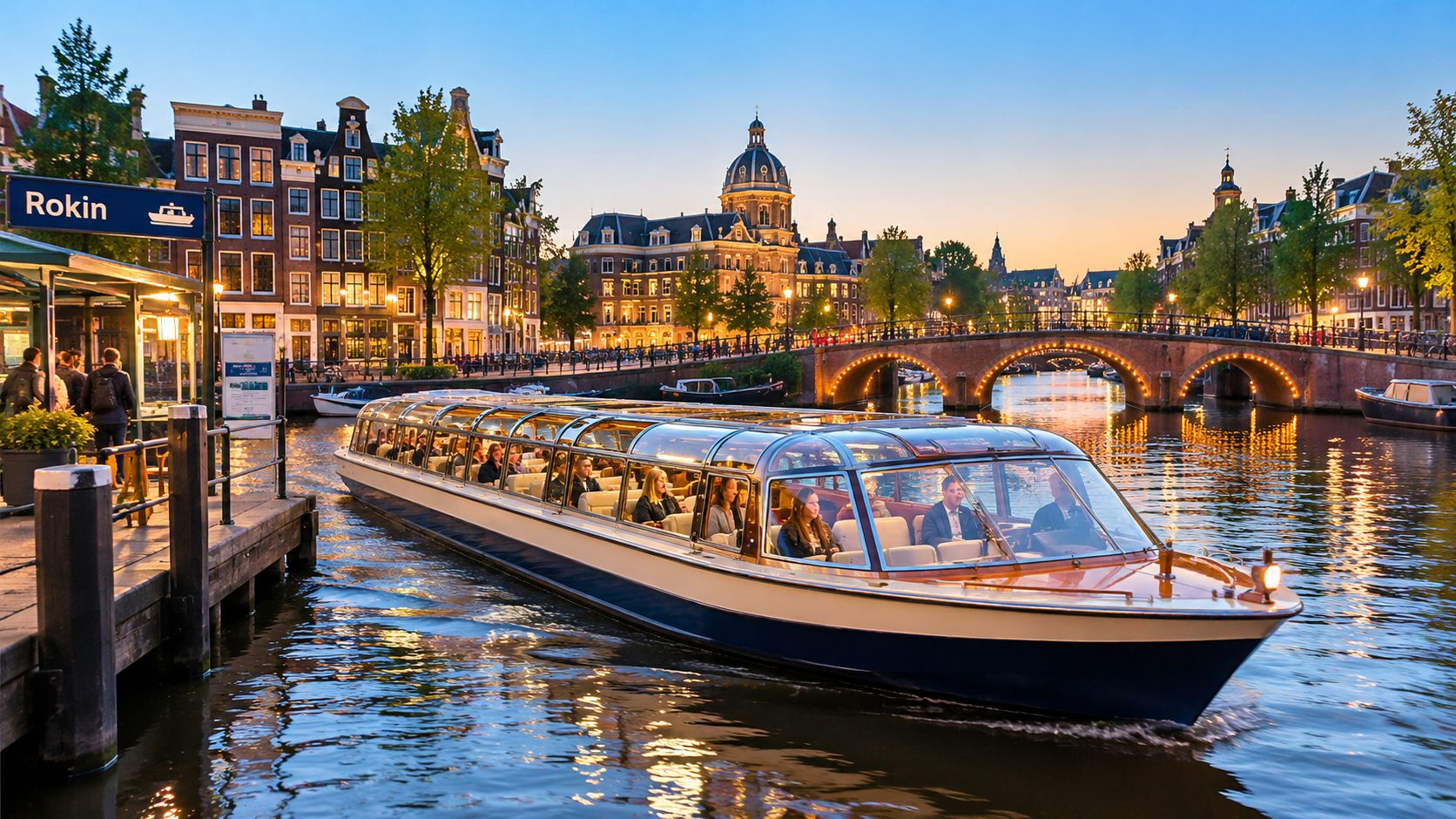
A classic itinerary generally follows sections of the central canal belt, often including the Prinsengracht, Keizersgracht, and Herengracht. The exact route can change because of local traffic, access restrictions, weather, or the operator's departure point, so a booking page should be treated as a route description rather than a promise that every bridge will appear in a fixed order.
Boat design changes the feel of the evening:
- Covered saloon boats protect passengers from wind and rain and usually suit visitors prioritising comfort.
- Open-top boats offer a stronger connection with the buildings and bridges, but the temperature can drop noticeably after sunset.
- Low electric sloops tend to create a quieter, more intimate setting, particularly when passengers want conversation rather than loud entertainment.
Onboard arrangements vary. A cruise might include a welcome drink, an audio guide in several languages, live hosting, a curated playlist, or simple background music. Restroom availability also differs by boat, so groups shouldn't assume that every vessel has one.
What changes after dark
A night cruise trades some open-sky visibility for atmosphere. Operators may reduce speed around residential stretches, keep sound restrained, and use lighting that helps passengers see without flooding the canal houses with glare. That's why the best evening product isn't always the boat with the loudest entertainment. It's the one whose format matches the group's purpose.
Shared Cruises, Private Charters, and Party Boats Compared
The right night cruise depends on three decisions: how many people are coming, how social the evening should feel, and whether drinks and entry need to be bundled. Shared cruises, private charters, and hosted party boats solve different planning problems.
A shared cruise runs to a fixed departure and combines passengers from separate bookings. It suits couples, solo visitors, and small groups that want canal views without managing the boat themselves. The trade-off is limited control over seating, music, route adjustments, and how easily the group can interact with other passengers. Standard online rates are commonly €18 to €30, according to this Amsterdam cruise pricing guidance.
A private charter gives one group exclusive use of the vessel. Families, anniversary parties, and corporate groups often choose it when conversation and privacy matter more than meeting other visitors. Departure timing and onboard arrangements can be more flexible, although catering, drinks, decorations, and extended sailing usually require separate confirmation. In our experience, private charters commonly start around €120 per group, with the final cost depending on vessel capacity and the arrangement.
A hosted party boat puts the social programme at the centre of the booking. A host, pre-arranged drinks, and a group-focused atmosphere can suit stag and hen groups, birthday parties, and international visitors who want a planned start to the night rather than a route between several bars. A shared booze cruise shows how this format makes the cruise itself the main social activity.
Night Canal Cruise Formats Compared
| Format | Best For | Group Size | Drinks & Music | Price Band |
|---|---|---|---|---|
| Shared sightseeing cruise | Couples, solo travellers, small groups | Mixed public groups | Depends on the booking | Commonly about €18 to €30 for standard online rates, according to the guidance above |
| Private charter | Families, anniversaries, corporate groups | The group's confirmed boat capacity | Arranged with the operator | Commonly €120 to €200 or more, depending on the vessel and arrangement, as an operator-side range |
| Hosted party boat | Stag, hen, birthday, and social groups | Depends on the licensed passenger vessel | Hosted entertainment and pre-arranged drinks may be included | Confirm the package directly before payment |
Choose based on the group's purpose. A couple may find a hosted party format too busy, while a large celebration may find a quiet sightseeing cruise too passive. Compare the package only after deciding whether the booking needs transport, scenery, privacy, or a complete social start to the evening.
Pricing, Inclusions, and What Is Usually Bundled
A €25 ticket can be good value for one group and poor value for another. Amsterdam's night cruise market places standard shared trips around €18 to €30 per person, with broader standard-tour pricing around €15 to €35. Small-group or heavily narrated trips can reach €30 to €50, while private rentals can cost €120 to €200 or more, depending on the arrangement, as outlined in this Amsterdam canal cruise comparison.
The ticket usually covers the boat and a defined onboard service. A basic sightseeing booking may include commentary but charge separately for every drink. A hosted party package may include a welcome drink, a drinks allowance, or entry to a later nightlife venue. A private charter may cover the vessel while leaving catering, premium spirits, decorations, and extra sailing time outside the quoted price.
Read the inclusion list literally
Compare the actual package before comparing the headline figure:
- Welcome drinks: One prosecco or beer on boarding is different from drinks served throughout the cruise.
- Bar arrangement: Ask what “open bar” covers, including beer, wine, mixed drinks, and premium spirits.
- Food: Snacks, Dutch bites, and a full dinner are separate levels of catering.
- Music: A DJ, host-led playlist, and background music produce different social settings.
- Nightlife extras: Club entry, queue access, and a later venue may be optional rather than bundled.
- Onboard charges: Check for coat storage, gratuities, upgrades, and service fees before payment.
Group size and social intent should guide the choice. A small group that mainly wants conversation may not need hosted entertainment or a drinks package. A birthday or stag group may value one planned payment and a lively boat more than the lowest fare. For a private charter, confirm whether the quote covers the whole vessel or only a seat allocation, then check the permitted sailing time and passenger capacity.
Departure timing can change both availability and the final payable amount. Friday and Saturday nights often offer fewer suitable spaces for larger groups, while midweek or shoulder-season departures may provide more choice. Compare the complete booking total, not the first attractive figure shown online.
| Format | What the base arrangement usually includes | Common exclusions or add-ons | Price reference |
|---|---|---|---|
| Shared sightseeing | Boat trip and standard commentary | Drinks, snacks, and upgrades | Per operator listing |
| Standard tour | Boat, route, and the stated onboard service | Premium seating, food, or drinks | Per operator listing |
| Small-group narrated trip | Smaller setting or more detailed narration | Food and premium beverages | Per operator listing |
| Private rental | Vessel hire for the agreed booking | Catering, decorations, extra time, and special service | Per operator listing |
Ask one question before paying: “What is included in the headline price, and what will be charged separately?”
Rules That Shape Every Night Cruise in 2025 and Beyond
Night cruising in central Amsterdam is shaped by rules that affect the boat itself, the sound level, and the way groups board. From 1 April 2025, the affected central canal network moved to a low-emission regime allowing electric, hydrogen, or manually powered boats, while passenger and excursion boats in the centre were already required to use emission-free propulsion. Amsterdam boating information explains why propulsion is now an operational requirement, not just an environmental label.
For visitors, electric power has practical benefits. It reduces exhaust smell at the quay and engine vibration onboard, while quieter operation makes commentary easier to hear without raising the volume. That matters late in the evening, when residential buildings sit directly beside the route.
Capacity and sound are part of the product
Recreational craft on inner-city canals are capped at 12 passengers plus a skipper, and boats must keep to about 6 kilometres per hour, according to Amsterdam's boating guidance. Larger groups therefore need a licensed passenger vessel rather than a private pleasure craft. A group that books several small boats without checking the rules can create unnecessary separation and a less coherent night.
Noise is another practical limit. Operators are told not to use amplified music or make excessive noise, and canal-specific guidance describes restrictions on speakers and amplified music on open decks after 22:00. A party cruise can still be social, but the legal and residential setting favours hosted conversation, controlled music, and respectful behaviour.
Passengers should also expect the operator to manage boarding responsibly. The legal drinking age in the Netherlands is 18, and legitimate nightlife operators check identification, as explained in this Amsterdam pub-crawl guide. Guests should carry valid ID and understand that intoxicated or disruptive behaviour can affect whether boarding is permitted.
The practical result is straightforward. Ask what type of vessel is being used, whether it can legally carry the full group, how drinks are handled, and what sound limitations apply. Those answers tell a visitor more about the likely experience than a generic promise of a “party boat.”
Cruise or Pub Crawl: Which Works for Your Group
A group arriving in Amsterdam after a long day faces a practical choice: book one shared base with drinks and entry handled together, or build the evening around walking between venues. A canal cruise suits groups that value scenery, conversation, and a defined timetable. A pub crawl suits groups that want several venues, new company, and a night that develops beyond the first meeting point.
The social mechanics differ. On a boat, everyone remains in one controlled space, so organisers spend less time counting heads or repeating directions. A crawl creates more variety and interaction, but each move introduces possible delays, missed instructions, and people falling behind.
Three useful comparisons
Social interaction: A cruise concentrates conversation among the people who booked together. That works well for couples, mixed-age groups, corporate teams, and visitors who want a structured introduction to Amsterdam. A crawl changes the setting and brings contact with other groups, which can suit guests seeking a more outgoing format.
Pacing: Using the 60-to-75-minute format described earlier, a cruise fits a fixed window, while a crawl runs longer by design, according to independent Amsterdam nightlife guidance. One hosted crawl format includes three to five bars, a drink at each stop, and a club finale with reduced entry. See our guide to surviving a pub crawl in Amsterdam for practical preparation. Another guide to how a hosted Amsterdam pub crawl works explains the format.
Group management: For a group of eight or more, one cruise can simplify the evening because the group boards and leaves from the same setting. A much larger party may find walking between venues easier than sourcing one boat with suitable capacity. Group size should decide the format before scenery does.
When the hybrid makes sense
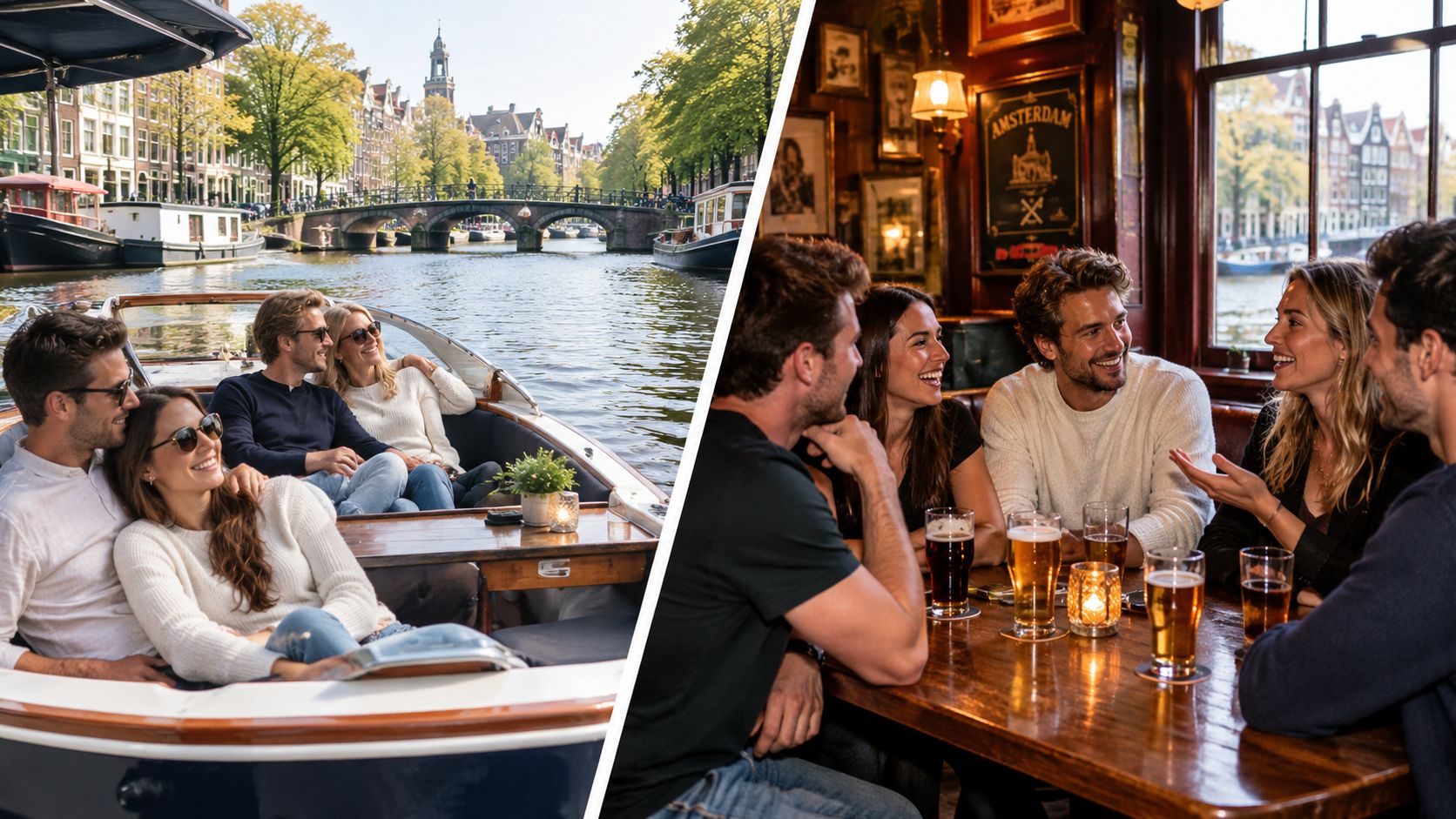
A hosted cruise can open a longer night. The group shares a first activity, settles into the plan, and then continues to bars or clubs. This suits visitors who want canal views without committing the entire evening to sightseeing. It also gives the organiser a clear point at which to check that everyone is together before changing venues.
Drinks and entry matter as much as the route. Bundled inclusions reduce decisions during the evening, while a pay-as-you-go crawl leaves more control with each guest. Check those terms alongside the boat schedule and any operating limits shaped by Amsterdam's 2025 emission rules.
- Choose a cruise for scenery, one shared base, relaxed conversation, or a defined opening activity.
- Choose a crawl for several venues, changing energy, and a longer nightlife route.
- Combine both when the group wants canal views first and venue variety afterwards.
Booking Tips That Prevent the Most Common Mistakes
Friday and Saturday night departures can fill quickly during busy travel periods, and independent nightlife guidance describes early booking as particularly important for those slots. Amsterdam tourism advice also recommends booking ahead during spring tulip season, summer weekends, and the Amsterdam Light Festival period.
Groups should begin with the date, the preferred departure window, and the number of people who will attend. A booking that looks suitable for a small group may not work once the organiser adds late joiners, partners, or friends arriving on different flights. The operator should confirm the licensed vessel and available capacity before payment.
The confirmation checklist
The booking confirmation should state more than the date. Check each item below before the group leaves for Amsterdam:
- Departure pier: Confirm the exact boarding location and how the operator identifies it.
- Boarding time: Treat the arrival time as a deadline, not a suggestion.
- Boat details: Ask for the vessel name or a clear description of the boat type.
- Contact method: Keep the operator's phone or messaging contact available on the day.
- Cancellation terms: Save the policy with the booking confirmation, especially for group plans.
- Weather policy: Find out whether the boat sails in rain, what happens during unsafe conditions, and whether covered seating is available.
- Licence and insurance: Ask whether the operator holds the required passenger-vessel permissions and public liability cover.
A dinner cruise may call for smarter clothing, while an open party boat needs practical layers and shoes that work on a moving deck. Even in mild weather, the air over the canals can feel cooler after sunset. Guests prone to seasickness should choose a stable covered vessel where possible, and everyone should bring valid ID for alcohol service.
A charged phone is useful for QR tickets, location sharing, and contacting late arrivals. The organiser should also avoid promising that every guest can board after drinking elsewhere. Captains and hosts have to protect the group and the operation, so visibly intoxicated or disruptive passengers may be refused.
Picking the Right Canal Night for Your Type of Group
The right format becomes clearer when three variables are separated: group size, social intent, and drink arrangement. A calm couple's evening has little in common with a birthday group that wants music and a single moving venue. Treating both as generic “canal cruise” customers leads to poor bookings.
Solo travellers and couples usually benefit from a shared evening cruise when they want atmosphere without managing a private itinerary. A guide or host can add context, while a quieter shared boat leaves room for conversation. Couples seeking privacy should investigate a private charter instead of assuming that a public departure will feel intimate.
For friend groups of four to eight, a hosted party format can be more practical than designing a bar route. Drinks arranged in advance reduce the number of decisions during the cruise, while the fixed setting keeps the group together during the opening part of the night.
Stag and hen groups need to think about movement. A hosted party cruise can provide one start time, one meeting point, and one shared venue, which reduces the risk of people disappearing between bars. The operator still needs the exact headcount and the group must respect the boat's rules, but the format solves a real coordination problem.
Corporate and birthday groups that want everyone seated should look at a private or dinner-oriented format. They'll need to confirm catering, drinks, timing, and onboard facilities directly rather than relying on a generic cruise description. A private booze cruise is the type of option to investigate when exclusive use matters more than meeting other passengers.
Canal Night Format by Group Type
| Group Type | Best Format | Why It Fits | Watch Out For |
|---|---|---|---|
| Solo travellers and couples | Shared evening cruise or quiet private charter | Atmosphere without complex planning | Public boats may not offer privacy |
| Friends of four to eight | Hosted shared party cruise | Group stays together and drinks can be arranged in advance | Check the music and drink format |
| Stag and hen groups | Hosted party cruise | One venue, one departure, fewer opportunities to lose people | Confirm capacity and behaviour rules |
| Corporate groups | Private charter or dinner format | Seated conversation and controlled surroundings | Catering and timing may be separate arrangements |
| Birthday groups | Private or hosted party format | Matches either celebration energy or exclusive use | Clarify what entertainment and drinks include |
A simple decision rule works well. If the group wants chill, prioritise boat style and sound level. If it wants celebration, prioritise hosting and drink arrangements. If it wants minimal coordination, choose the format that keeps everyone in one place.
For groups comparing a canal cruise night in Amsterdam with a pub crawl, Ultimate Party Amsterdam offers shared and private electric-boat experiences with drinks arranged around the cruise format. Visit Ultimate Party Amsterdam to compare the available options and choose the one that fits the group's size, social plans, and preferred level of organisation.
🍻
Experience it Yourself
Skip the planning — join Amsterdam's biggest pub crawl and get 6 bars, free drinks and VIP club entry for €20.