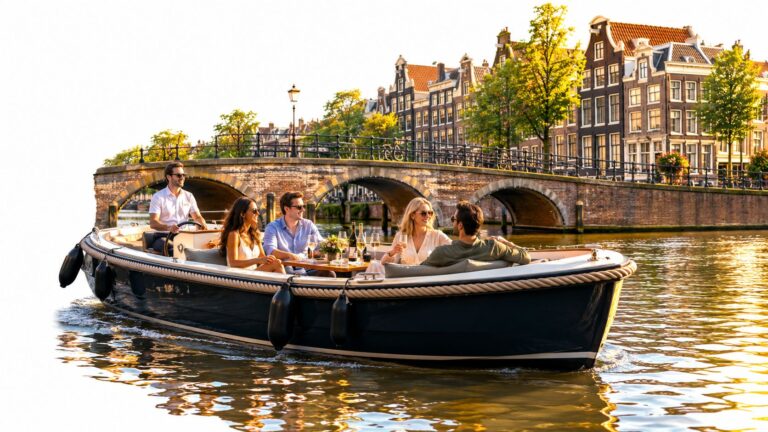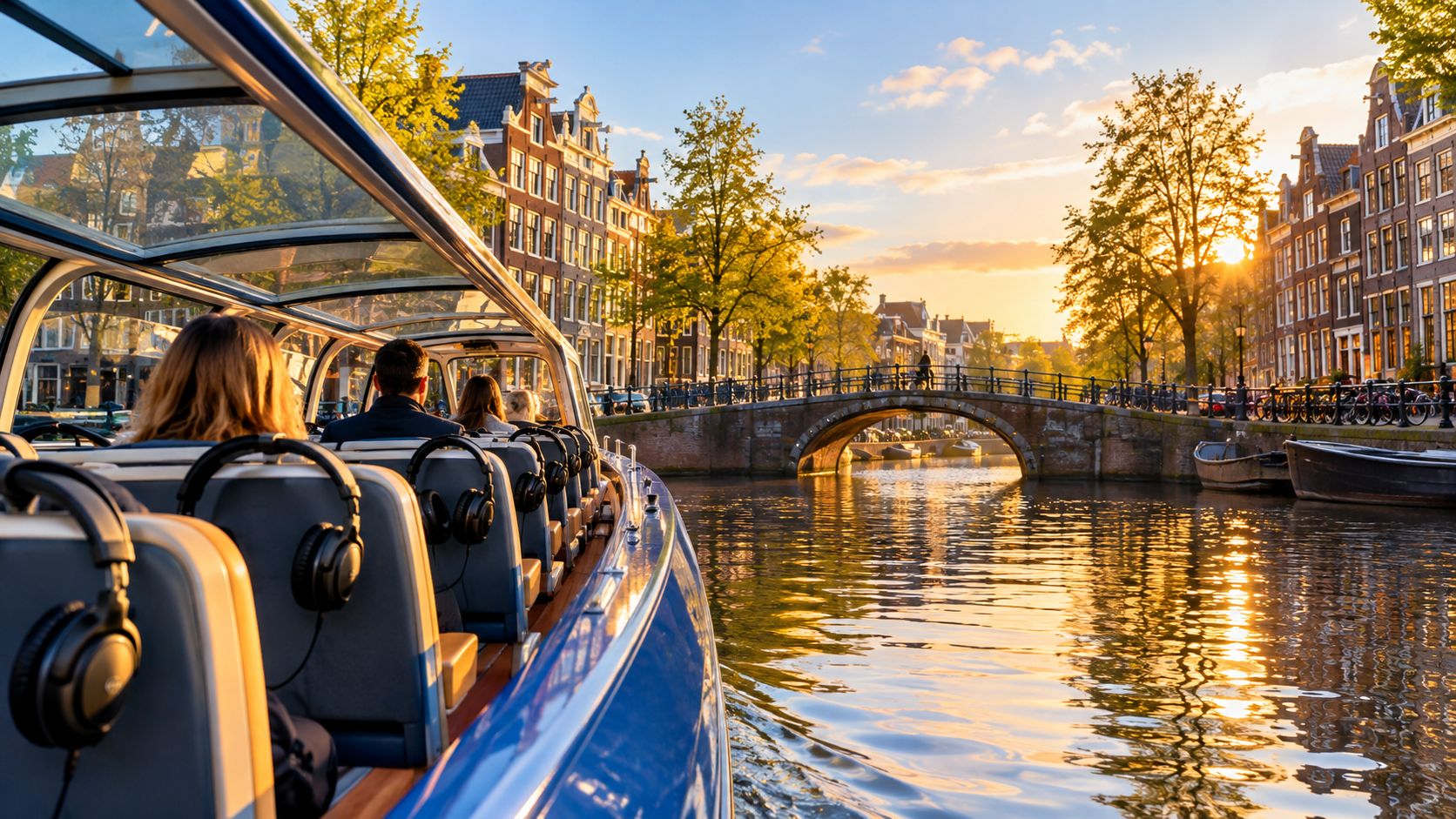
Blue Boat's City Canal Cruise is a 75-minute trip through Amsterdam's historic canal ring with personal audio commentary in 20 languages. It's a structured sightseeing experience, not a hosted party cruise.
A group has arrived in Amsterdam, the hotel rooms aren't ready, and someone suggests getting straight onto a boat before dinner. That sounds efficient until the organiser checks the luggage policy, the departure location and whether the group wants to listen to commentary.
The useful question isn't whether Blue Boat is worth booking. It's whether that particular cruise fits the passengers, their bags and the rest of their night.
Table of Contents
- What to Expect on a Blue Boat Canal Cruise in Amsterdam
- Who Blue Boat Company Is and Why It Matters
- Routes, Duration and the Onboard Experience
- Sightseeing Cruise vs Party and Booze Cruises
- Accessibility, Luggage Rules and Pre-Boarding Logistics
- Ticket Types, Typical Prices and Booking Tips
- Which Canal Experience Fits Your Night
What to Expect on a Blue Boat Canal Cruise in Amsterdam
At the dock, the distinction between sightseeing and social cruising becomes practical. A visitor wanting an introduction to Amsterdam's architecture is choosing something different from a birthday group expecting drinks, conversation and a host to keep everyone involved.
Blue Boat's standard product runs daily with several departures and includes use of a personal audio system, according to its City Canal Cruise overview. That makes it a scheduled activity to build into an itinerary, rather than an open-ended boat rental.
Passengers should approach it as a sightseeing appointment on the water. The attraction is the view and the explanation of the city, not an entertainment programme designed around a celebration.
A city overview rather than a party venue
A typical visitor arrives with a booking confirmation, finds the correct departure point and boards ready to watch the canals unfold. The headset gives that visitor something to follow while the boat passes the cityscape. For an international group, individual commentary means passengers don't all need to understand the same language.
That format works when people share an interest in seeing Amsterdam but don't necessarily want constant conversation. It's less suitable when the main purpose is to get friends talking, celebrate together or start a lively night out.
- Choose sightseeing for orientation. The cruise can help visitors decide which parts of the centre deserve a longer visit on foot.
- Choose a social format for interaction. A group that wants a host and included drinks should compare those features explicitly.
- Keep the next activity separate. A canal ticket shouldn't be treated as proof of any restaurant reservation, nightlife admission or onward transport.
A boat can be the right setting and still be the wrong experience. The onboard format matters as much as the scenery.
For a short stay, the sensible approach is to connect the cruise with nearby plans rather than bolt it onto an already crowded day. The day-to-night Amsterdam itinerary offers a useful starting point for arranging sightseeing and nightlife as separate, complementary activities.
The dock address deserves particular attention. An organiser shouldn't assume every canal departure is near Central Station, or send a group to whichever waterfront boarding point looks familiar.
Who Blue Boat Company Is and Why It Matters
Blue Boat's name comes with a substantial operating history. According to its company history, the business began in 1948 as Rederij Noord-Zuid, founded by an Amsterdam entrepreneur; after Daniël and Hermen van Gent took over, its fleet grew from 5 boats to 9 during the 1990s, followed by the 2005 Blue Boat Company rebrand and the 2007 acquisition of Amsterdam Canal Cruises, which added 6 boats and brought the total to 15.
That background helps explain why the name appears so often in canal-trip planning. This isn't a recently assembled sightseeing concept. It's an established operation whose identity developed alongside Amsterdam's visitor economy.
What operating scale means for a booking
The company reports approximately 750,000 passengers annually and roughly 18 million since its founding, and describes a fleet consisting largely of electric vessels following the introduction of its Naturally green programme in 2014. Those figures and the programme history are reported on the company-history page linked above.
For visitors, scale and longevity are useful context, but neither settles the booking decision. An established sightseeing operation can be exactly right for a couple interested in architecture and still be a poor match for a group expecting a hosted celebration.
The practical comparison should remain specific:
- Published format. Does the advertised experience match what the group wants to do onboard?
- Departure arrangements. Can the organiser confirm a suitable location and any required accessibility provision?
- Environmental detail. Does the information describe the assigned vessel, or only the operator's broader policy?
- Total booking conditions. Are the inclusions, amendment rules and cancellation terms clear before payment?
Reputation isn't an inclusion
A familiar operator name doesn't establish that drinks, music, private space or a live host are part of a particular ticket. Those are separate purchasing decisions.
The same applies to sustainability. A fleet-development policy is meaningful, but a group with environmental requirements should ask about the actual boat allocated to its departure. The strongest booking decision combines confidence in the operator with a close reading of the selected product.
For nightlife planning, that distinction prevents a common mismatch: choosing a well-known sightseeing name when the group's real priority is spending time together.
Routes, Duration and the Onboard Experience
Amsterdam's canals aren't a scenic loop created for tourists. The city has more than 100 kilometres of canals, approximately 90 islands and around 1,500 bridges; expansion of the canal ring began in 1613, and the 17th-century canal-ring area received UNESCO World Heritage status in 2010, as described in the history of Amsterdam's canal network.
The Herengracht, Keizersgracht and Prinsengracht form the best-known belt. Their historic functions included urban expansion, transport, water management, defence and commercial development. That context makes a canal cruise more useful than a sequence of attractive photographs: passengers are looking at the infrastructure around which the city developed.
Follow the published sightseeing route
Blue Boat's standard canal-tour details specify a 75-minute cruise, landmarks including the Magere Brug, Montelbaanstoren, city-centre canal houses and architectural highlights around Piet Heinkade, a personal audio system in 20 languages, and check-in at least 15 minutes before departure.
The route provides a concentrated overview, not a stop-by-stop exploration of every canal. A passenger interested in a particular building should treat the cruise as an introduction and leave time for a separate visit rather than expect to disembark beside it.
A clear boarding plan helps keep the experience straightforward:
- Check the booking confirmation. Use the address and departure attached to that ticket, not a remembered dock from another trip.
- Build check-in into the itinerary. The published arrival requirement belongs in the group message, alongside the sailing time.
- Choose commentary deliberately. Each passenger can select a preferred language instead of relying on a group translation.
- Leave room after the cruise. Dinner or nightlife plans should account for disembarkation and the journey to the next meeting point.
What the headset format changes
Personal audio works well for mixed-language visitors because everyone can follow the sightseeing independently. It also changes the social rhythm: people concentrating on narration won't necessarily be participating in a group conversation.
That's an advantage for visitors who want a calm introduction to the city. It's a trade-off for friends who mainly want to catch up or celebrate.
Planning rule: A fixed cruise duration is useful only when the organiser also allows for check-in, boarding and the onward journey.
The standard experience should therefore be judged on its actual purpose. It offers a defined route and commentary, rather than the flexibility of a private charter or the interaction of a hosted drinks cruise.
Sightseeing Cruise vs Party and Booze Cruises
For group travellers, the most important comparison is commentary versus conversation. Both formats put passengers on Amsterdam's canals, but they organise the time onboard around different priorities.
A sightseeing cruise suits passengers who want the city explained. A hosted booze cruise suits passengers who want the canals as the setting for a social occasion. Neither is automatically the better choice, and paying more won't resolve a mismatch between the format and the group.
Blue Boat Sightseeing Cruise vs Amsterdam Party Cruise
| Criterion | Blue Boat Sightseeing Cruise | Hosted Booze Cruise |
|---|---|---|
| Main purpose | Historic sightseeing and city orientation | Social time and group celebration |
| Format | Personal audio commentary | Host-led interaction and drinks service, where included |
| Duration | Fixed sightseeing schedule described above | Product-specific sailing period |
| Drinks | Don't assume an open bar | Check the advertised drinks selection and limits |
| Price comparison | Assess the sightseeing ticket and optional extras | Assess included drinks, shared or private use, and booking conditions |
| Group suitability | Passengers interested in architecture and narration | Friends and celebration groups prioritising conversation |
| Night-out use | A separate sightseeing activity before later plans | A social activity that can precede dinner or nightlife |
| Main trade-off | Less emphasis on group interaction | Less emphasis on detailed historic commentary |
The shared booze cruise is an option for travellers seeking a hosted canal experience with unlimited beer, wine and soft drinks on an electric boat. Shared seating means the experience isn't reserved solely for one group, which matters for celebrations where organisers want control over who attends.
When shared works and when private makes sense
A shared format can suit a couple, solo traveller or small collection of friends who are comfortable joining other passengers. The organiser doesn't need exclusive use of the boat merely because the booking includes a celebration.
Private use is more relevant when keeping the party together is central to the occasion. A stag or hen group may prefer its own space; a corporate organiser may want a setting where colleagues can talk without integrating into a wider passenger group.
The useful questions are concrete:
- Host expectations. Is a host included, and what role does that person perform?
- Music expectations. Is music permitted or provided? A booze-cruise label alone doesn't answer that.
- Drink expectations. Which drinks are included, and during what part of the experience?
- Next-stop expectations. Does the finish location work for the dinner or nightlife booking that follows?
A group wanting drinks, music and a host should verify all of those features rather than infer them from photographs. Included drinks don't establish a particular soundtrack, and private use doesn't establish every requested entertainment arrangement.
The practical dividing line is simple: if passengers would be disappointed by wearing headsets instead of talking together, the standard sightseeing format probably isn't their first choice.
Accessibility, Luggage Rules and Pre-Boarding Logistics
The luggage policy can change the order of an entire Amsterdam day. Blue Boat's frequently asked questions state that suitcases can't be taken onboard or stored at the dock, strollers must be folded and left behind, and all boats have toilets except the small open boat.
That makes a cruise a questionable first activity for passengers arriving with airport-transfer luggage. A central departure location doesn't solve the problem if the bags can't travel with them.
Sort bags before choosing a departure
Hotel luggage storage is worth arranging before the cruise, even when room access isn't yet available. Station storage is another possibility to investigate, but availability, opening arrangements and collection logistics should be checked rather than assumed.
The suitcase restriction shouldn't be stretched into an invented rule about every backpack. For a large backpack or an uncertain cabin-bag format, the organiser should confirm acceptance directly before travelling to the dock.
- Suitcases. Arrange storage elsewhere before arrival.
- Strollers. Confirm where the folded stroller will be left and how it will be collected.
- Essential belongings. Keep medication, documents and other necessities accessible rather than packing them into stored luggage.
- Toilet needs. Confirm the selected boat type and any specific facilities required.
Arriving early with prohibited luggage doesn't fix the booking. The bags need a separate plan before the group reaches the water.
Accessible departures require coordination
The canal-tour information cited earlier specifies that wheelchair-accessible departures use designated boats and leave exclusively from Stadhouderskade 501, opposite the Hard Rock Cafe, with advance reservation and wheelchair disclosure required. Accessibility therefore depends on matching the passenger, vessel and departure, not buying any available ticket.
The presence of a toilet also shouldn't be interpreted as confirmation of an accessible toilet. Passengers with specific requirements should establish those details before booking.
For arrivals through Central Station, the organiser should compare the walking route with current public-transport options using the exact dock address. A tram stop is only useful if the route from that stop to the boarding point suits the passengers and their mobility needs.
Anyone arriving early should first confirm the check-in location. Only then does a nearby break make sense, with enough time retained to return without rushing.
Ticket Types, Typical Prices and Booking Tips
The standard City Canal Cruise is the baseline for comparing Blue Boat tickets. Its value lies in the sightseeing route and commentary already described, so any upgrade should be assessed against a specific need rather than purchased because it sounds more complete.
A reliable current price band can't be stated without a dated fare for the selected product. The sensible comparison is the payable total shown for the intended departure, together with its inclusions and conditions. An uncited estimate would give the appearance of precision without helping the booking.
Compare the actual ticket, not the category name
An open boat changes exposure to the weather and the onboard setting. An evening or illuminated option, if available for the intended date, should be checked for its actual sailing time and whether darkness is likely during the trip.
Combination tickets require a different calculation: does the passenger want the other attraction, and do its reservation conditions fit the itinerary? Hop-on/hop-off access shouldn't be assumed to be part of a fixed sightseeing ticket, or assumed to be available from the same operator without checking the current listing.
| Booking question | What to establish before paying |
|---|---|
| Standard or upgraded ticket | Exact boat format, route and inclusions |
| Combination purchase | Separate reservation requirements and usable dates |
| Group booking | Whether passengers share the same departure and what the quoted total covers |
| Accessible booking | Confirmed vessel allocation and suitable boarding arrangements |
| Cancellation or amendment | The terms attached to that purchase channel |
| Private experience | Charter duration, drinks, meeting point and any additional charges |
Booking direct can make it easier to keep product information and booking conditions together. It doesn't justify claiming that every direct ticket is cheaper or more flexible. A reseller may offer convenience, but the organiser should compare like-for-like terms rather than assume a discount.
Check the vessel behind environmental claims
Blue Boat's fleet information states that it has invested in electric boats since 2006, planned full-fleet electric operation for 2025, and uses GTL fuel with exhaust-gas after-treatment for boats not yet electrified. The published target isn't, by itself, confirmation that every current departure is electric.
For a group comparing sightseeing with a private drinks experience, propulsion is only part of the decision. Exclusive use, hosting, the bar arrangement and the finish location also need to match the occasion.
A private booking should be treated as a different product, not merely an upgraded sightseeing seat. Its value depends on what the group intends to do together onboard.
Which Canal Experience Fits Your Night
A solo visitor or couple interested in Amsterdam's historic centre will usually find the sightseeing format the clearer fit. The practical move is to choose an available departure that leaves room for the rest of the day, rather than squeeze the boat trip between tightly timed reservations.
Match the format to the passengers
- Friends, stag and hen groups. A hosted drinks experience makes more sense when conversation and celebration matter more than narration. The private booze cruise offers a 60-minute private charter on a luxury electric boat with an open Dutch bar.
- Families. Resolve stroller handling and toilet requirements before choosing the sailing.
- Wheelchair users. Arrange the designated accessible departure and confirmed boarding location rather than relying on general availability.
The meeting point and time slot should come from the final booking confirmation. Nightlife plans should then be built around the actual finish arrangements, not an assumed return near the next venue.
The right canal experience depends less on a familiar operator name than on what passengers want to do while afloat. Historic commentary, shared social time and a private celebration are different purchases, even when the scenery overlaps.
Ultimate Party Amsterdam offers guided pub crawls and shared or private canal booze cruises for visitors planning Amsterdam nightlife. Visit Ultimate Party Amsterdam to compare the canal options, check their inclusions and choose a booking that fits the group's plans before and after the boat.
🍻
Experience it Yourself
Skip the planning — join Amsterdam's biggest pub crawl and get 6 bars, free drinks and VIP club entry for €20.