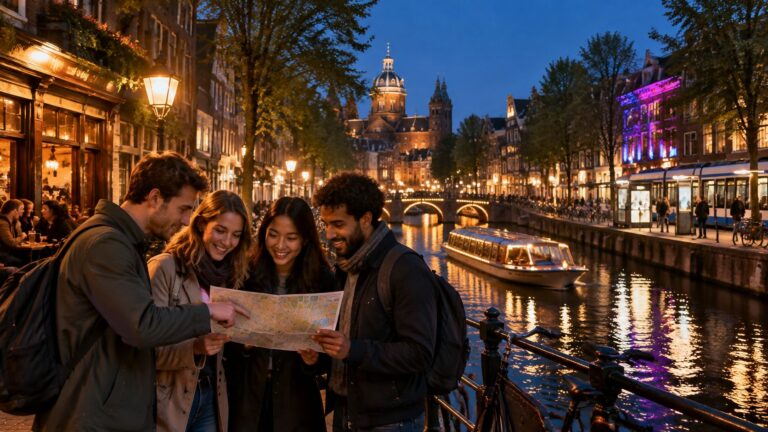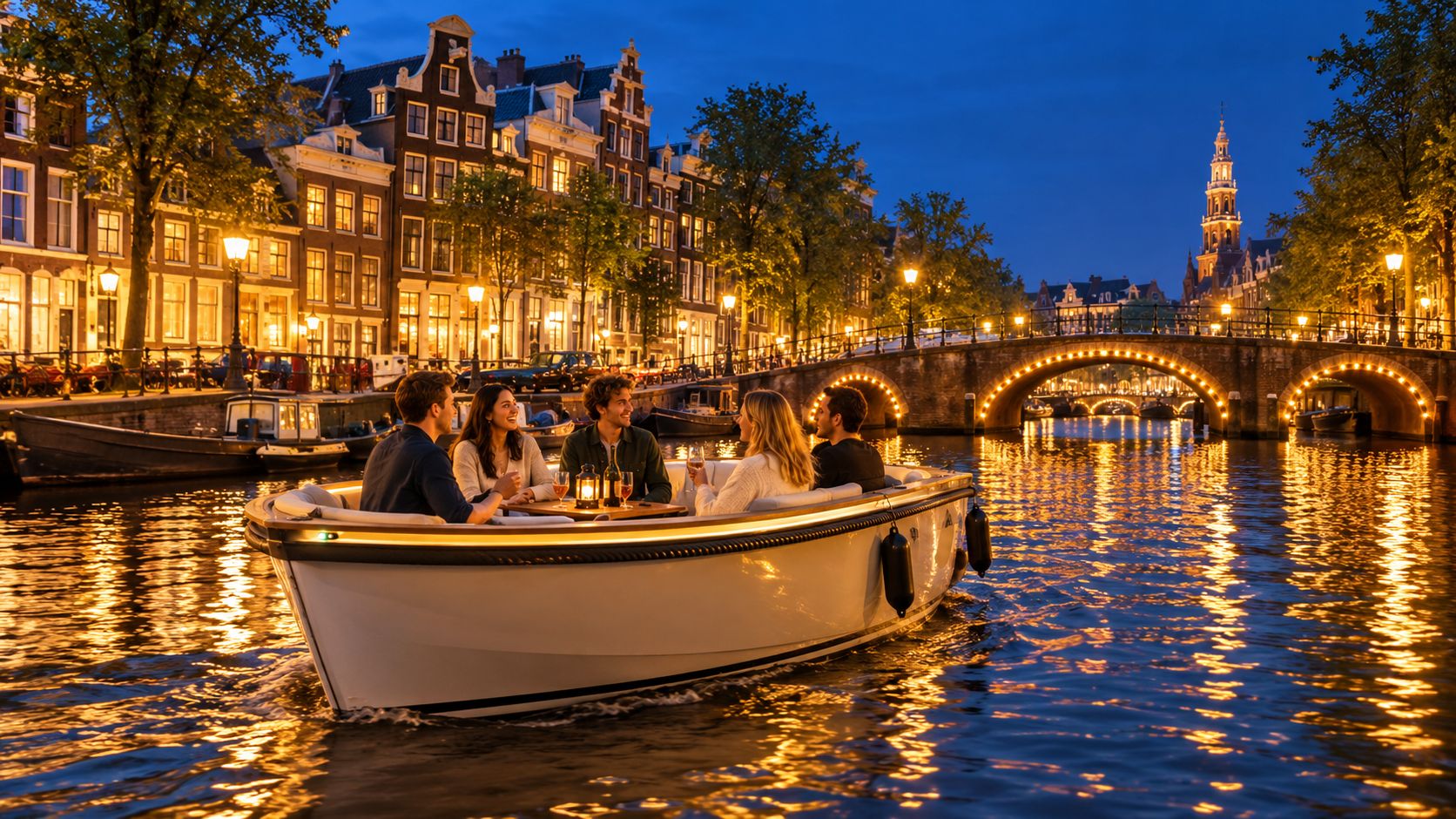
Four friends land in Amsterdam with one free evening, no route planned, and a simple wish to see the city from the water. That's the moment a canal cruise Amsterdam at night works best, provided the format suits the group, the headcount, and the kind of evening people really want.
Table of Contents
- Night Canal Cruise Options at a Glance
- What You See on the Water After Dark
- Atmosphere, Noise and Etiquette on the Canals
- Rules, Speed and Bridges That Shape Your Route
- Accessibility and Boarding in Low Light
- Planning Mistakes That Spoil a Night on the Water
- Checklist and Next Step
Night Canal Cruise Options at a Glance
The main choice is whether to share the boat or keep it private. That decision affects the feel of the evening, while the night itself shapes what you see, how sound carries near homes, and how straightforward boarding feels. Most central canal trips last about an hour, but check the specific departure, boat and inclusions before paying.
A listed price does not tell you whether drinks are included, whether other passengers will be aboard, or which boat suits your group size. Ask those questions directly. Also check the departure point and boarding access, since reaching a pier in the dark can affect the start of the evening.
| Format | Duration | Drinks | Boat | Best for |
|---|---|---|---|---|
| Shared booze cruise (Ultimate Party Amsterdam) | One hour | Unlimited beer, wine and soft drinks | Shared electric boat | Solo travellers, couples and friends who want a social evening |
| Private booze cruise (Ultimate Party Amsterdam) | 60 minutes | Open Dutch bar | Private luxury electric boat | Private groups and celebrations |
| Pleasure craft with skipper | Ask how long the scheduled trip lasts | Ask whether drinks are included in the per-person price | Up to 12 passengers plus skipper | Small groups who want their own boat |
| Licensed passenger vessel with skipper | Ask how long the scheduled trip lasts | Ask whether drinks are included or available to buy | Licensed vessel for larger groups | Larger parties and corporate teams |
How to Read the Choices
Start with your headcount, then decide how social you want the ride to be. A pleasure craft can suit a small private group, while larger parties need to ask which licensed passenger vessel accommodates them. The distinction affects more than comfort. For the group-size rules, see Rules, Speed and Bridges That Shape Your Route.
Next, compare the time on the water, drink arrangements and whether the boat is shared. Ask where boarding takes place, whether the price includes drinks, and what happens if the departure or route changes that night. Those details matter more after dark, when the view depends on lighting and the skipper may need to account for bridges or nearby residents.
The shared booze cruise in Amsterdam suits guests who want conversation with other travellers as part of the evening. A private format gives a birthday group, stag or hen party, or work team its own space and pace.
Practical rule: Choose a shared cruise to meet other travellers. Choose a private boat when your group wants to keep the evening to itself.
Ask about the boat's capacity, drink inclusions, trip length and boarding point before paying. These answers make it easier to choose a format that fits the group and the conditions on the night.
What You See on the Water After Dark
Darkness simplifies the canal ring in a useful way. Shop signs and street clutter fade, while lit windows, bridge lamps, gabled rooflines, and reflections draw the eye to the shape of the city itself. The houses were built to face the water, so a boat gives the intended view, low and continuous, rather than the fragmented view from a pavement.
The dates explain why the scene feels planned rather than accidental. Large scale construction began in 1613, when Amsterdam started digging three principal canals westward to the Leidsegracht, and between 1656 and 1662 the waterways were extended across the Amstel, as the Canon of the Netherlands history of the canal belt records. The seventeenth century canal ring inside the Singelgracht joined the UNESCO World Heritage List in August 2010, so an evening cruise passes through a preserved city plan, not a purpose built entertainment strip.
Three Canals Worth Watching Closely
- Herengracht: Look for the grander, more formal façades and the way interior light turns tall windows into a repeating pattern along the water.
- Keizersgracht: Watch the bridges and converted warehouses, where reflections make the wider stretches feel calmer and more spacious after dark.
- Prinsengracht: Notice houseboats, smaller frontages, and waterfront life close to the boat, giving this arc a more lived in feel.
Routes differ by operator, departure point, traffic, and bridge conditions. A one hour canal cruise Amsterdam at night covers only part of the ring, so it's worth asking which stretches the boat normally uses rather than assuming every famous view is included. Anyone set on a particular canal should confirm that before paying, especially on busy evenings when skippers may need to adapt.
Seat choice matters more than camera settings. Sit facing the houses rather than only facing companions, and expect the clearest, least interrupted views on wider water where the boat isn't squeezed beside moored vessels. Phones often struggle with moving reflections, so short bursts of looking beat an hour spent chasing a perfect photograph.
Bring a warm layer, even after a mild day. Air over open water feels colder than air between buildings, and a seated passenger generates little warmth. Comfortable guests notice the lit warehouses, bridges, and terraces. Cold guests mostly notice the time.
Atmosphere, Noise and Etiquette on the Canals
At night the soundscape is close and detailed. Water taps against the hull, bicycle bells ring from bridges, glasses knock on tables, and ordinary conversation carries across still water much farther than people expect. That carrying effect is the key to understanding etiquette on a residential canal.
Engine sound is only part of the picture. A TNO and Waternet assessment found recreational vessel engine noise represented only about 5% of the loudest measured events above 75 dB(A), while typical audible pleasure boat noise at the quay was estimated at 60 to 75 dB(A), according to the passenger vessel terms summarising that TNO and Waternet assessment. The same assessment still identified localised nuisance when boats accelerate, manoeuvre, operate heavily loaded, or pass close to residences.
Why Voices Matter More Than Expected
A quiet propulsion system doesn't make a loud group quiet. Shouting, chanting, and amplified music can become the dominant disturbance even when the boat itself moves smoothly and slowly. Houses sit directly on many canals, houseboats sit even closer, and sound has few soft surfaces to absorb it.
Ultimate Party Amsterdam describes its cruise boats as electric, which helps create a calmer onboard setting, but passenger behaviour still decides whether nearby residents hear a passing conversation or a travelling party. Good hosts set that expectation before the first drink rather than trying to reset the mood halfway along a narrow residential stretch.
Simple habits keep the evening pleasant for everyone:
- Stay seated and central: Movement is safer and conversation stays within the boat.
- Lower voices near homes: Late evening residential stretches call for talking, not chanting or shouting to the quay.
- Keep music modest: Sound that feels contained onboard can sound exposed from a bedroom window.
- Follow the skipper promptly: A request to sit down or quieten down usually relates to sightlines, bridges, or nearby homes.
The best night boats are lively at the table and unremarkable from the pavement.
That balance protects the atmosphere people came for, calm water, lit façades, and a group enjoying itself without turning every bridge into an announcement.
Rules, Speed and Bridges That Shape Your Route
The canals aren't an open lake with decorative edges. They're a tight working network shared by cruise boats, pleasure craft, houseboats, bridges, and side canals with short sightlines. The standard maximum speed is 6 km/h, vessels keep right, and boats shorter than 20 metres give way to longer vessels, as the City of Amsterdam safe boating guidance sets out. Correct navigation lighting is mandatory after dark.
That slow pace isn't a missed opportunity to cover more ground. Early speed reduction limits wake, suction, and collision risk where another boat may appear from a junction or a bridge opening may hide oncoming traffic. For passengers, the benefit is a steadier view, fewer abrupt movements, and time to look closely at houses rather than watch them slide past.

Capacity and the 12 Plus Rule
Capacity rules determine which boat can legally take a group. Since 23 May 2019, Amsterdam's 12 plus rule has required groups of 12 or more passengers to use a licensed passenger vessel with a skipper, as the I Amsterdam boating guidance on the 12 plus rule explains. A pre departure headcount therefore isn't administrative fuss. It confirms that the booking, vessel, and actual party still match.
Guests also help the skipper by remaining seated or evenly distributed. Clear sightlines matter at bridges and junctions, and sudden movement to one side for a photograph can affect stability. A short briefing before departure prevents repeated corrections once the boat is among traffic.
Bridges, Locks and Flexible Routes
Movable bridges and locks don't operate as if every crossing is continuously available. Waternet directs boaters to the Waternet bridge and lock operating information and vaarweginformatie.nl for current hours and waterway information. A skipper may wait, slow down, or choose another stretch based on live conditions.
The advertised duration therefore describes the experience, not a guaranteed fixed loop. A delayed bridge can shorten one section while opening extra time somewhere else. Before booking a timed canal cruise Amsterdam at night, ask how the operator handles delays and whether route changes are explained onboard. A clear answer matters more than a promise that every named landmark will appear.
Accessibility and Boarding in Low Light
Step-free pier access does not guarantee an accessible boat. At night, a wet quay, uneven lighting, and the gap between the stone edge and vessel can make boarding harder to judge. Check the street route, the boat's entrance, and the arrangements onboard separately.
Uneven quays, dim boarding areas, wet surfaces, low bridges, cold exposure, and limited visibility can turn a manageable daytime step into a difficult transfer after dark. Accessibility also varies by vessel and departure point. Ask about the specific boat you'll board, rather than relying on a general accessibility label.
| Question to ask | Why it matters at night | What to confirm |
|---|---|---|
| Is the route from the street to the pier step-free? | Dim, uneven or wet quays are harder to cross in the dark | The exact walking route and any stairs |
| Is the boat itself accessible? | Step-free pier access does not automatically mean an accessible vessel | Whether the boat can be boarded without steps |
| Can a wheelchair stay onboard? | Moving a chair after dark is harder and can delay boarding | Yes or no, and where it is secured |
| Is boarding assistance available? | The gap between pier and boat is hard to judge with limited light | Who helps and at which point of boarding |
| Is advance notice required? | Crew may need to plan seating and boarding for particular needs | The notice period and the contact channel |
| What about seating, restrooms and shelter? | Cold, wind or rain makes a one-hour trip uncomfortable | Seat stability, facilities and covered areas |
Accessibility needs can also relate to balance, restroom access, or sensitivity to cold. A stable seat near the boarding point may help one guest; covered seating may matter more to another. Confirm these details for the exact vessel and departure point, since a daylight photograph cannot show the boarding conditions at night.
Before paying: Get the pier route, boarding method, wheelchair position, and assistance arrangements confirmed in writing.
Ultimate Party Amsterdam offers email and WhatsApp contact routes for pre-booking questions. Contact the team early with access needs so they can clarify the arrangements before you pay, rather than leaving details to resolve at the water's edge.
Planning Mistakes That Spoil a Night on the Water
The night can change what a group enjoys: landmarks show up as pools of light, voices carry across quiet stretches, and bridge traffic may affect the route. Choose a cruise format that suits the group, then plan around the area and onward journey. Groups that skip the drinks question are the ones who arrive surprised at the pier, so ask what is included before boarding.
Six Avoidable Errors
- Treating the cruise as dinner or a long sunset trip: The evening format is shorter. Eat beforehand or choose somewhere to go afterwards.
- Dressing for warm streets: Open water can feel colder after dark. Bring a warm, wind-resistant layer, even if the walk to the pier feels mild.
- Cutting arrival too fine: Boarding windows on canal quays are short, and boats cannot easily wait in traffic. Arrive a few minutes early.
- Drinking heavily before boarding: Wet steps, moving decks and low light make balance harder. One very drunk guest can change the mood for everyone onboard.
- Expecting a fixed route: Bridges and other vessels can affect which stretch the boat covers. Ask how delays are handled rather than expecting a guaranteed loop.
- Leaving the rest of the night unplanned: Pick the next stop in advance. Busy weekend streets can slow the walk from the pier.
Leidseplein and the Red Light District sit within central Amsterdam's nightlife, but offer different crowds and walking routes. A group's size and preferred atmosphere can shape which area makes sense after the cruise. Check the guide to Amsterdam nightlife areas before boarding, so you agree on a destination while everyone is still together, rather than deciding on a crowded pavement.
A meal plan, an extra layer, an earlier arrival, moderate drinking and one agreed destination help the evening run smoothly. Check the drinks question and ask how a bridge delay could affect the route. These small decisions leave less to settle in the dark, when the water is moving and the group is ready to head on.
Checklist and Next Step
At the pier, a clear confirmation on your phone can save a late-night scramble. Before paying, verify the departure point and exact boarding time, what drinks or extras are included, the number of guests covered, and how to contact the operator if plans change. Make sure the meeting point is specific enough to find in the dark, and that the confirmation opens on your phone without needing access to another person's inbox.
Ask for the cancellation terms in writing, including the deadline and how a cancellation is handled. Check whether the booking names the boat format and what happens if your group size changes. These details matter more after dark, when finding the right quay or sorting out a booking by phone can be harder.
If anyone has mobility or comfort needs, get written answers about the pier, boarding assistance, seating, restroom access, and shelter. A short message to the operator is more useful than assuming a central departure point has step-free access.
For a wider evening plan, the guide to a 24 hour Amsterdam experience from day to night can help fit the cruise around the rest of the day. Treat anything beyond the boat ride as a separate arrangement unless the booking explicitly includes it.
Choose a shared or private cruise based on how your group wants to spend the night: shared boats put you among other passengers, while private bookings give your party its own setting. Check the current schedule and confirm the details that affect your group before paying. A canal cruise Amsterdam at night is easier to enjoy when the meeting point, booking terms, and plans after the ride are clear.
To check the available shared and private booze cruise options, visit Ultimate Party Amsterdam, review the details for your preferred date, and message the team with your group size if anything needs confirming.
🍻
Experience it Yourself
Skip the planning — join Amsterdam's biggest pub crawl and get 6 bars, free drinks and VIP club entry for €20.