It's Friday night, your flight landed at four, and the group chat has turned into a screenshotted list of bars with no street names attached to it. Everyone wants to be out by nine. Nobody has checked which venues stop letting people in before midnight, or which of you is carrying ID that a Dutch door host will accept.
Amsterdam rewards preparation more than most party cities. The centre is small enough to cross on foot, but licensing hours, door policy, entry charges and the journey home shape the night far more than the bar list does. What follows is the logistics version of bar hopping Amsterdam: what to decide, in what order, and where doing it yourself stops being the smarter option.
Table of Contents
- Why Amsterdam Works for Bar Hopping and Where to Go
- Etiquette and Rules Visitors Often Miss
- How to Build a Bar Hopping Route in Amsterdam
- Typical Drink Prices and Hidden DIY Costs
- Getting Home Safely After the Last Bar
- Compare DIY and Hosted Crawls and Choose Your Night
Why Amsterdam Works for Bar Hopping and Where to Go
Amsterdam suits bar hopping because the venues sit close together. A brown café in the Jordaan, a dance bar off Leidseplein and a club on Rembrandtplein all fit inside a walkable ring, so changing venue costs minutes on foot rather than a taxi ride across town. That compactness is why a crawl works here and falls apart in cities where the nightlife is scattered across separate districts.
The scale is measurable. Amsterdam's official nightlife vision, citing Atlas Research, counts 541 nighttime venues in 2019, including 38 nightclubs and 30 music venues, and reports that approximately 1.5 million foreign visitors travel to the city specifically for its nightlife each year. That's an ecosystem built for moving between venues, not for committing to one.
The short version of the map is below. Match the area to the energy of your group, not to how famous the name is.
| Area | Best for | Bar style | Watch out for |
|---|---|---|---|
| Leidseplein | Dance bars and party groups | Loud bars, dance floors, late club finish | Crowded at weekends, high energy |
| Rembrandtplein | Larger groups who want terraces | Terrace bars and big club rooms | Busy with groups, fewer quiet corners |
| Red Light District (De Wallen) | Groups wanting bars, games and a club | Mixed bars and clubs with strict local rules | No photos of sex workers, no street drinking |
| Spui and Grachtengordel | Pre-drinks and relaxed cafés | Cafés, wine bars, canal-side spots | Fewer late-night options |
| Jordaan | Couples and visitors wanting brown cafés | Traditional brown cafés | Small rooms, quieter late evenings |
Two of these areas are where Ultimate Party Amsterdam runs its crawls: Leidseplein on Thursday to Saturday and the Red Light District every night of the week. A Monday arrival therefore changes the shortlist. The guide to Amsterdam's nightlife areas fills in the streets between the squares, which is usually where the better bars sit.
One rule applies across all five zones. Use two or three neighbouring areas in a single night, not five. A Jordaan start that finishes on Leidseplein is one long but walkable transfer. A Spui start that finishes on Rembrandtplein takes minutes. Pick the pairing your group will still tolerate at 1 a.m.
Etiquette and Rules Visitors Often Miss
The mistake that costs people money and entry is assuming the drink in their hand travels with them. It doesn't. Alcohol in Amsterdam is served under venue licences, so the glass stays inside the bar, café or club, and the walk to the next stop happens empty-handed. Groups that carry drinks between venues give door staff a reason to turn them away before anyone has ordered.
Age checks are door policy, not paperwork. Alcohol may only be sold or served to people aged 18 or older, and bars and clubs commonly ask for identification at the door, as Amsterdam Authority's nightlife guide explains. Carry a valid government-issued ID for the whole evening. Being old enough to drink doesn't guarantee entry if staff can't verify your age, and international groups hit this most often, because a foreign driving licence or a photo of a passport on a phone may not be accepted as proof.
What changes in De Wallen
The Red Light District layers its own rules on top of the citywide ones. Photography and video of sex workers is not allowed, street drinking is not allowed, and some venues close earlier at weekends than they do midweek, as the City of Amsterdam's visitor guidance sets out. Groups that arrive loud, filming and blocking the narrow streets get refused fastest.
Practical rule: check two times for every stop, the last-entry time and the closing time. They are rarely the same, and last entry is the one that decides your night.
Large, celebratory groups draw more attention than a table of four. A bachelorette party in matching sashes is visible from the end of the street, and door staff price that in. Agree on behaviour before the first drink, not after the fourth.
- Carry physical ID: passports and ID cards work; phone photos usually don't.
- Keep every drink indoors: no open cans, no glasses on the canal wall, no roadies between stops.
- Confirm last entry, not just closing: a bar that shuts at 2 a.m. may stop admitting at 1 a.m.
- Quiet down near homes: most of the centre is residential above the ground floor.
- Film nothing in De Wallen window areas: this is the fastest route to a confrontation.
How to Build a Bar Hopping Route in Amsterdam
Route building starts with one decision: pick a single compact area and stay in it. Everything after that is scheduling.
Closing times are set per venue rather than by one citywide rule, so the timetable has to come from each bar's licence. Bars in the historic centre close at 2:00 a.m., other licensed categories can operate later, and the city prohibits drinking alcohol in public areas of the centre, with fines possible, according to Government of the Netherlands guidance. The consequence for a crawl is concrete: the route moves between licensed venues, and the final club gets scheduled before its admission cut-off rather than after it.
The order that works in practice is one direction, one neighbourhood: a quiet café first, a lively bar second, the club last, with no leg longer than about ten minutes on foot. Anyone doubling back is losing drinking time and cooling down between stops.
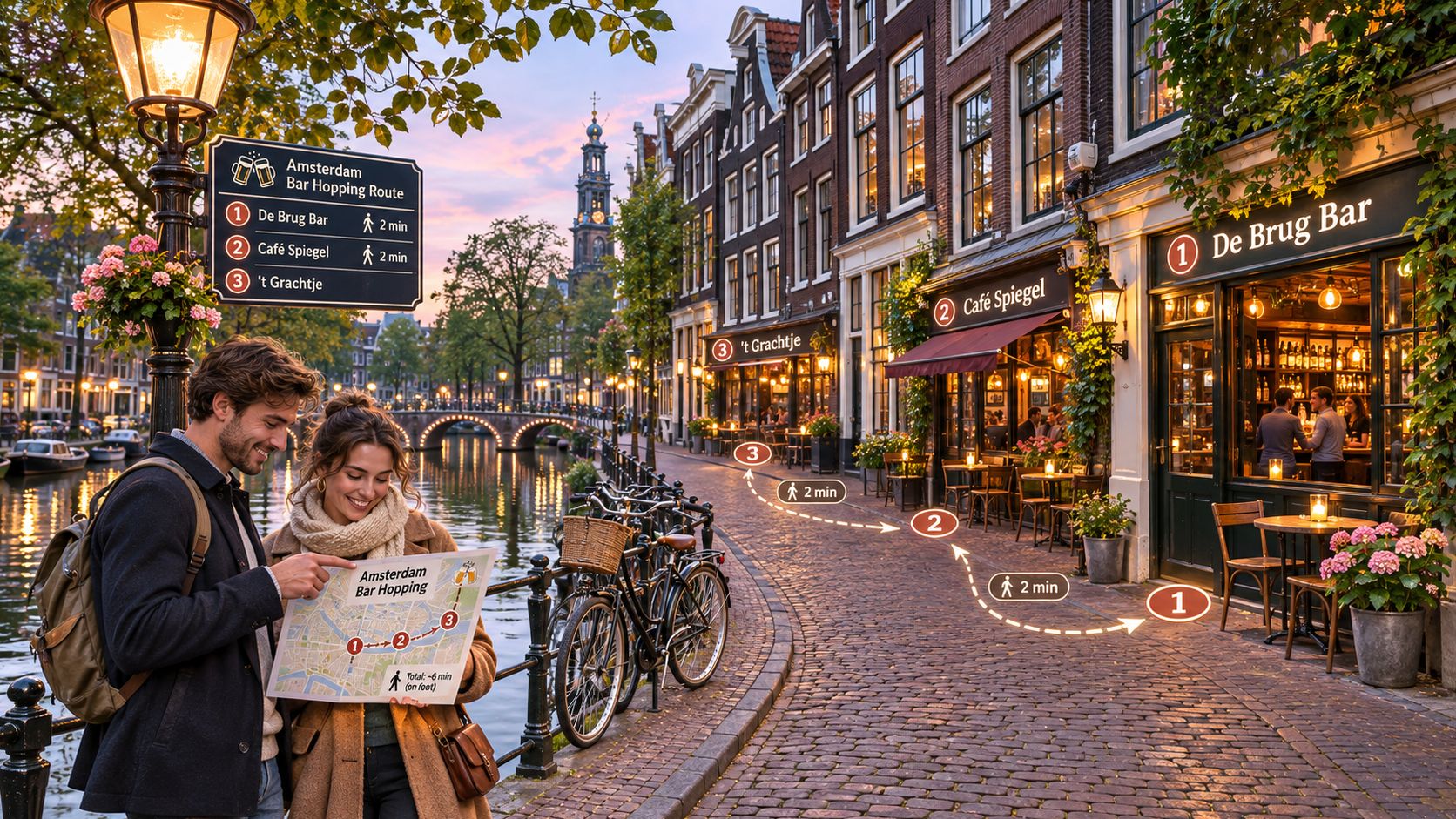
- Fix the finish before the start. Choose the club you want to end in, check its admission cut-off online the day before, and work backwards. A route built forwards from the first bar almost always arrives at the club too late.
- Pick three to five stops within a short walk. Ten minutes on foot between venues is comfortable in heels or winter coats. Mix one quiet café with one lively bar so the pace has a warm-up.
- Time-box each stop at 45 to 60 minutes. Without a time, the second bar swallows the night and the club never happens. One person keeps the clock.
- Name a meeting point near the first venue. A landmark everyone can find without a working phone beats a bar name that three people will mishear.
- Agree the split-up rule. A group message at every stop keeps everyone accounted for and makes it obvious within minutes if someone has gone missing.
- Check the walk against the drink. If getting from one stop to the next takes longer than finishing a drink at the first, the route is too spread out. Cut a stop and tighten the cluster before you set off, not at midnight.
A worked example for a Saturday
Say the group of six starts at 8:30 p.m. in a brown café in the Jordaan, one round of beers and a plate of bitterballen to settle in. At 9:30 the walk to a canal-side bar near Spui takes about ten minutes. That is the loud stop, and it runs until 11 p.m. Then a five-minute walk to the club, arrival well before last entry, two hours of dancing, and the group is outside again in time for the night bus.
Total walking time for the whole night is about fifteen minutes. That figure, more than the bar list itself, is what tells you whether a route will still hold together at 1 a.m. when it rains and half the group is tired.
Typical Drink Prices and Hidden DIY Costs
The frictions around the drinks cost the most: the cover charge that never appeared on the website, the line outside a popular bar at 11 p.m., four card transactions per round because everyone pays separately, and a taxi fare that has climbed by the time the group is too tired to argue about it.
For the drinks themselves, use the hosted benchmark as your working figure. An Amsterdam pub crawl with Ultimate Party costs €20 per person and includes 6 bars, free drinks and VIP club entry, so price a DIY night against that. If each person spends more than €20 on rounds and the group still misses the club, the DIY version lost.
| Cost item | What to expect | How to budget |
|---|---|---|
| Beer or house wine | Cheapest in brown cafés and smaller local bars; prices step up in canal-side and tourist-heavy venues | Make the first café the big round and count rounds, not drinks |
| Cocktails and spirits | The top of the price ladder, especially inside clubs | Pick one planned stop for cocktails and order simpler elsewhere |
| Cover charges | Busier clubs charge entry, often only at weekends or after a set hour | Check the door policy before queuing and carry card plus cash |
| Queues | Costs time rather than money; a line at the wrong hour can cost the club slot | Leave slack in each stop so a wait does not eat the last entry |
| Split tabs | Four separate payments per round slow service and blur who owes what | Rotate rounds and settle up in the app the next morning |
| Taxi home | Fares rise late and on busy nights | Check the app fare before getting in and hold back a ride-home buffer |
Bill splitting turns group nights sour socially as well as financially, and this piece on avoiding bill-splitting blame on group trips covers the etiquette before it becomes a 1 a.m. argument on a canal bridge.
The unplanned version is easy to cost. Four friends paying separately produce sixteen card transactions across four stops, slow every round at the bar, reach the club after the cheap-entry window and end up in a taxi whose meter ran while they debated the route home. Carry both card and some cash, because small bars are the likeliest to be card-only or cash-only on any given night. Ways to keep the total down without cutting the fun are covered in this guide to Amsterdam nightlife on a budget.
Getting Home Safely After the Last Bar
The night has a second half that most guides skip: the stretch between the club door and your bed. That stretch is where groups separate, phones die and the cheap decisions get made badly.
Night buses run after the daytime network stops. GVB's Night Bus 1 Ride gives unlimited travel on all GVB night buses for 1.5 hours from the first check-in, and GVB's travel products page lists OVpay with a debit card, credit card or mobile phone as the way to pay. Time the ticket to your first bus of the night rather than to the moment you leave the club, or the validity window expires while four people are still looking for a coat.
Safety habits matter most in the crowded districts, not the quiet ones. Phone theft happens in packed bars and on the square at closing time, not on empty streets. Keep valuables in a front pocket or zipped bag, walk the lit route rather than the shortcut, and use a taxi app instead of hailing a passing car, so the fare and the driver are both recorded.
Share live location with someone who isn't out that night. It's the fastest fix if the group splits.
Copy this into the group chat before you leave: regroup point at 1 a.m., one person with a charged phone and a battery pack, ID in a pocket not a bag, and a named person who walks anyone home who wants to leave early.
The team that plans the exit enjoys the night more. Groups that leave the return leg to chance are the ones still arguing on a corner at 4 a.m.
Compare DIY and Hosted Crawls and Choose Your Night
Doing it yourself has real advantages. A DIY night gives full control over pace, stops and spending, and it can cost less if the group drinks lightly and already knows the area. The honest price is planning time, a separate payment at each venue that charges entry, and waiting outside popular places with no fallback.
A hosted crawl trades control for a pre-selected route and one ticket price. Ultimate Party Amsterdam's Red Light District crawl runs every night of the week and includes 6 free shots with entry fees at every venue covered. The Leidseplein version runs Thursday to Saturday, covers 5 stops of dance bars with 5 free drinks, and finishes in a club with VIP entry. Queues can still apply at venues, and no skip-the-line is offered.
| Factor | DIY bar hopping | Hosted crawl (Ultimate Party) |
|---|---|---|
| Upfront price | Pay per drink, with entry and cover charges that vary | €20 p.p. all-in on the Red Light District crawl (20% off the regular €25) |
| Free drinks | None included | 6 free shots on the Red Light District crawl; 5 free drinks on Leidseplein |
| Venue entry | Paid at each venue where charged | Entry fees at every venue included |
| Route planning | You research and book every stop | Pre-selected venues led by a party host |
| Flexibility | Change, skip or extend stops at will | Fixed route with set stops |
| Queues | Plan for waiting time at popular venues | Queues may still apply; no skip-the-line offered |
| Group fit | Works for any size, but one person must organise | Works for groups; private crawls available for your own party |
Who should run their own night
Experienced planners who know the city, groups of two or three, and anyone who wants to drift between two bars and call it a night. DIY also suits visitors who have already picked a specific venue for a specific night. The trade-off is that someone stays sharp enough to watch the clock, check the last order times and move everyone on before a venue fills.
Who should book a hosted crawl
First-timers, weekend visitors with one night to spend, mixed-experience groups where three people want clubs and two want cocktails, and anyone organising for twelve others who doesn't want to be the person chasing payment. The host handles the route, keeps the group together and moves everyone on when a stop runs long.
Two nights out calls for the 2 Night Pass: it covers both crawls on any two nights, consecutive or separate, at €20 per person, a 2-for-1 deal against the regular €40, with the kick-off shots and every included drink and entry on both nights. Groups planning a stag, hen or birthday can arrange a private pub crawl for their own party only. Every guest must be 18 or over with valid government-issued ID, whichever format you choose.
Decide between two starting points. Use the Red Light District pub crawl for a first night in the city with bars, bar games and a club finale, or the Leidseplein pub crawl if the group wants dance floors and a VIP finish. Staying longer than two nights? Add a single-crawl booking on top of the pass, or pick the one week pass and join as many crawls as you like over seven days.
Ultimate Party Amsterdam has been running guided pub crawls in the city since 2006, with a Red Light District route every night of the week and a Leidseplein route from Thursday to Saturday, entry fees and free shots included in the ticket. If the route planning above is the part you would rather hand to someone who does it weekly, start with Ultimate Party Amsterdam and pick the crawl that matches your group and your night.
🍻
Experience it Yourself
Make it your night — a private pub crawl with your own dedicated party host, 6 stops and 6 free shots for €30 p.p.