
You've planned one Amsterdam night, but the itinerary has become three different doors: drinks in a relaxed bar, a club in the centre, and perhaps a later venue where the staff look closely at every guest. The outfit that feels perfect in the hotel mirror can become a problem outside the club, especially when it includes sportswear, beach shoes, or a novelty accessory from a stag or hen weekend.
The safest dress code for Pure Nightclub is polished smart casual, not full gala dressing and not daytime streetwear. Clean, intentional clothing gives travelers room to move between Amsterdam neighborhoods, while obvious casual categories create avoidable problems at the door. The practical question isn't just what Amsterdam clubs allow. It's how strict the specific venue is, and whether one outfit can handle the whole night.
Table of Contents
- Why Amsterdam Nightclub Dress Codes Still Matter
- What Gets You In and What Gets You Rejected
- How Strict Is the Door at Different Amsterdam Venues
- Building One Versatile Outfit for Multiple Venues
- Outfit Planning for Stag Parties and Hen Groups
- VIP Entry and Guest Lists Do Not Override Dress Codes
- Your Amsterdam Nightlife Planning Checklist
Why Amsterdam Nightclub Dress Codes Still Matter
A group can spend the evening walking through Amsterdam, stop for drinks, and arrive at a club feeling ready to dance. Then a door host notices the tracksuit bottoms, athletic shorts, sandals, or a branded sports top. The reservation may be real, the group may be on a guest list, and everyone may have valid identification, yet the outfit can still decide the result.
That isn't a rare misunderstanding of fashion etiquette. Established venues use dress codes as enforceable entry rules. Ministry of Sound in London tells guests to arrive “smartly dressed,” accepts jeans, T-shirts, and branded trainers, and excludes tracksuits and sportswear. Its published terms also state that refunds aren't issued when admission is refused because of the dress code. The venue's published terms show how a nightclub dress policy can operate as a condition of entry rather than a friendly suggestion.
The door protects a venue's identity
Nightclubs use appearance standards to shape the room they want to run. A polished crowd supports a particular brand image, while restrictions can help staff screen guests and manage the atmosphere around a busy entrance. Dress requirements also sit alongside capacity control and the venue's right to refuse admission.
Amsterdam feels relaxed compared with many major nightlife cities, but relaxed doesn't mean every door accepts everything. Amsterdam's nightlife areas attract different crowds and venue styles, so a casual look that works for an early bar stop may not suit a late central club.
Dress codes have a social history
The rules also deserve a more critical reading. A peer-reviewed study published in 2015 described dress codes in privately owned, publicly accessible urban venues as “an informal color line,” showing that clothing standards can work as selective barriers rather than neutral style guidance. The study in Sage is a useful reminder that door policies affect access, identity, and belonging as well as appearance.
For visitors, the immediate lesson is simple: check the venue before leaving the hotel, choose an outfit that looks deliberate, and don't assume Amsterdam's informal reputation overrides a club's house rules.
What Gets You In and What Gets You Rejected
The reliable Amsterdam formula is smart casual with clean footwear. Dark or well-kept jeans, well-fitted trousers, a neat shirt, blouse, fitted top, bodysuit, dress, skirt, or polished layer can work across many nightlife settings. The outfit should look ready for an evening out, not like clothing chosen for a gym, beach, airport, or festival field.
Clean sneakers deserve a specific note. Many venues are becoming more sneaker-friendly, but that doesn't mean every athletic shoe passes. Tidy, undamaged sneakers can support a smart casual outfit. Dirty trainers, visibly worn footwear, and shoes strongly associated with sport create a different impression.
Pack these first
- Smart trousers or dark jeans: These give a group flexibility and avoid the informal appearance of sweatpants or athletic bottoms.
- A polished top: A shirt, blouse, stylish knit, fitted top, or bodysuit immediately looks more intentional than a basic sports jersey.
- A structured layer: An oversized blazer, neat jacket, or sharp overshirt can lift a simple base outfit without making it uncomfortable for dancing.
- Clean sneakers or smart shoes: Choose footwear that looks maintained and can handle walking between venues.
- A compact bag: Check the venue's individual policy before departure, because some Amsterdam clubs restrict shoulder bags or backpacks.
Leave these at the accommodation
Sportswear is the clearest avoid. That includes tracksuits, sweatpants, athletic shorts, football or other sports jerseys, and gym clothing. Flip-flops, beachwear, sandals, caps, and visibly dirty or worn clothing also create regular door problems. Some venues publish additional restrictions, including rules against shorts, shoulder bags, or other accessories.
| Accepted Items | Rejected Items |
|---|---|
| Smart casual clothing | Tracksuits and sweatpants |
| Dark, tidy jeans | Athletic shorts |
| Clean, well-kept sneakers | Flip-flops and beachwear |
| Tailored trousers | Sports jerseys |
| Stylish tops, shirts, blouses, and bodysuits | Caps and visibly worn clothing |
| Structured jackets or blazers | Dirty or damaged footwear |
A useful comparison comes from formal nightlife markets. Travelers who want inspiration for a more polished evening look can browse polished Vegas looks with Cedar & Lily, then soften the result for Amsterdam by choosing comfortable footwear and removing anything that feels costume-like.
Practical rule: If an item would look natural at a beach, training session, or football match, it doesn't belong in the club outfit.
The safest packing choice is one complete look that avoids every obviously rejected category. That eliminates most door anxiety without forcing travelers into heels, formal dress shoes, or uncomfortable full-glam clothing.
How Strict Is the Door at Different Amsterdam Venues
Amsterdam doesn't have one universal nightclub dress code. Central clubs tend to be more formal, while venues in Noord and underground settings are often more relaxed. That distinction matters when travelers plan one outfit for several stops, because a look can be perfectly suitable for a casual neighborhood venue and still feel underdressed at a stricter central door.
Independent Amsterdam guidance says 90% of clubs accept smart casual and tidy sneakers. The Amsterdam club guide also identifies the categories stricter venues may reject, including shorts, caps, sportswear, beachwear, flip-flops, and sometimes backpacks. That percentage belongs to the guide's own reported guidance, not to a citywide official rule, so it shouldn't be treated as permission to ignore the specific venue.
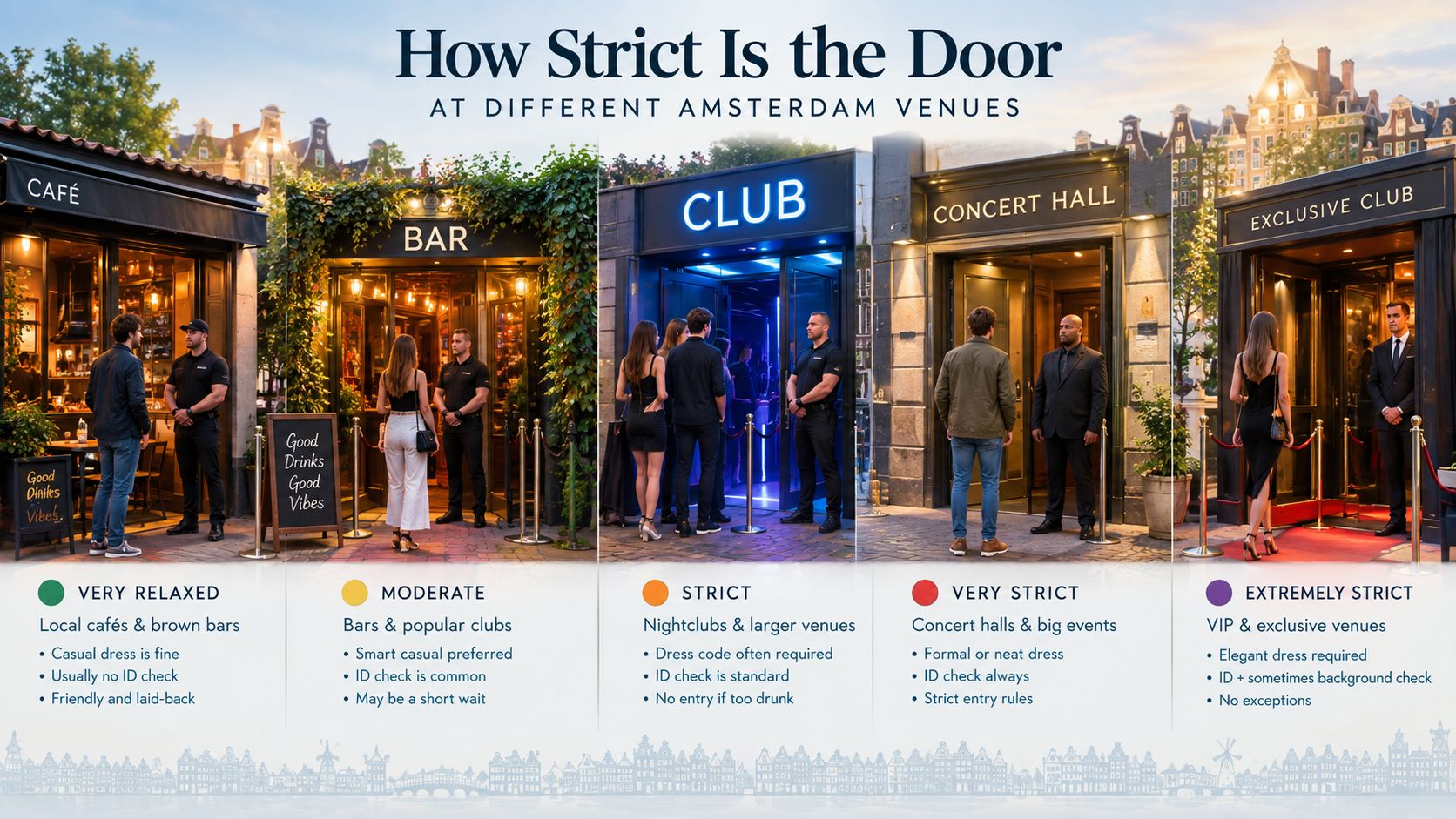
Use the strictest stop as the outfit benchmark
For a mixed itinerary, the decision tree is straightforward:
- Bar or casual first stop only: A neat casual outfit may be enough, but sportswear and beachwear still make poor choices.
- Central club later: Dress up the base look with a structured jacket, refined top, well-fitted trousers, or a clean dress.
- Underground or Noord destination: The room may tolerate a more relaxed style, but the clothing should remain clean and intentional.
- Several club types in one night: Dress for the strictest venue, not the most relaxed one.
Amsterdam's official nightlife guidance recommends checking each venue's house rules because exclusive clubs can enforce stricter standards. The local nightlife guide also reflects the city's informal character, while acknowledging that venue expectations differ.
For groups considering a particular music scene, checking the venue's policy matters more than relying on a citywide stereotype. Information about Amsterdam hip-hop clubs can help travelers build a route, but the final outfit decision still belongs to the specific door policy.
A club's neighborhood is a useful signal, not a guarantee. The strongest default remains smart casual, with clean footwear, no athletic clothing, and no beach items.
Building One Versatile Outfit for Multiple Venues
Travelers don't need a suitcase full of nightlife looks. They need a base outfit that can move from dinner or drinks to a stricter club without looking overdone. The most useful middle ground in 2026 trend coverage is polished casual, with oversized blazers, bodysuits, metallic textures, cutouts, and other refined details appearing alongside more dressed-down styling. Recent clubwear trend coverage describes this split between polished glamour and casual dressing, which is why a single universal “club outfit” answer no longer works.
Three formulas that travel well
Formula one, the structured casual look: dark jeans or fitted trousers, a fitted top, clean sneakers, and an oversized blazer. The jacket creates a sharper silhouette, while the shoes keep the outfit practical for Amsterdam streets and long dancing sessions.
Formula two, the polished dress look: a simple dress with a neat jacket and tidy sneakers or smart shoes. Metallic texture or a defined cut can add nightlife character without requiring uncomfortable accessories.
Formula three, the coordinated separates look: a bodysuit or stylish top with a skirt or well-fitted trousers, plus one structured layer. This works for guests who want a more expressive outfit but still need flexibility between venue types.
Full glam has its place, but it can become impractical when the night includes walking, cycling routes, queues, or several different rooms. Heels and formal shoes aren't automatically necessary, and a dressed-down look isn't automatically careless. The deciding factor is whether every piece looks chosen for the night.
For more ideas that account for different venue moods, travelers can review these venue-specific outfit ideas from House of Saint, then adapt the styling to Amsterdam's walking-heavy nightlife.
Keep group coordination subtle
Matching outfits often look more like a costume than a night-out look. Groups should coordinate through a shared color family, similar accessories, or one visual theme while allowing each person to choose a comfortable silhouette. That keeps photographs cohesive without turning the entire group into a door-policy risk.
The efficient traveler packs one polished base, one layer, and one pair of reliable shoes. That combination handles relaxed and stricter venues far better than separate outfits built around extremes.
Outfit Planning for Stag Parties and Hen Groups
Stag and hen groups create a special door problem. The organizer may want matching shirts, novelty accessories, or a costume that makes the celebration obvious, while the club wants guests who fit its evening atmosphere. A group can celebrate loudly without dressing every person in clothing that staff may reject.
The first mistake is treating the group theme as more important than admission requirements. Matching sports shirts, sweatpants, beach shoes, oversized props, and deliberately messy outfits can turn a simple entry check into a delay for everyone.
Coordinate without creating a uniform
A stronger approach uses one shared detail rather than a complete costume:
- Choose a color: Black, silver, white, or another agreed shade can create a group identity without changing the basic dress standard.
- Repeat a small accessory: A neat pin, wrist detail, or compact accessory can signal the occasion more discreetly than a large prop.
- Keep the base outfit individual: Each guest should wear smart casual clothing that fits comfortably and looks suitable for a club.
- Remove novelty items before the strictest door: Oversized signs, bulky props, and accessories can create practical or venue-specific issues.
Door staff check people individually. A guest list or group arrangement doesn't transform an unsuitable outfit into an acceptable one, and one person who needs to return to the hotel can hold up the entire party.
Tell every guest before departure
The organizer should send a clear message before the group leaves: no sportswear, no flip-flops, no beachwear, no visibly dirty clothing, and no assumption that a matching shirt guarantees entry. Everyone should also carry the required physical identification and check the venue's bag rules.
For a larger celebration, the route itself deserves planning. A hosted activity can reduce the pressure of moving a group between unfamiliar areas, while a private arrangement may suit a party that wants one point of coordination. Advice on planning an Amsterdam bachelorette party can help organizers think through timing, outfits, transport, and group communication before the night starts.
The winning group look is festive but credible. Guests should look like a well-dressed party, not a walking challenge for the door team.
VIP Entry and Guest Lists Do Not Override Dress Codes
A confirmed booking doesn't replace the outfit check. Nightclub staff generally assess attire separately from reservations, guest lists, or pre-arranged entry. A guide to nightclub dress codes and door policy makes the operational point clearly: guests can still face an attire decision at the door even when their booking is confirmed.
That matters because travelers often confuse administrative confirmation with admission approval. A booking confirms that a place, list position, or arrangement exists. It doesn't force staff to accept clothing that conflicts with the venue's stated standards.
Protect the booking before leaving
Groups with a reserved table or special entry arrangement should treat smart casual or upscale clothing as a minimum benchmark. A practical check takes less than a minute:
- Remove sportswear, athletic shorts, and beach items.
- Replace flip-flops or worn shoes with clean footwear.
- Swap a cap, novelty item, or bulky bag if the venue restricts it.
- Add a blazer, neat jacket, or polished top when the itinerary includes a stricter club.
- Confirm that every guest has physical identification and understands the same rules.
This approach protects more than money. It keeps the group together, avoids a frustrated conversation with staff, and prevents one person from becoming the reason everyone waits outside.
A guest list gets a name checked. It doesn't get an unsuitable outfit approved.
The most reliable assumption is that the door policy remains active until the guest has entered. Travelers should plan accordingly, even when the booking details look reassuring.
Your Amsterdam Nightlife Planning Checklist
Before leaving the hotel, each traveler should run through this short list:
- Choose polished casual: Wear polished pieces that look intentional and allow comfortable movement.
- Avoid obvious rejections: Leave sportswear, beachwear, flip-flops, caps, and visibly worn clothing behind.
- Use clean footwear: Tidy sneakers can work at many venues, but athletic or damaged shoes remain risky.
- Dress for the strictest venue: Central and exclusive venues may expect more polish than relaxed or underground destinations.
- Check house rules: Amsterdam has no single standard for every club, so venue-specific guidance matters.
- Prepare the group: Matching themes should stay subtle, and every guest should meet the same entry requirements.
- Remember the booking limit: Reservations and guest lists don't cancel the attire check.
- Plan the route: A hosted pub crawl, canal booze cruise, or nightlife concierge arrangement can help groups organize an evening without guessing their way through Amsterdam.
Ultimate Party Amsterdam offers hosted pub crawls with venue entry arrangements and guided nightlife routes, plus shared and private canal booze cruises for groups that want part of the evening organized before reaching the clubs. The right choice depends on the group's preferred atmosphere, schedule, and need for coordination, but the clothing rule remains the same: arrive clean, polished, and ready for the specific door.
Visit Ultimate Party Amsterdam to compare Amsterdam pub crawls, canal booze cruises, and group nightlife arrangements before booking. With the outfit planned around the strictest venue and the route organized in advance, the night starts at the door instead of ending there.
🍻
Experience it Yourself
Skip the planning — join Amsterdam's biggest pub crawl and get 6 bars, free drinks and VIP club entry for €20.