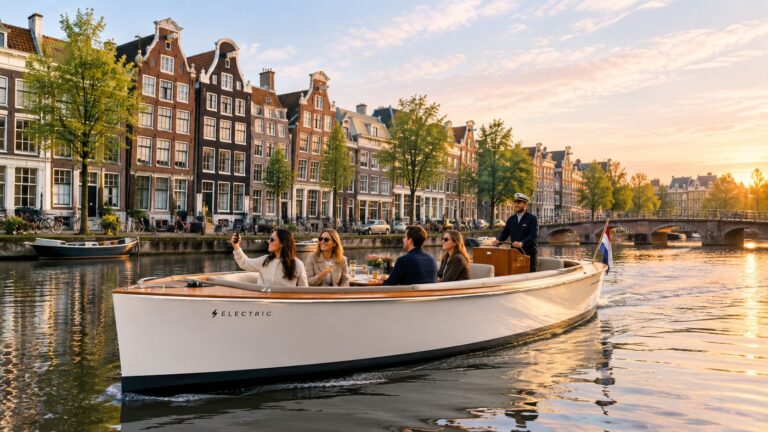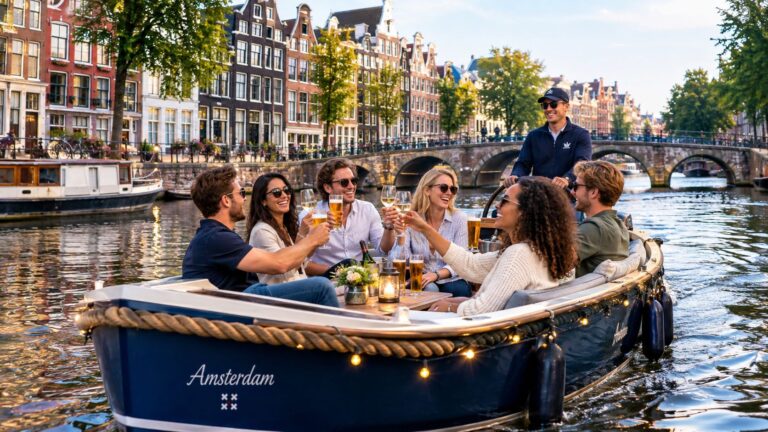
You've probably got the group chat open already. Someone wants drinks on the water, someone else wants something private, and the person paying is trying to work out whether a canal boat is a relaxed start to the night or just another booking to manage.
A private boat tour Amsterdam makes sense when the plan needs one moving space that feels social, but not chaotic. It gives a group its own skipper, its own pace, and enough privacy to talk, toast, and take in the city without being folded into a stranger's schedule. That matters more than most listings admit, because the right boat in Amsterdam is shaped by capacity, propulsion, noise, and route access, not just by how nice the photos look.
Table of Contents
- Why Choose a Private Boat Tour in Amsterdam
- What a Private Canal Charter Actually Includes
- What Drives the Price of a Private Tour
- Rules That Shape Your Booking
- Matching the Experience to Your Group
- A Realistic 60-Minute Canal Route
- How to Book Without Getting Burned
- Practical Questions Worth Answering Upfront
Why Choose a Private Boat Tour in Amsterdam
A Friday night group often reaches the same crossroads. Shared cruises are easy, a pub crawl is lively, and a club night is obvious, but none of them gives a group full control over the room the way a private charter does. On a private boat, the conversation stays inside the group, the pace is calmer, and nobody has to compete with another table for attention.
That control is the product. The skipper handles navigation, docking, and compliance, while the group gets a floating setting that works for birthdays, hen and stag weekends, mixed-generation families, and teams that want something more polished than a bar crawl. For a planner who wants to line up several moving parts, a practical guide such as deposits for group tour operators is useful because private events often hinge on how quote, payment, and confirmation are handled.
| Experience | Vibe | Group Size Control | Drinks | Best For |
|---|---|---|---|---|
| Private Tour | Contained, flexible, social | High | Usually arranged by the operator or host | Celebrations, mixed-age groups, private hosting |
| Shared Cruise | Casual, mixed company | Low | Fixed by the cruise format | Smaller groups that don't need privacy |
| Pub Crawl | Busy, social, venue-based | Medium | Built around stops rather than a single setting | Travellers who want nightlife variety |
| Club Night | Loud, late, venue-led | Low | Bought at the venue | Groups that want dancing first and structure second |
For a bachelorette plan, the private route also pairs well with a broader night-out structure, especially when compared with the ideas in how to plan the perfect Amsterdam bachelorette party. A boat gives the group a start, a breather, or a celebratory centerpiece without locking the rest of the night into one format.
Practical rule: if the group wants privacy, drinks, and easy conversation, a private charter usually beats a shared boat, even when the latter looks simpler on paper.
What a Private Canal Charter Actually Includes
A proper private charter is more than a boat with seats. The group gets the whole vessel, a designated skipper, and an itinerary that can usually be adjusted within the limits of the route, the weather, and the city's operating rules. That's the key difference from a shared cruise, where the route and rhythm are fixed around a mixed crowd.
The skipper is not a host in costume
The skipper's job is safety, navigation, docking, and rule enforcement. On Amsterdam canals, that matters because the waterway is busy, narrow, and full of places where a careless stop would annoy everyone else on the water. Alcohol may be part of the booking, but the skipper still has to stay sober and in control, which is exactly how it should be.
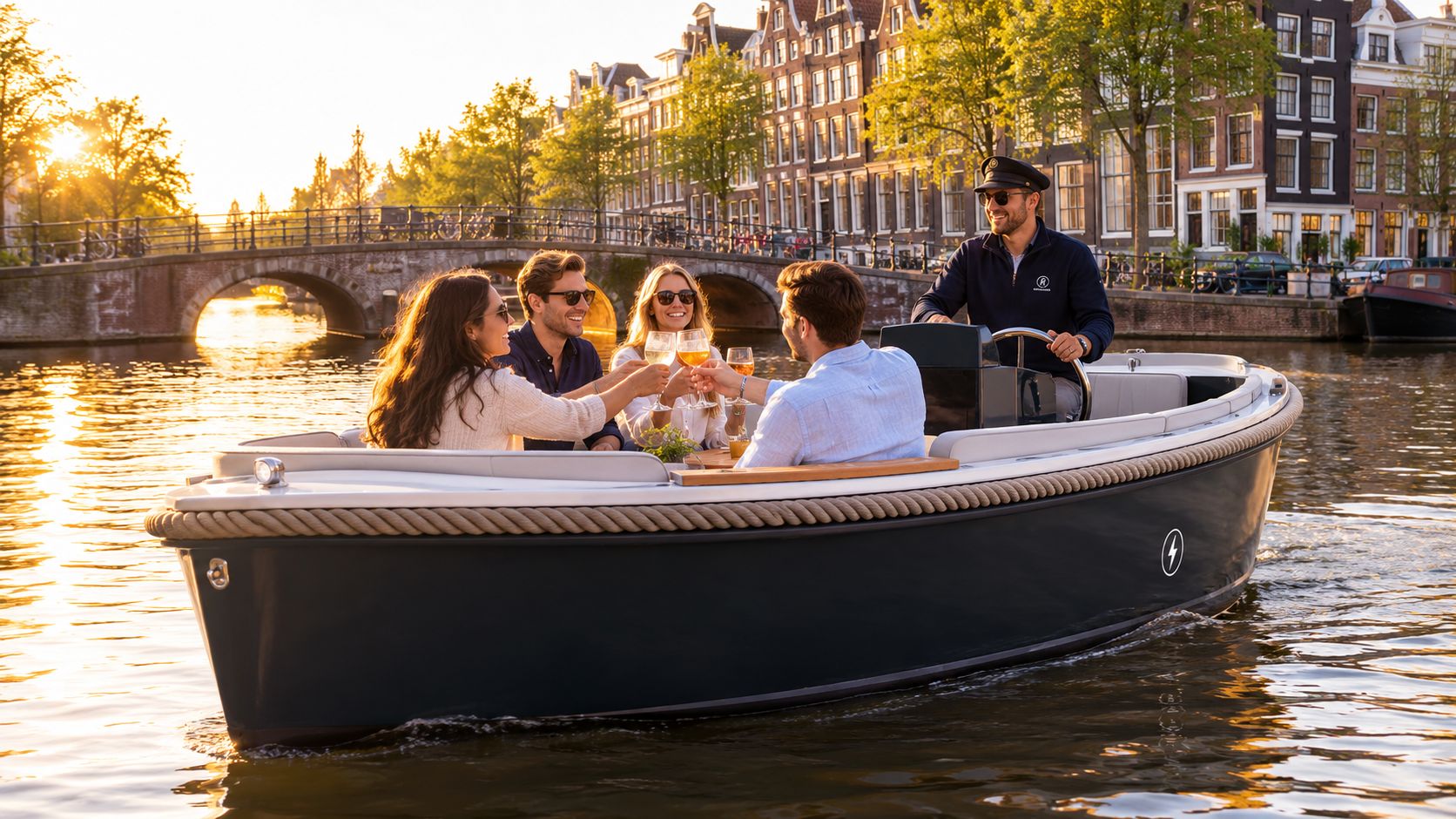
Most private boats used for this kind of trip are low, compact, and built for the city's canal dimensions. Electric propulsion is common for a reason. It fits the canal environment better than anything loud or bulky, and it leaves room for conversation rather than forcing the group to shout over the engine.
A good charter feels effortless to guests because someone else is quietly managing the part that can't be improvised.
On the guest side, the usual structure is simple. A private booking normally includes a set duration, a flexible route, and drinks service if requested. Ultimate Party Amsterdam's Private Booze Cruise is a straightforward example of that format, a 60-minute luxury electric canal charter with an open Dutch bar, which gives planners a concrete reference point for what a private party cruise can look like in practice.
That's also why private boats work well for groups that don't want to assemble every detail themselves. The best version is not overloaded with extras. It's a clean setup, a reliable skipper, and a route that makes the most of the time on the water.
What Drives the Price of a Private Tour
Private boat pricing in Amsterdam usually comes down to a few moving parts. Group size changes the type of boat that's needed. Duration affects the labor and the booking block. Drinks packages alter the onboard service. Route distance and timing can also shift what an operator needs to plan for.
What usually sits inside the quote
A sensible quote often bundles the basics into one figure. That typically means the boat hire, the skipper, fuel or power, and the standard drinks package if the cruise is sold as an all-in experience. Anything beyond that usually starts to depend on how the group wants to use the boat.
The most common extras are easy to predict:
- Premium drinks: higher-end spirits or upgraded bottles change the cost structure.
- Longer hire windows: more time on the water means more staffing and operating cost.
- Custom routing: special pickup points or more complex canal patterns take planning.
- Peak demand: busy evenings and popular dates tend to tighten availability.
A strong budget starts with the group's actual priorities, not with the cheapest-looking listing. If the drinks matter most, the group should price the bar first and the route second. If the route matters more, the planner should ask how much freedom exists on the canal side and how much is locked in by timing or boat type.
Ultimate Party Amsterdam's reviews are presented with verified 4.9 and 4.8 averages across thousands of reviews, which is a useful quality signal when a planner is comparing operators that all look similar at first glance. That doesn't remove the need to ask the right booking questions, but it does help narrow the field before any deposit is paid.
Budget check: the best quote is the one that explains what's included clearly enough that the group doesn't need to negotiate basics later.
Rules That Shape Your Booking
Amsterdam does not treat the canal system like open water. From 1 April 2025, the central area, including the Singelgracht, falls under an emissions-free zone for pleasure boats in the city's core canal network (Amsterdam municipality boating rules). In practice, the boat has to be electric, hydrogen-powered, or manually propelled to operate there, unless a specific hybrid setup meets the required conditions.
Why this changes the booking conversation
A private cruise is no longer just a comfort choice. The operator has to know whether the vessel is allowed on the route, whether charging and power access are in place, and whether the itinerary crosses the regulated zone. For the guest, that ties boat type and route together in a way many listings still gloss over.
Amsterdam's boating guidance also keeps the water slow and controlled. The city sets a 6 km/h ceiling for most inner-city boating, with a limited 7.5 km/h allowance on specified waterways such as parts of the Amstel and Oosterdok (municipal boating guidance). A faster boat does not buy more canal city in an hour. The trade-off is route density, stops, and how much time the group spends in the most active stretches.
Passenger limits shape the booking just as much. Recreational vessels are generally capped at 12 guests plus a skipper, and groups of 12 or more need a licensed passenger vessel with a skipper (municipal boating guidance). That threshold changes the booking immediately. A 13-person group is not just a larger version of a 12-person group.
Noise rules are the other constraint that matters on the water. Operators are expected to avoid excessive noise and not play amplified music on the inner waterways (Amsterdam boating conduct guidance). Electric, low-noise boats fit the city for a reason. They work within the operating conditions, and they keep the cruise social without turning it into a disruption.
Matching the Experience to Your Group
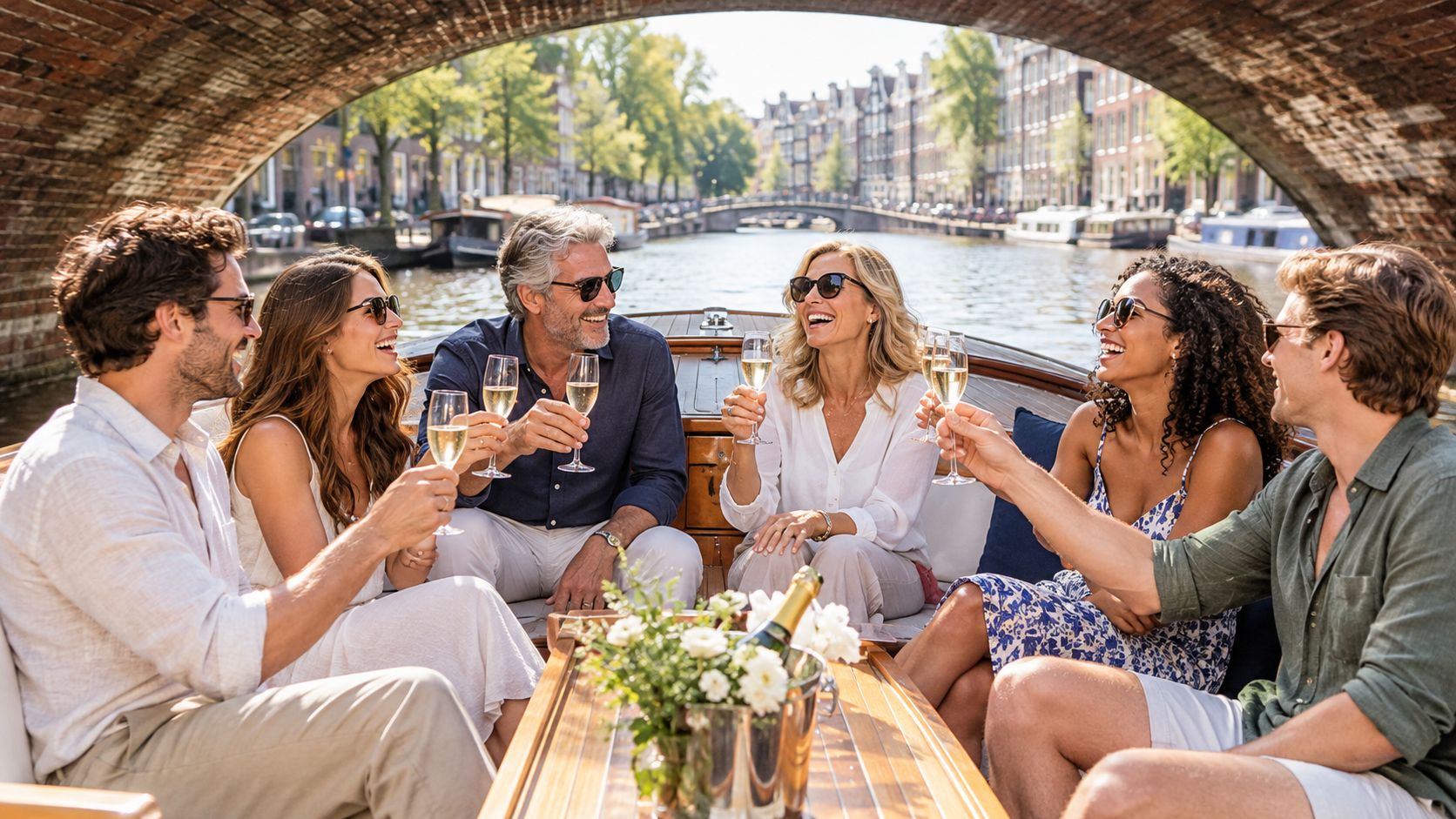
A private cruise is the right tool when the group wants to stay together without the pressure of venues, queues, or table timing. It suits stag and hen groups that want a social start, birthday groups that need an easy focal point, families with mixed ages, and corporate teams that need something polished but not stiff.
Where it fits, and where it doesn't
A couple can use a private boat for privacy without paying for a massive yacht-style setup. A reunion group can use it as a calm reset before the night moves on. Even a small work group can use it to keep everyone in one place before dinner or drinks elsewhere.
It's less useful for very large groups that need a different vessel class, or for anyone expecting nightclub volume on the water. It's also a weak fit for ultra-late or ultra-early slots if the group's main goal is noisy partying, because the canal setting rewards smoother hosting. The best private cruise is a comfortable social anchor, not the loudest moment of the night.
| Group Type | Strong Fit? | Why |
|---|---|---|
| Stag or hen party | Yes | Easy shared start, relaxed atmosphere |
| Birthday group | Yes | Private setting without venue stress |
| Family group | Yes | Works across ages and conversation styles |
| Corporate team | Yes | Controlled, presentable, easy to manage |
| Very large party | Usually not | Capacity and vessel type become the issue |
| Full-volume nightlife crowd | Usually not | Canal rules and residents' expectations matter |
For groups that want a broader social format, a shared booze cruise can be the lighter option when privacy isn't the priority. A private charter wins when the booking needs its own social bubble.
A Realistic 60-Minute Canal Route
A good 60-minute route in Amsterdam should be built around landmarks, not speed. The canals are compact, and the best value comes from smart routing, not from trying to cover too much ground in too little time. The group should expect a sequence that feels curated, not rushed.
What a workable route looks like
A practical start is the Herengracht and Keizersgracht, where the façades, bridges, and canal houses do most of the visual work. From there, a short stretch on the Amstel gives the skipper room to work with the city's limited faster allowance where it applies, and the route can loop back through the historic canal belt for the postcard angle everyone expects.
The UNESCO-listed canal ring is the part that gives the whole experience its weight. The historic canal ring was added to the UNESCO World Heritage List in August 2010 under the designation "Seventeenth-Century Canal Ring Area of Amsterdam inside the Singelgracht" (Amsterdam facts and figures). That status is more than decorative. It tells guests they're moving through a planned historic setting, not just a pretty waterfront.
Golden hour usually suits façade shots and softer reflections. After dark, the route feels more intimate, especially when the boat stays quiet and the city lights take over. Wind and congestion can change the flow, so a competent skipper always leaves room for adjustment rather than forcing a rigid loop.
Route rule: if the boat's movement starts competing with the view, the route is too ambitious for a 60-minute charter.
Mooring etiquette matters too. Boats should not stop under bridges, and they need to dock safely where permitted. That sounds small until the group watches another skipper make a clumsy stop and block a narrow stretch that should've been left clear.
For a wider night-out plan, it helps to think about how the cruise connects to the rest of the evening. The route can be the opening scene, the main social block, or the calm interval before dinner and clubs, which is why the ultimate 24-hour Amsterdam experience is a useful way to think about sequencing.
How to Book Without Getting Burned
A smart booking starts with the group, not the boat. The planner should pin down the date window, the actual headcount, and the one thing the group cares about most, whether that's privacy, drinks, route control, or a clean handoff into dinner or nightlife. Once those basics are fixed, the quote becomes easier to read.
The booking order that works
First, request a written quote that spells out the duration, drink setup, departure point, and route flexibility. Second, ask what the boat is authorized to do in the central area, especially if the itinerary touches the regulated zone. Third, confirm the payment terms before anything is transferred.
When the cruise is part of a bigger celebration, a coordination service can save a lot of back-and-forth. Ultimate Party Amsterdam's Nightlife Concierge fits naturally when the plan also needs a restaurant booking, VIP transport, or a later table reservation. If the cruise is the only moving part, a single well-defined booking is usually enough.
The one thing that should always be clear before any deposit is paid is the onboard rule set. If drinks are included, ask what the bar contains. If music matters, ask how the operator handles sound expectations on the canals. If the route matters, ask whether it can be adjusted for weather, congestion, or bridge openings.
A useful point of comparison is the planning depth that comes with an experience catalogue like browse experiences, because the decision is often less about boat type and more about how many moving parts the organiser wants to manage in one place.
Practical Questions Worth Answering Upfront
A group of 13 changes the booking fast. On a recreational boat, the standard private setup no longer fits once you cross the passenger cap covered earlier in this guide, so the right move is to ask whether the operator has a licensed vessel sized for the headcount. Trying to squeeze people in creates problems for comfort, loading, and compliance.
Another common question is what “open bar” covers. In a private cruise, it usually means drinks are available during the booking window, but the selection can still vary. A by-the-glass package and a fully stocked bar are different setups, so the group should confirm the drink list in writing instead of guessing.
Weather, access, and route changes
Rain affects comfort more than the booking itself. On a low canal boat, guests sit close to the water, so coverings, shelter, and seating layout matter. Access needs an early check too, because low boats are not equally easy for every guest to board.
Route changes happen for practical reasons. Wind, congestion, bridge openings, and canal traffic can all shape where the skipper goes. A good operator plans for that from the start, which makes route flexibility more useful than a glossy promise.
The last question is how the cruise fits the rest of the night. A private boat works best as part of a bigger social plan, whether that means drinks after the cruise, dinner before it, or a hosted group night later on.
If the group wants a private cruise that respects Amsterdam's rules, keeps the night smooth, and avoids last-minute surprises, Ultimate Party Amsterdam can help shape the booking around the group size, route, and drinks setup. Visit Ultimate Party Amsterdam to plan a private boat tour that fits the way Amsterdam works on the water.
For groups that want a broader planning view, browse experiences can help compare how much coordination different bookings require.
🍻
Experience it Yourself
Skip the planning — join Amsterdam's biggest pub crawl and get 6 bars, free drinks and VIP club entry for €20.