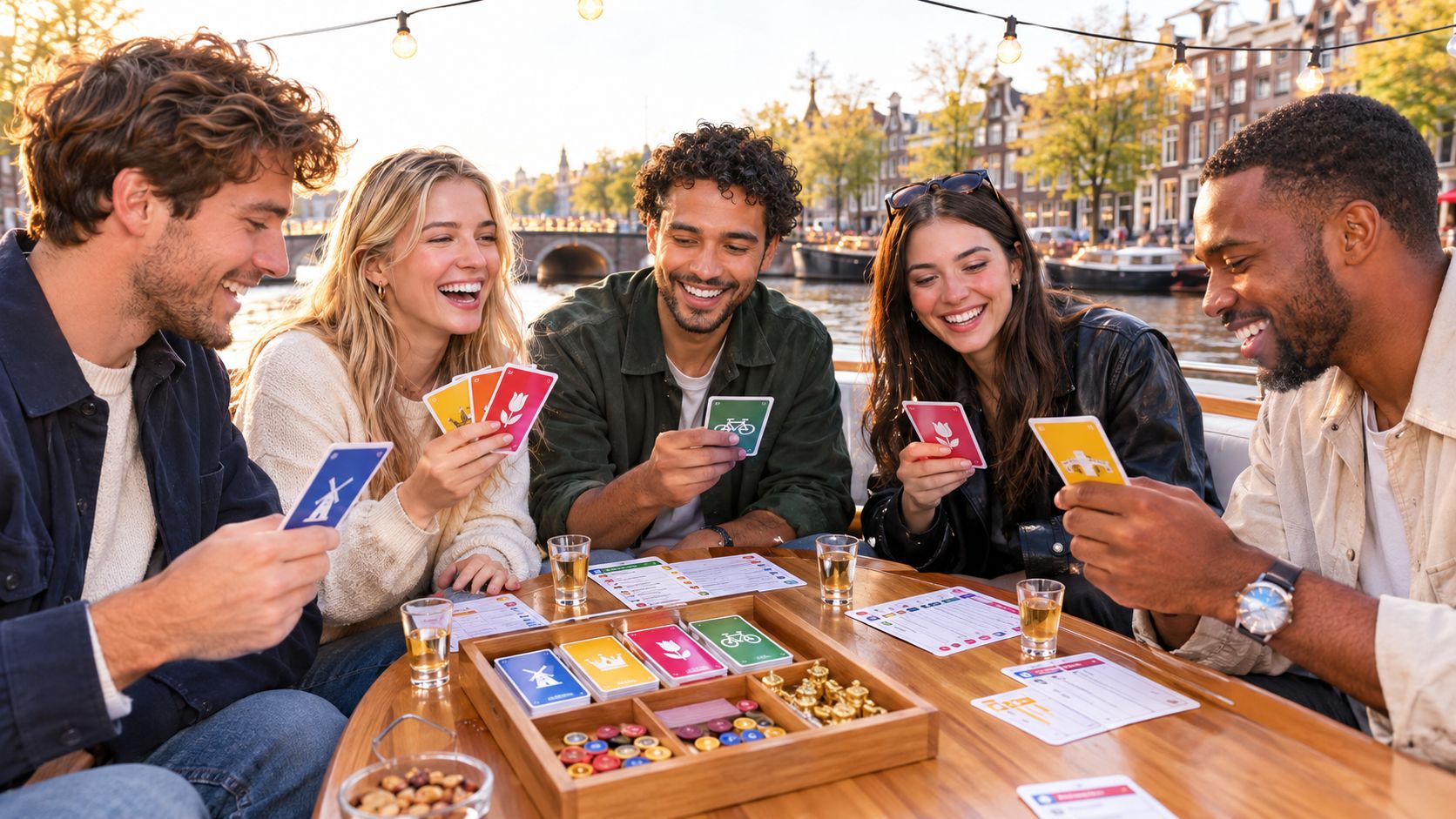
The group has just arrived in Amsterdam, but nobody has quite the same idea of a good night. One guest wants a lively pub crawl, another prefers conversation over drinking, a relative is joining for only part of the evening, and the bride or groom is already trying to keep everyone together while moving between venues. Later, the group may settle onto a canal boat, where the setting is more contained but the energy still rises and falls.
The best stag and hen bachelorette party games don't demand a full living room, complicated equipment, or constant attention. They work in short rounds, pause when the group needs to move, and give both confident performers and quieter guests a way to participate. The list below covers social icebreakers, printable challenges, photo-led games, Amsterdam trivia, team competitions, and formats that work especially well on shared or private cruises.
Consent and venue etiquette matter more than a dramatic dare. Guests should be able to opt out without explanation, non-drinking players should have an equal role, and no challenge should interrupt staff, block walkways, pressure strangers, or create a problem for the host. A charged phone and a shared chat help, but the group should also confirm plans with crawl hosts or boat staff before starting. Ultimate Party Amsterdam's hosted pub crawls and canal booze cruises can provide a ready-made setting, while each game remains adaptable to the group's own itinerary.
Table of Contents
- 1. Pub Crawl Scavenger Hunt
- 2. Never Have I Ever Pub Edition
- 3. Fancy Dress Themed Crawl Challenge
- 4. Bar Bingo or Venue Checklist Challenge
- 5. Two Truths and a Lie Group Edition
- 6. Drink Roulette or Dare Challenges
- 7. Amsterdam Trivia Contest
- 8. Photo Scavenger Hunt or Instagram Challenge
- 9. Collaborative Storytelling or Progressive Drinking Game
- 10. Pub Crawl Relay Races or Physical Challenges
- Top 10 Stag & Hen Party Games Comparison
- Choose Games That Fit the Night
1. Pub Crawl Scavenger Hunt
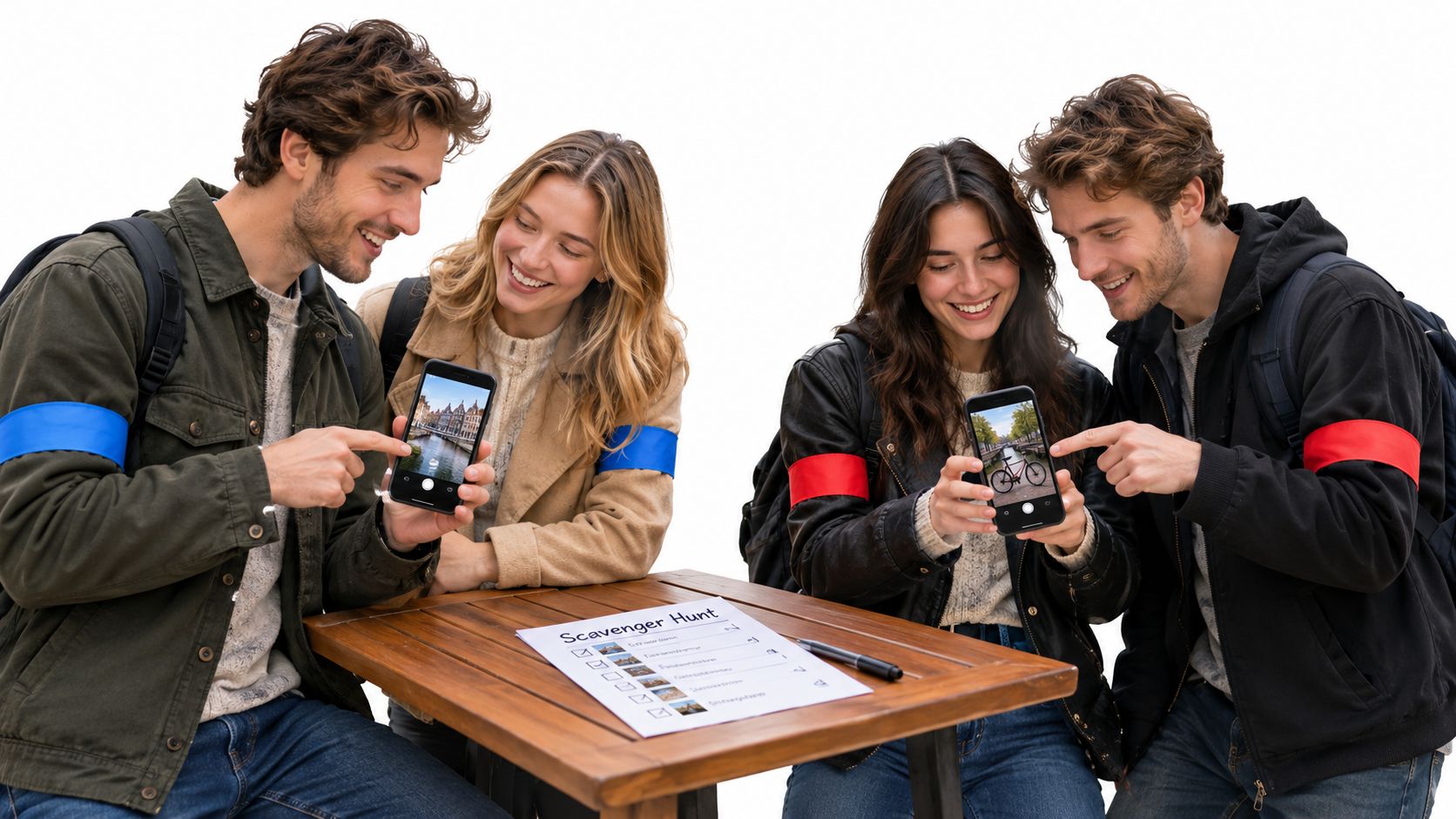
A pub crawl scavenger hunt turns the journey between venues into the game board. Divide the group into teams before leaving, then give each team a short list of tasks connected to Amsterdam, the route, and the people taking part. A team might photograph a canal landmark visible near a venue, answer a question about Dutch culture, or use a few Dutch phrases in a friendly conversation.
The strongest challenges create interaction without making other people part of the entertainment without permission. “Find a canal bridge and photograph the team” is easy to manage. “Buy a stranger a drink” is a poor default because it pressures another customer and complicates venue etiquette. A better replacement is asking a bartender whether the team can photograph a signed scorecard, or inviting a willing guest to join a harmless group photo.
Practical rule: Every challenge should be achievable without blocking a bar, interrupting staff, or requiring alcohol.
Use a WhatsApp group or shared note for live scores, and appoint a non-drinking scorekeeper or rotate that responsibility. The host should explain the rules before the first stop, including what counts as proof, when teams must return, and which challenges are off limits. Small prizes such as Amsterdam postcards or novelty items keep the competition light without encouraging faster drinking.
The game suits groups that like movement and friendly rivalry, but it can become distracting if every task takes too long. Challenges should match the route rather than send teams wandering away from the group. For practical route planning, the guidance on planning an Amsterdam bachelorette party can help the organiser think through timing, locations, and group flow.
2. Never Have I Ever Pub Edition
Never Have I Ever needs no cards, props, or dedicated room, which makes it useful during a quiet transition on a pub crawl. Players sit or stand in a loose circle, and one person gives a statement beginning with “Never have I ever.” Anyone who has done it can raise a hand, take a sip, or use a non-alcoholic alternative such as taking a token.
Start with neutral prompts so newer guests aren't exposed too quickly. “Never have I ever visited Amsterdam before this trip,” “Never have I ever tried Dutch pancakes,” and “Never have I ever ridden a Dutch bicycle” give the group easy ways to discover shared experiences. More personal prompts can follow only if the group is comfortable, and nobody should be targeted by name or pushed to explain an answer.
The format works best in small circles where everyone can hear. A large party should split into smaller groups rather than trying to shout across a busy bar. One facilitator can keep the statements moving, while a second person keeps a backup list ready for the inevitable moment when the group runs out of ideas.
For a private cruise, the contained setting makes the game easy to restart between conversations. On a busy route, it belongs in a quieter venue or during a short pause, not in the middle of a crowded entrance or while staff are serving the group. Alcohol should never be the only response. A sip of soft drink, a point, or a simple hand raise keeps sober, pregnant, and medication-sensitive guests involved without making them explain their choice.
The game also gives solo travellers and less-connected guests a natural opening line. Advice on making friends on a pub crawl is useful here because the same low-pressure conversation principle applies to a mixed stag or hen group.

3. Fancy Dress Themed Crawl Challenge
A themed crawl creates a visual identity before the first drink is ordered. The group could choose 1980s tracksuits, comic-book characters, famous couples, a “worst outfit” theme, or a playful bride-and-groom swap. Matching accessories such as hats, sashes, or armbands often work better than demanding a complete costume from every guest.
Points can reward creativity, staying in character, or a photo with a willing participant. The rules should never require strangers to perform, sign clothing, or pose. A bartender or passer-by who agrees to appear in a photograph can add to the fun, but consent should be requested first and the answer should be accepted immediately.
Make the costume work for Amsterdam
Costumes need to survive walking, stairs, weather, and crowded venues. Oversized props can become a hazard on a narrow route, while masks may make communication difficult. Anyone planning clubs should check dress codes in advance because elaborate fancy dress isn't accepted everywhere.
A small repair kit with safety pins, tape, and spare elastic can rescue a damaged accessory. The organiser should also nominate a photographer or rotate phone duty, otherwise the person managing the route may spend the whole night documenting costumes instead of enjoying the celebration.
Costumes should help the group identify one another, not make venue staff manage avoidable problems.
Tell the crawl host about the theme before departure. The host can explain any venue restrictions and help the organiser avoid creating a bottleneck at the entrance. Budget-friendly clothing from existing wardrobes, thrift shops, or simple DIY pieces keeps the game accessible, especially when guests are travelling with limited luggage.
The scoring can remain informal, with the bride or groom choosing a favourite look at the final stop. That approach avoids turning a social costume theme into a demanding contest and leaves room for guests who prefer a small accessory over a full outfit.
4. Bar Bingo or Venue Checklist Challenge
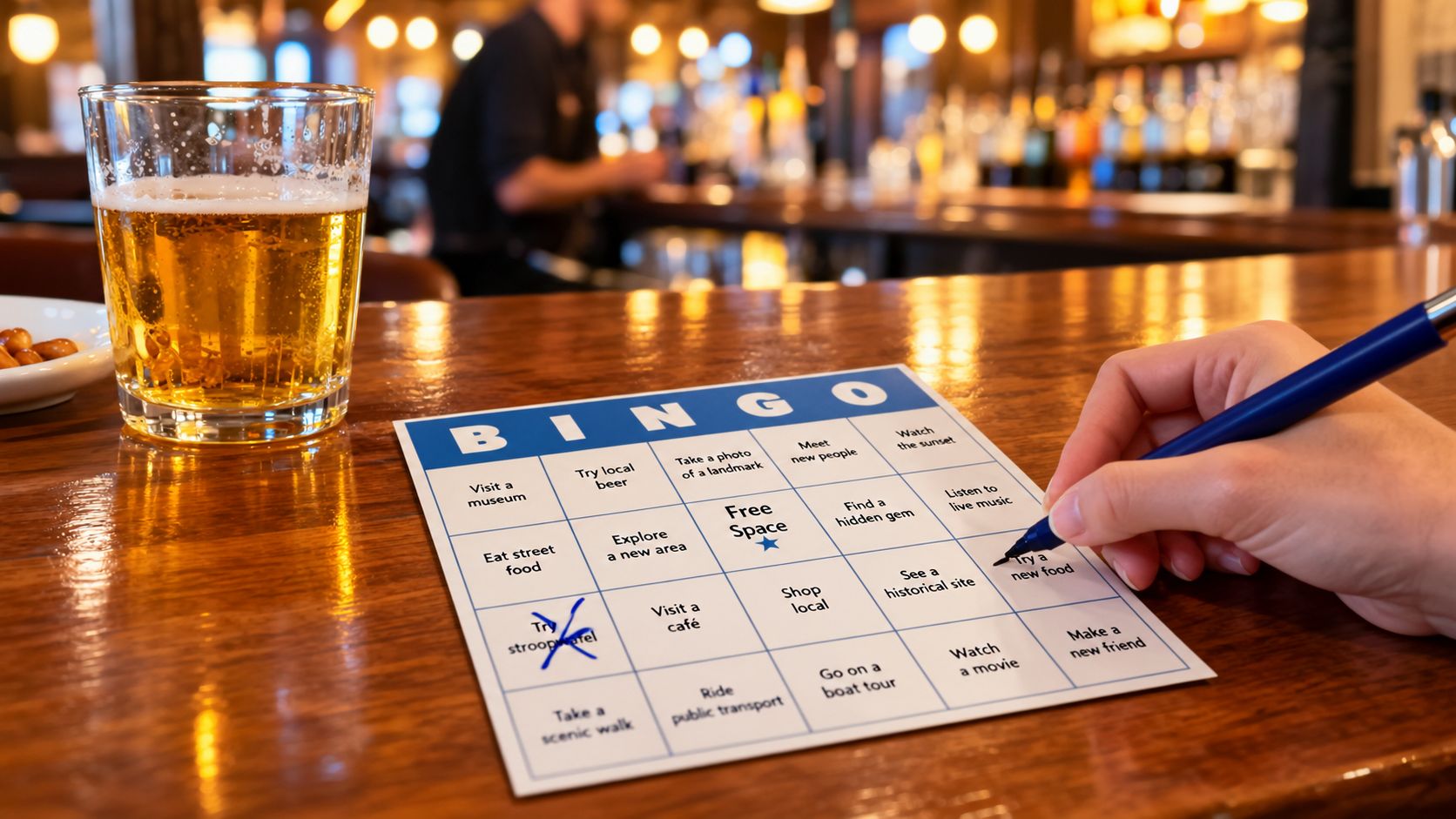
Bar bingo gives a moving group a clear objective without requiring constant performance. Each player or team receives a digital or printed card containing observations and small tasks, such as spotting a canal boat, learning to say “Proost,” ordering a Dutch drink, or asking permission for a venue staff member to sign a card.
The format is strongest when the squares mix easy observations with optional social tasks. A guest who dislikes approaching strangers can identify a local detail or answer a cultural question, while a more outgoing guest can ask a willing bartender for a team signature. “Dance on the bar” should be removed unless the venue explicitly allows it. A challenge that looks funny on paper can become a nuisance in a real Amsterdam bar.
A practical version uses a one-hour playing window, with the winner completing a full vertical or horizontal line. Diagonal lines don't count, and each completed task must be witnessed before it can be ticked off, according to the hen-party bingo rules. That fixed structure prevents arguments and stops the game from continuing indefinitely.
Keep the card route-friendly
Tasks should fit the venue rather than sending players across the city. The organiser can close the game after a chosen venue, appoint a bingo master, and verify completions through a shared chat. That keeps paper cards from becoming damp, lost, or unreadable during a night out.
Bingo suits mixed-age and mixed-energy groups because players can choose how visible their participation becomes. Small prizes, such as postcards or novelty items, provide an ending without turning the final venue into a transaction point. The game works particularly well as the structured middle activity between an icebreaker and a bigger final challenge.
5. Two Truths and a Lie Group Edition
Two Truths and a Lie is a good choice when the group contains people who know the couple well and people who have only just met. Each participant says three statements about personal experiences, with two true and one false. The rest of the group guesses the lie, either by pointing, voting, or writing an answer in a shared note.
The game can stay casual, or the organiser can add scoring. Correct guessers receive a point, while the storyteller receives a point if the group believes the lie. The exact scoring matters less than maintaining a quick turn order. A facilitator should move the game along, especially when guests are distracted by music, drinks, or the next venue.
Use statements that reveal something interesting without demanding sensitive information. “I introduced the couple,” “I once performed on stage,” or “I have never left Europe” can open conversation, but participants should avoid claims that expose private relationships or invite unwanted questioning. The person telling the statements controls how much detail follows.
A private cruise offers the best environment for a longer version because the group remains together while the journey continues. On a pub crawl, use it during a quieter stop or between venues rather than trying to compete with loud music. Guests can prepare their statements before the night, which reduces pressure and helps less outgoing players take a turn confidently.
The game also creates useful follow-up questions. Once the lie is revealed, the storyteller can expand on one true statement, giving the group a personal story rather than another round of forced drinking. A non-drinking player can keep the score or use points instead of sips, so participation doesn't depend on alcohol.
6. Drink Roulette or Dare Challenges
A dare game can lift the energy on a private cruise, but it needs more control than a random online wheel. Players draw cards, spin a wheel, or roll a die to receive a mild, moderate, or spicy challenge. The organiser should write the prompts before the night and remove anything humiliating, dangerous, expensive, or dependent on a stranger agreeing.
Mild tasks include telling a joke, complimenting a friend, or singing a short line. Social tasks can involve starting a conversation with someone who has agreed to participate, while drinking tasks should be optional rather than the default. “Finish your drink” and “take a shot” create poor pacing on a long night, particularly when guests are moving between venues or sharing a boat.
Build in a genuine pass
Every player needs a veto option, and the group should treat a pass as ordinary rather than disappointing. A player can swap a drinking prompt for a dance, trivia answer, group pose, or short story. This keeps the game lively while accommodating sober guests, pregnancy, medication, anxiety, and different personal boundaries.
The dare master verifies completion and protects the pace. On a boat, the game should avoid running near railings, blocking the crew, or involving objects that can fall into the canal. On a pub crawl, it should happen only when the host and venue staff are comfortable with the activity.
The game works because it creates surprise, not because players consume more alcohol. Alternating physical, creative, and conversational prompts gives the group a better rhythm and leaves space for water and food. A custom wheel can be shared digitally, but a small card box is often easier when phones are already being used for photos and navigation.
7. Amsterdam Trivia Contest
Amsterdam trivia gives the group a competitive activity that doesn't depend on dancing, drinking, or approaching strangers. Teams can answer questions about Dutch culture, canal history, local geography, famous Amsterdammers, or details noticed along the route. Questions can be delivered during transitions, with one or two prompts at each venue.
The organiser should verify every answer before the night. A question such as “Which canal is the longest?” can create unnecessary confusion if the answer isn't checked carefully, while a prompt connected to the group's actual route feels more rewarding. The best questions invite discussion rather than testing obscure facts that only one person could know.
Use a mix of easy, medium, and challenging questions. Teams can research answers on their phones when the point is collaboration, or the quizmaster can keep answers sealed when the group wants a more traditional contest. For larger celebrations, teams of four to six help prevent one knowledgeable guest from answering everything.
A good Amsterdam quiz makes the city part of the celebration, not just a backdrop for drinking.
Trivia works particularly well on a shared canal cruise because guests can look outward, notice landmarks, and return to the next question without splitting up. It also gives sober guests and older relatives a central role. A host may be able to add a local observation, but the organiser should confirm any fact rather than presenting an unverified story as history.
Keep the score simple and award a small prize at the end. Postcards, novelty items, or a team photo are enough. The quiz should support the itinerary, not delay departure or keep guests staring at screens while Amsterdam passes outside.
8. Photo Scavenger Hunt or Instagram Challenge
A photo scavenger hunt produces a record of the night while giving teams a reason to notice the city. Prompts can include the whole group on a bridge, a Dutch treat, a shared canal-boat photo, a creative pose, or a consenting bartender holding a team sign. The organiser should design the list around the planned route so participants don't disappear in search of distant landmarks.
Photo consent needs to be explicit. A stranger should never be photographed as a prop, and prompts involving police officers, performers, venue staff, or other customers should be replaced if permission isn't given. A private WhatsApp album or shared Google Photos folder often suits mixed groups better than a public social feed.
Protect the phone and the route
Nominate one phone holder per team, keep the device in a secure pocket, and use a power bank. The phone holder shouldn't be expected to give directions, photograph every moment, and manage scores alone. A fixed closing point, such as the final venue or the end of the cruise, stops teams from chasing one difficult image after the rest of the group has moved on.
The prompts should mix quick wins with creative tasks. “Everyone touches their nose in one group photo” takes seconds. A team tableau based on a Dutch phrase may take longer but creates a memorable result. The organiser can use a private group hashtag if everyone agrees, and a wedding hashtag generator can help create a simple tag without exposing personal details unnecessarily.
For route-specific inspiration, the guide to Amsterdam's most Instagrammable bars can help organisers think about visual variety. The game suits a pub crawl particularly well, while a shared or private cruise is better for group-wide prompts that don't require leaving the boat.
9. Collaborative Storytelling or Progressive Drinking Game
Collaborative storytelling fills a quiet stretch without needing cards or a large playing area. One person starts a story about the couple's worst date, an Amsterdam heist, or a fictional night on the canals. Each player adds one sentence, and the story continues around the group.
Constraints make the game more focused. Every sentence might need to include “Amsterdam” or “Dutch,” or each person may have to stay in character as a film role. A player who breaks the agreed rule can receive a point penalty, take a non-alcoholic forfeit, or accept a playful reset. Drinking should never be the only consequence.
Keep the story moving
Turns should be brief enough that the group doesn't lose interest. A facilitator can give a gentle prompt when somebody gets stuck, and anyone should be able to pass without becoming the joke. A recorder can write down the funniest lines or capture a short voice memo with the group's permission.
The game suits a quieter venue or the middle of a private cruise. It doesn't work well in a loud bar where players can't hear the previous sentence, and it becomes unwieldy when too many people speak in one circle. Large groups can form separate story teams and compare their endings later.
Content boundaries matter. A story about the bride or groom can become hurtful quickly if guests use private information or old conflicts for laughs. Keep the premise playful, avoid sexual humiliation, and let the couple veto themes that make them uncomfortable. The reward is a shared joke that everyone helped create, not a punishment for whoever happens to be less quick with words.
10. Pub Crawl Relay Races or Physical Challenges
Physical challenges can break up a night of standing and drinking, but they require the clearest venue permission. Suitable rounds are short, light, and easy to judge, such as a creative dance move, a beer-mat toss, a balance exercise using an empty cup, or a quick trivia race. The game should test coordination or humour rather than speed drinking.
Challenges involving alcohol need particular care. Finishing a drink quickly, taking shots, or carrying liquid through a busy venue can encourage unsafe pacing and create spills. A better relay may have one player mime a drink, another answer a question, and a third complete a simple movement. Teams still compete, but the outcome doesn't depend on who can consume alcohol fastest.
Run controlled heats
A judge who isn't competing can verify each result, while the venue staff decide where and whether a round can happen. Keep the activity away from stairs, doorways, wet floors, service areas, and canal edges. The organiser should explain that anyone can decline a challenge and receive an alternative task.
Short heats work better than one huge contest. They reduce crowding, give quieter guests a turn, and make it easier for the group to hear the rules. A final score can combine movement, trivia, and creative rounds so that different abilities matter.
This is the most venue-sensitive game on the list. It belongs in a private space or an agreed area, not in a crowded bar where staff are carrying trays. Small prizes and humorous titles are safer than meaningful rewards that make guests feel they must take risks to win.
Top 10 Stag & Hen Party Games Comparison
| Game | Implementation complexity | Resources required | Expected outcomes | Ideal use cases | Key advantages |
|---|---|---|---|---|---|
| Pub Crawl Scavenger Hunt | Medium, needs rules and route planning | Smartphones, checklists, scorekeeper, small prizes | High engagement, team bonding, shareable photos | Hosted pub crawls; mixed-energy stag/hen groups | Scales across venues; competitive and social |
| Never Have I Ever – Pub Edition | Very low, no prep needed | None beyond drinks | Conversation, laughter, surprising revelations | Quiet transitions, intimate groups, canal cruises | Zero prep; inclusive and flexible |
| Fancy Dress Themed Crawl Challenge | Medium–High, advance coordination required | Costumes/accessories, possible host notice | Strong visual identity, increased social interaction, photos | Stag/hen parties seeking spectacle; younger groups | Instant group unity; highly photogenic and attention-grabbing |
| Bar Bingo / Venue Checklist Challenge | Medium, card design and verification needed | Printed/digital bingo cards, verification method, prizes | Structured exploration, cultural engagement, venue interaction | Mixed-age groups, first-time visitors, corporate teams | Clear rules; adaptable difficulty; encourages local discovery |
| Two Truths and a Lie – Group Edition | Low, simple turn-taking format | None (optional scorekeeper) | Personal stories, deeper bonding, surprising facts | Small–medium groups, private cruises, icebreakers | Minimal prep; inclusive; fosters authentic connection |
| Drink Roulette / Dare Challenges | Medium, requires safe challenge design | Wheel/cards/dice, dare master, safety rules | High spontaneity and entertainment; risk of over-drinking | Private cruises, trusted stag/hen groups | Random, high-energy fun; adaptable difficulty tiers |
| Amsterdam Trivia Contest | Medium, question bank and facilitator needed | Prepared questions, host/facilitator, phones for research | Educational engagement, steady paced competition | Cultural groups, corporates, mixed-age visitors | Inclusive; educates about locale; flexible pacing |
| Photo Scavenger Hunt / Instagram Challenge | Medium, prompt list and tracking setup | Smartphones, hashtag/album, prompt list, battery plan | Curated photo album, exploration, social media content | Tech-savvy groups, Gen Z/millennial, social-media focused | Highly visual; creates shareable memories; motivates exploration |
| Collaborative Storytelling / Progressive Drinking | Low, simple rules, turn order | None (optional recorder) | Creative laughter, collective memory, inclusive participation | Creative or intimate groups, cruises, transition moments | Zero prep; inclusive; adaptable constraints and pace |
| Pub Crawl Relay Races / Physical Challenges | Medium, safety and venue coordination needed | Minimal props, judge, venue permission, safety plan | High energy, memorable moments, physical risk potential | Younger, energetic stag/hen parties | Spectator-friendly; varied challenges; strong entertainment value |
Choose Games That Fit the Night
The group doesn't need ten games. Trying to run every format can make the organiser more focused on instructions, scores, and phones than on the people celebrating. A stronger plan uses a small combination that follows the natural rhythm of the evening.
Start with one easy icebreaker. Never Have I Ever or Two Truths and a Lie works when guests are still learning who knows whom. Keep the first prompts light and give people permission to pass. The aim is to create conversation before the group becomes too loud, too tired, or too spread out to hear one another.
Add one structured game for the middle of the itinerary. Bar bingo gives guests something to notice while moving between venues, while Amsterdam trivia works well when the group wants a seated or boat-based activity. The choice depends on the setting. Bingo creates movement and observation, whereas trivia keeps the group together and gives non-drinking guests a clear role.
Finish with one headline challenge. A photo hunt can build toward the final venue, a themed costume challenge can end with a group vote, and a carefully controlled dare game can work during a private cruise. Physical relays should only be used when staff and hosts agree to the exact format. A game that interrupts service or blocks a venue entrance isn't worth the laugh it might produce.
A practical game plan should also include:
- A non-drinking route through every game: Replace sips and shots with points, tokens, movement, trivia, or storytelling so sober guests never have to announce why they're not drinking.
- A consent rule for photographs and dares: Nobody should be pressured to touch, kiss, disclose private information, approach strangers, or appear in a public post.
- A short instruction brief: Explain the objective, proof rule, scoring, closing point, and pass option before the group leaves.
- A realistic phone plan: Use one scorekeeper, one photographer per team, shared charging, and a private album when guests don't want public posts.
- Portable prizes: Amsterdam postcards, novelty items, or small agreed rewards are easy to carry and don't encourage unsafe drinking.
- Venue approval: Check with pub-crawl hosts, bartenders, and boat crews before using a space for photos, movement, scoring, or group challenges.
Historical context also explains why these games are so adaptable. The terms “stag” and “hen” parties originated in the mid-19th century, while the modern American-style bachelorette party became common in the 1970s and 1980s. In the UK, “hen party” was first used in a modern pre-wedding sense in 1976, and earlier hen gatherings were more associated with tea, singing, dancing, cards, and genteel amusements than with modern nightlife formats. The history of stag and hen celebrations supports a useful planning point: the games don't need to follow a fixed ritual. They can change with the group, venue, and comfort level.
Modern groups are also more mixed than old stereotypes suggest. The available survey data records participation in hen dos and stag dos across genders and includes “sten do” participation, which reinforces the need for games that work across friend circles and identities. A game should test curiosity, humour, observation, or teamwork, not whether guests fit a particular party role.
There is a substantial market for these celebrations. The UK stag and hen weekend industry is estimated at £400–600 million annually and serves over 2 million participants, according to UK stag and hen weekend statistics. That scale doesn't mean every group needs a packaged activity. It does show why simple add-ons, from a well-designed bingo card to a hosted route, can make the night easier to coordinate.
Structured social games are already a central part of the format. One independent report found that playing some sort of game was popular with 49% of respondents, with bingo, quizzes, and scavenger hunts described as especially well received in communal settings. The same evidence supports a practical conclusion: a low-prep game often contributes more than an ambitious activity that takes too long to explain.
Ultimate Party Amsterdam has operated in Amsterdam nightlife since 2005, while its publisher information records the company as founded in 2006. Its hosted Red Light District and Leidseplein pub crawls, shared canal booze cruises, private cruises, and Nightlife Concierge service give organisers different settings for the same flexible game principles. Guests can use a crawl for route-based bingo or scavenger tasks, and choose a shared or private cruise when the group wants to stay together for storytelling, trivia, or carefully moderated prompts.
For groups that want help coordinating the setting and logistics, Ultimate Party Amsterdam's hosted Red Light District or Leidseplein pub crawls, shared or private booze cruises, and Nightlife Concierge support can reduce the burden on the organiser. More ideas are available in this guide to the best games for a hen do, but the most successful plan remains the one that fits the actual group.
Explore Ultimate Party Amsterdam for hosted Red Light District and Leidseplein pub crawls, shared and private canal booze cruises, and Nightlife Concierge support for private arrangements. Choose the setting first, then add a few short, consent-led games that keep the group connected without taking over the night.
🍻
Experience it Yourself
Skip the planning — join Amsterdam's biggest pub crawl and get 6 bars, free drinks and VIP club entry for €20.