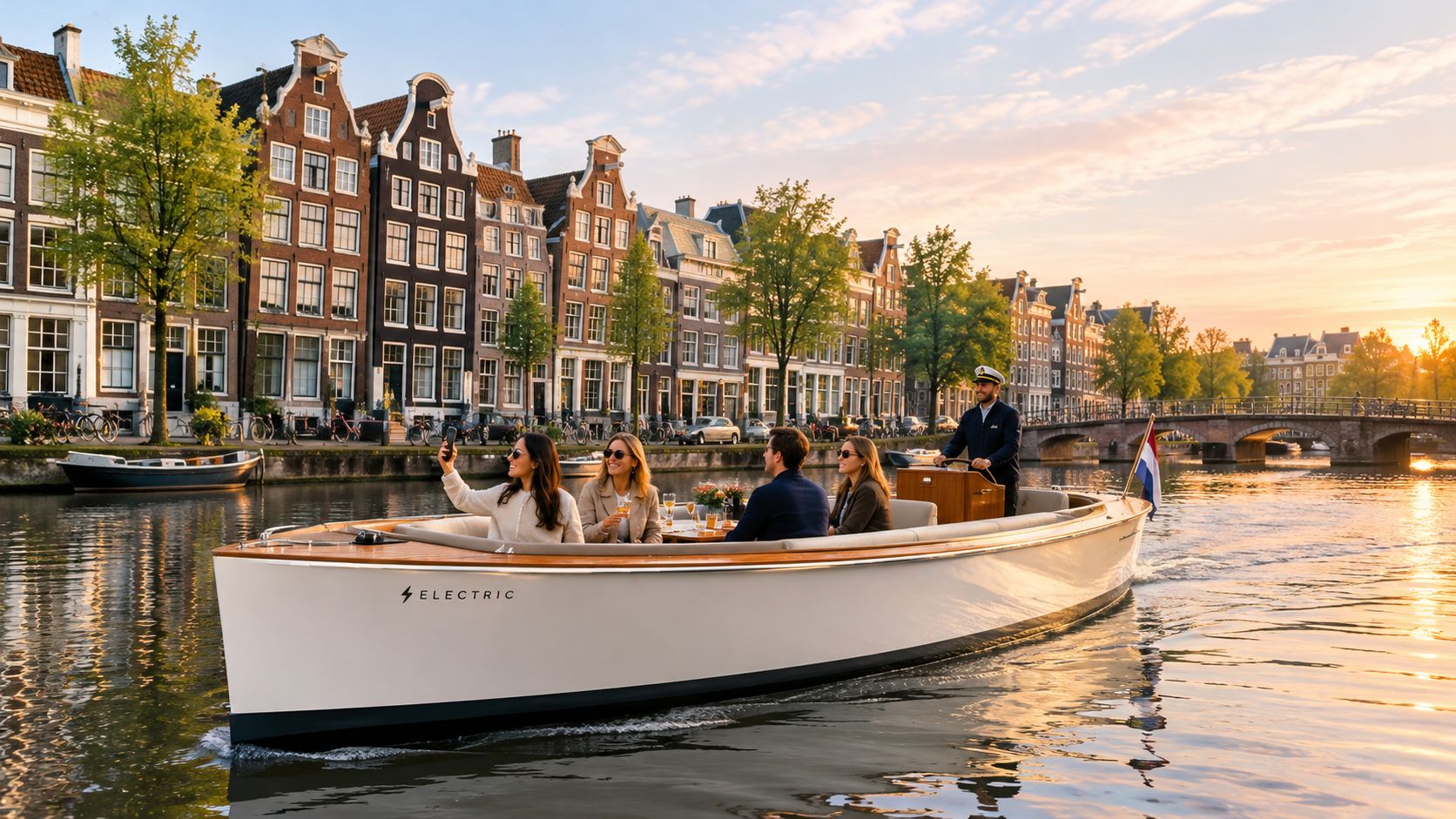
A canal boat in Amsterdam looks effortless from the quay, but the experience runs on tight rules, narrow water, and very little margin for sloppy planning. The best groups treat it less like a floating photo stop and more like a moving venue, because once the boat leaves the pier, the route, the vessel size, the noise level, and even the boarding setup start shaping the whole night.
That matters whether the plan is a relaxed daytime drift, a private celebration, or a social cruise before heading back into the city. Amsterdam's canals reward people who book with realistic expectations and punish anyone who assumes every boat works the same way.
Table of Contents
- Navigating the Reality of Amsterdam Waterways
- Choosing Between Sightseeing Tours and Nightlife Cruises
- The Shift to Electric Boats and Speed Regulations
- Accessibility and Boarding Logistics for Groups
- Route Planning and Nightlife Etiquette on the Water
- Common Booking Questions and Misconceptions
Navigating the Reality of Amsterdam Waterways
A canal boat in Amsterdam moves at a measured pace for a reason. The city's canal network stretches for about 100 kilometers and covers roughly 25% of Amsterdam, while the historic canal ring began in 1613 and grew through the seventeenth century, shaping the city's layout and trade routes (Amsterdam canals facts, Amsterdam canals history).
That old structure still controls the ride. Boats pass through a dense grid of bridges, private craft, service traffic, and tight turns, so the strongest cruises feel intimate, not rushed. A good operator plans around the water, not around fantasy timing.
What that pace means on board
At 6 kilometers per hour, the canal experience becomes a slow glide rather than transport in a hurry (Amsterdam boating rules). That works in Amsterdam's favor. It gives a group time to talk, drink, take photos, and notice the canal houses instead of flashing past them.
Practical rule: if a boat ride feels rushed in Amsterdam, something is off. The canals reward calm routing, not aggressive driving.
That slow pace also helps nightlife cruises work. People can hear each other, the captain can hold the boat steady in narrow water, and the route can stay focused on scenic stretches instead of wasting time on unnecessary manoeuvres. The city's mix of homes, businesses, and tourist traffic makes restraint part of the job.
Choosing Between Sightseeing Tours and Nightlife Cruises
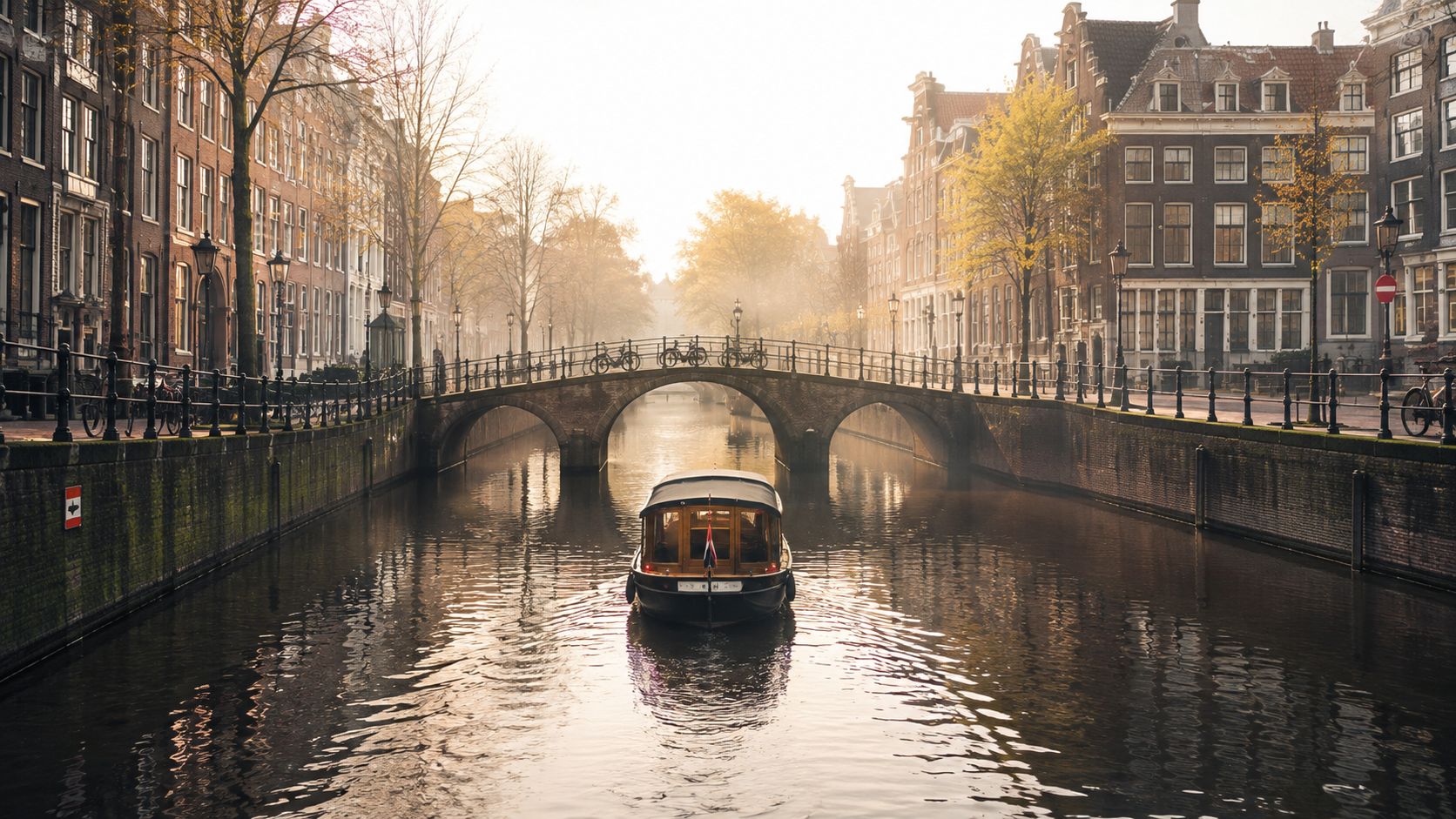
The wrong boat format is the quickest way to waste a good booking. A daytime sightseeing vessel, a private charter, and a social evening cruise may all move through the same canals, but they solve different problems and create very different moods.
| Boat Type | Best For | Atmosphere | Typical Inclusions |
|---|---|---|---|
| Large sightseeing vessel | First-time visitors, mixed-age groups, short city breaks | Quiet, structured, more observational than social | Fixed route, commentary or audio guidance, standard seating |
| Private luxury charter | Celebrations, corporate groups, families wanting control | Flexible, more personal, depends on the host and group | Private use of the boat, tailored timing, selected drinks or catering |
| Shared nightlife cruise | Travelers who want a social start to the night | Lively, relaxed, group-friendly, more conversational | Hosted sailing, drinks service, social setting, one-hour format |
The main split is simple. Sightseeing boats are built for viewing. Nightlife boats are built for group energy. If the goal is a social first stop before bars or clubs, a hosted cruise is a much better fit than sitting behind glass with a quiet commentary track.
For that reason, a shared format often makes sense for smaller groups that want atmosphere without having to charter the entire boat. The shared booze cruise is the cleaner match when the priority is conversation, drinks, and an easy canal route rather than a formal tour.
A boat that matches the mood saves the night. A boat that fights the mood makes even a good group feel split between what they expected and what they booked.
The Shift to Electric Boats and Speed Regulations
Amsterdam's canal rules shape the ride as much as the scenery does. Canal boats must stay within the posted 6 kilometers per hour limit, with 7.5 kilometers per hour allowed only on specific stretches such as parts of the Amstel and Kostverlorenvaart, and captains still have to ease off if the boat throws too much wash (Amsterdam boating rules).
That wash limit is not paperwork for the sake of it. Extra wake can strain canal banks, disturb moored boats, and make close passes feel rougher than they should. For guests, the upside is a quieter trip, easier conversation, and less of the stop-start feel you get on waterways that were never built for heavy modern traffic.
Why electric boats suit nightlife better
Electric boats fit nightlife cruising well because they cut the noise and smell that can wear on a group after a while. That matters on a boat where people are talking, moving around, and staying onboard for the social side of the night.
Delft University of Technology notes that from 2025, commercial canal boats must meet zero-local-emission standards, and its analysis says electric concepts need at least 33% energy efficiency from fossil-fuelled land-based electricity generation, including transport, to beat a mechanical baseline on global emissions (TU Delft research). A separate TNO analysis reported that hybrid propulsion could cut emissions by more than 80% for pollutants, reduce CO2 by about 55%, and that fully battery-electric drivetrains could reduce CO2 by 60% or more depending on the electricity source.
The practical trade-off is straightforward. A quieter boat still needs enough battery reserve, a route that fits the charging plan, and the right passenger load. Electric is not magic, but it does remove some of the friction that used to make a canal night feel less comfortable than it should.
Accessibility and Boarding Logistics for Groups
Accessibility is where most canal boat bookings get sloppy. The canal district is historic, which means a step-free pier does not automatically mean an easy boat entry, and an accessible route does not guarantee an accessible toilet or a usable seating layout.
A good booking check starts before payment, not after arrival. The key question is not whether a cruise is “accessible” in the abstract, but whether this exact boat, this departure point, and this boarding setup work for the people going aboard.
What to confirm in writing
- Step-free boarding: ask whether there is level access from street to pier and from pier to deck.
- Wheelchair fit: check the usable width, turning space, and whether the boat can accept the chair onboard or only at the dock.
- Transfer requirements: confirm whether passengers need to step down into the cabin or over a high lip at boarding.
- Toilet access: ask whether there is an onboard toilet on the exact vessel, not just on “some boats.”
- Stroller storage: clarify where a buggy goes during the cruise and whether it blocks seating.
- Departure pier details: confirm the exact pier, because city piers and boat piers often differ in accessibility.
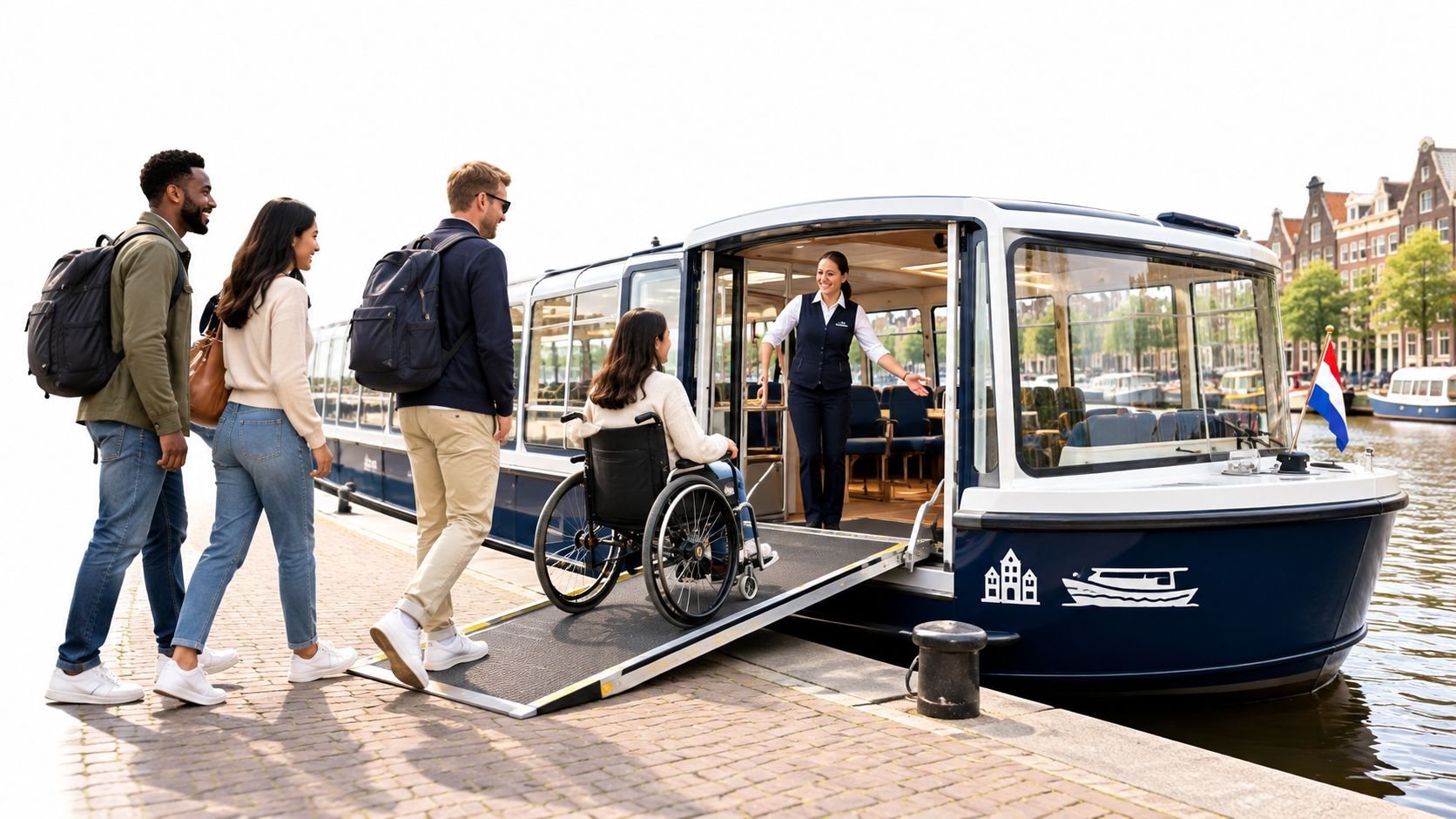
Some boats have ramps and accessible seating, while others are not suitable for wheelchair users at all. Public cruises can also change vessels, which means toilet availability may vary from departure to departure, and that matters for older guests, pregnant travelers, families with children, and anyone planning a long evening before heading out again.
A private option can solve part of that uncertainty because the vessel is fixed in advance. The private booze cruise is the cleaner choice when a group needs more control over boarding, seating, and the overall flow of the night.
Route Planning and Nightlife Etiquette on the Water
Amsterdam's route logic is shaped by bridges, locks, and operating hours, not just by scenery. Waternet manages many of the city's bridges and locks, and if two red traffic lights are showing, the bridge or lock is not being operated, so crews check current conditions before departure (Waternet bridges and locks).
Experienced hosts do not treat every canal as open at all times. They plan around bridge timing, route restrictions, and the simple fact that a nightlife cruise has to keep moving without wasting time on dead turns or blocked passages.
What good route planning looks like
A strong one-hour cruise uses the densest scenic sections and avoids unnecessary manoeuvring. That keeps the energy up, gives the group the best views, and reduces the chance that the boat spends too much time waiting near infrastructure instead of cruising.
Nightlife etiquette matters just as much. The city expects boats to move safely among residents, private owners, and commercial traffic, so the host should keep sound controlled, keep passengers seated or stable when needed, and make the group aware that the canals are shared space, not a private festival route. Hosts who know the Amsterdam nightlife areas can time the route so the boat drops the group close to the district where the night continues.
The route also changes by height. Amsterdam has a standing-mast route for vessels with a mast higher than 6.90 meters, and those vessels may use it only at night, with specific operating times published for places such as the Nieuwemeersluis, the Schinkel bridges, and the Singelgracht railway bridge (Waternet standing-mast route). Ordinary canal boats do not usually need that route, but it is a clear reminder that Amsterdam navigation runs on planning, not improvisation.
Common Booking Questions and Misconceptions
Bigger boats are not automatically better. A large boat can be useful for a huge group, but for most nightlife plans it can feel stiff, slow to board, and harder to socialise on if the layout is built for sightseeing rather than interaction.
Weather is another place where assumptions go wrong. Open-air boats can still work in mixed weather if the operator has sensible cover, but an exposed setup changes quickly once wind or rain enters the picture. The useful question is not whether the boat is “nice,” it is whether the vessel has enough shelter and structure for the group's plan.
The questions worth asking before booking
- Will this cruise still feel comfortable if the weather changes?
- Is the boat designed for social drinking, or is it a sightseeing boat with drinks added on?
- Can the route support a one-hour loop without feeling rushed or repetitive?
- Does the vessel have the facilities the group needs, especially for longer evenings?
- If the plan is drinks first and bars later, does the timing leave enough room to continue the night smoothly?
People also misunderstand “all-inclusive” on a short cruise. It usually means the agreed drinks setup for the cruise itself, not a broad promise that every part of the night, every venue, or every transfer is covered. The smart move is to treat the cruise as one chapter in the night, then connect it to the rest of the plan without overloading the boat with expectations it was never meant to carry.
For groups that want the water to be the opening move rather than the whole story, a canal cruise pairs well with a hosted night out in the city. That works especially well when the boat is used to build momentum before a pub crawl or a club-focused evening.
Ultimate Party Amsterdam handles canal booze cruises and guided nightlife formats that fit the way Amsterdam works, with hosted group experiences on the water and in the city. For a canal boat in Amsterdam that leads naturally into the rest of the night, visit Ultimate Party Amsterdam and choose the format that fits the group, the pace, and the boarding setup.
🍻
Experience it Yourself
Skip the planning — join Amsterdam's biggest pub crawl and get 6 bars, free drinks and VIP club entry for €20.