The most popular advice about a Red Light District tour is often the least useful: arrive after dark, follow the windows, and let the night take care of itself. De Wallen is a residential and working neighborhood, and Amsterdam's rules put clear limits on organized tours. A good plan starts by choosing what the group wants from the evening, then matching the route and behavior to that purpose.
Amsterdam's municipal Research and Statistics unit reported that the city recorded 15.1 million day-trippers in 2024, and 42% of international visitors experienced the Red Light District, according to NL Times' coverage of the figures. That popularity makes a practical distinction important: sightseeing in the district and going out for drinks are different activities, with different rules and expectations.
Table of Contents
- Which Red Light District Tour Fits Your Group
- The Rules for Guided Tours and Why They Exist
- How to Plan an Evening Route That Respects the District
- Sample Itineraries for Three Types of Group
- Behaving Respectfully Around the Windows and Residents
- Accessibility and Comfort Questions to Ask
- Common Mistakes That Spoil the Night
- How to Book Your Hosted Night Out
Which Red Light District Tour Fits Your Group
| Format | Best for | What the route covers | Alcohol on the night |
|---|---|---|---|
| Guided walking tour | History and culture, during the day or early evening | Canals, historic streets and the district's edges | Not allowed during the tour |
| Hosted pub crawl | Solo travellers, first-timers and social groups | Bars and clubs in nightlife areas, led by a host | Free drinks or shots at the stops |
| Boat cruise | Groups who want time together on the water | A canal route with the group together | Check what the operator includes |
| Private arrangement | Celebrations and groups with specific needs | Details agreed with the provider in advance | Confirm the arrangement in writing |
Visitors looking for context on De Wallen's history and changing regulation are better matched with a guided walk. Daytime or early evening makes conversation easier than late-night crowds. Alcohol is not allowed during the tour.
Solo travellers who want company, first-timers who prefer a host, and groups after a social night may prefer a pub crawl. The host leads the group between bars and clubs, with nightlife as the focus. Ultimate Party Amsterdam offers a Red Light District Pub Crawl with bar-hopping, games along the way and a big club finale. Its pub crawls cost €20 per person.
For friends who would rather talk than move between venues, a boat cruise keeps the group together on the water. Check what drinks are included before booking, since offerings vary by operator.
Celebrations and groups with specific requirements may benefit from a private arrangement. Confirm the timing and inclusions in writing so everyone knows what to expect.
Decision rule: Choose a guided walk for district context, a pub crawl for a hosted social night, a cruise for time together on the water, or a private arrangement when your group needs agreed details.
The Rules for Guided Tours and Why They Exist
Amsterdam's rules shape where guided tours can go, how groups move, and when tours can operate. Check the City of Amsterdam's rules for tour permits before booking, and confirm that the operator can explain how its route follows them.
| Rule | What it means on the night | Who it affects |
|---|---|---|
| Group size cap | Guided tours in the city centre allow a maximum of 15 participants, according to the City of Amsterdam's tour rules | Every tour group |
| Exemption above four | Groups of more than four people need an exemption, according to the City of Amsterdam's tour rules | Larger groups |
| Operating hours | Guided tours may run only between 08:00 and 22:00, according to the City of Amsterdam's tour rules | Tour operators and their guests |
| Windows | Tours must not pass sex workers' windows | Every guided route |
| No shared stops or merging | Tours must not stop where another tour group stops or merge with another group | Operators and groups |
| No alcohol or drugs | Alcohol and drug use are prohibited during the tour | Every participant |
The exemption threshold does not override the other conditions. Groups of four or fewer must still avoid passing windows, sharing stops with another tour, and merging with another group.
Before booking a guided walk, ask how many people will join, how the route avoids the windows, and whether the group will stop where another tour is already gathered. A legitimate educational walk explains the area through its streets and historic context. The city's official visitor guidance says guided tours aren't permitted in the Red Light District, while its tour-permit page sets conditions for guided tours in the city centre. Check the official information before travel and ask the operator to identify where its advertised walk can operate. If the answer is unclear, don't assume the route is permitted.
The district's history makes the rules easier to understand
De Wallen is a historic part of Amsterdam, not a nightlife destination. Historical accounts place brothels in the fortified inner-city canal area, known as the burgwallen, from at least the 15th century, when sailors and other maritime workers formed a major customer base. After Amsterdam's 1578 conversion from Catholicism to Calvinism, sex work was criminalized, although authorities continued periods of practical tolerance.
The legal position changed repeatedly. Under Napoleonic rule, the Netherlands lifted the prohibition in 1811 and introduced registration and compulsory health checks. In 1911, Dutch law banned brothels and pimping without fully outlawing prostitution. Brothels became fully legal and licensed businesses on 1 October 2000, as described in the historical account from the NICA Institute.
That history gives a responsible guide useful context for discussing the district, including debates about labor rights and commercial nightlife. Residents and sex workers are part of the place, not attractions.
How to Plan an Evening Route That Respects the District
Amsterdam's visitor-economy research connects nightlife disruption with noise, public urination, and public drunkenness, and recommends planning around visitor flows, toilets, waste bins, and transport capacity. The Amsterdam visitor-economy policy guide supports a simple operating principle: prevent predictable problems before the group reaches a crowded street.
Choose the format first. Decide whether the priority is historical context, a social night, or time together on the water. That choice determines whether the evening is a walk or a drinks-focused activity.
Confirm the group size and applicable rules. The city's tour conditions include a maximum of 15 participants and an exemption requirement for groups above four. Ask the operator to explain how those conditions apply to the specific activity.
Agree on a meeting point outside the residential core. Share the exact location and set a regroup time before anyone disperses. A clear starting point is easier to find than a last-minute message sent into a noisy crowd.
Identify toilets before setting off. A planned stop helps the group avoid public urination and littering. Keep the route's basic facilities in mind, especially if the evening includes drinks later.
Keep moving through narrow streets. Don't stop in doorways or block residential entrances to take photos, wait for someone, or listen to a long explanation. A host should choose a place where the group can gather without obstructing passers-by.
Separate sightseeing from drinking. A guided walk and a drinks-based night aren't interchangeable: alcohol and drugs are prohibited during a guided tour. Finish the walk before moving on to bars or clubs.
Set an end time and name one contact person. One person should know who is still with the group and how everyone will reconnect if plans change. This is especially useful when some guests want to leave earlier than others.
Staggered departures and small, host-led groups can help avoid putting several parties into the same narrow stretch at once. For a drinks-focused evening, choosing the right nightlife area also matters. The Amsterdam nightlife areas guide can help visitors think beyond De Wallen when planning where to spend the rest of the night.
Sample Itineraries for Three Types of Group
At 19:00, a solo traveller joining a hosted night out meets the group at its agreed central meeting point. A host leads the party between bars and clubs, so the traveller has a clear plan for the evening. If leaving early, tell the host and arrange how to continue independently.
For a couple interested in local history, a daytime walk through the canals and historic streets keeps the focus on De Wallen's setting rather than its window frontage. Afterward, have an early meal away from the nightlife core and head back before the evening gets busy. Any guided walk should finish within the city's permitted operating hours.
Before a group of six sets off to celebrate, agree on an end time and meeting point. If the group chooses a guided walk, check the applicable exemption and route arrangements. Keep the walk separate from a later drinks-focused activity in a nightlife area.
Make room for non-drinkers
A mixed group can include a café stop or an early finish for anyone who does not want to continue to bars or clubs. Agree on the option before leaving, so guests can stay involved without feeling pressured to drink or keep pace.
For example, a couple can take a daytime walk and have dinner before the busy evening hours, while a group heading out for drinks can schedule that activity afterward. Keeping the timing clear gives each part of the night its own purpose.
Behaving Respectfully Around the Windows and Residents
De Wallen is a working neighborhood where people live. A respectful visit treats residents and sex workers as people going about their lives, not as part of the attraction.
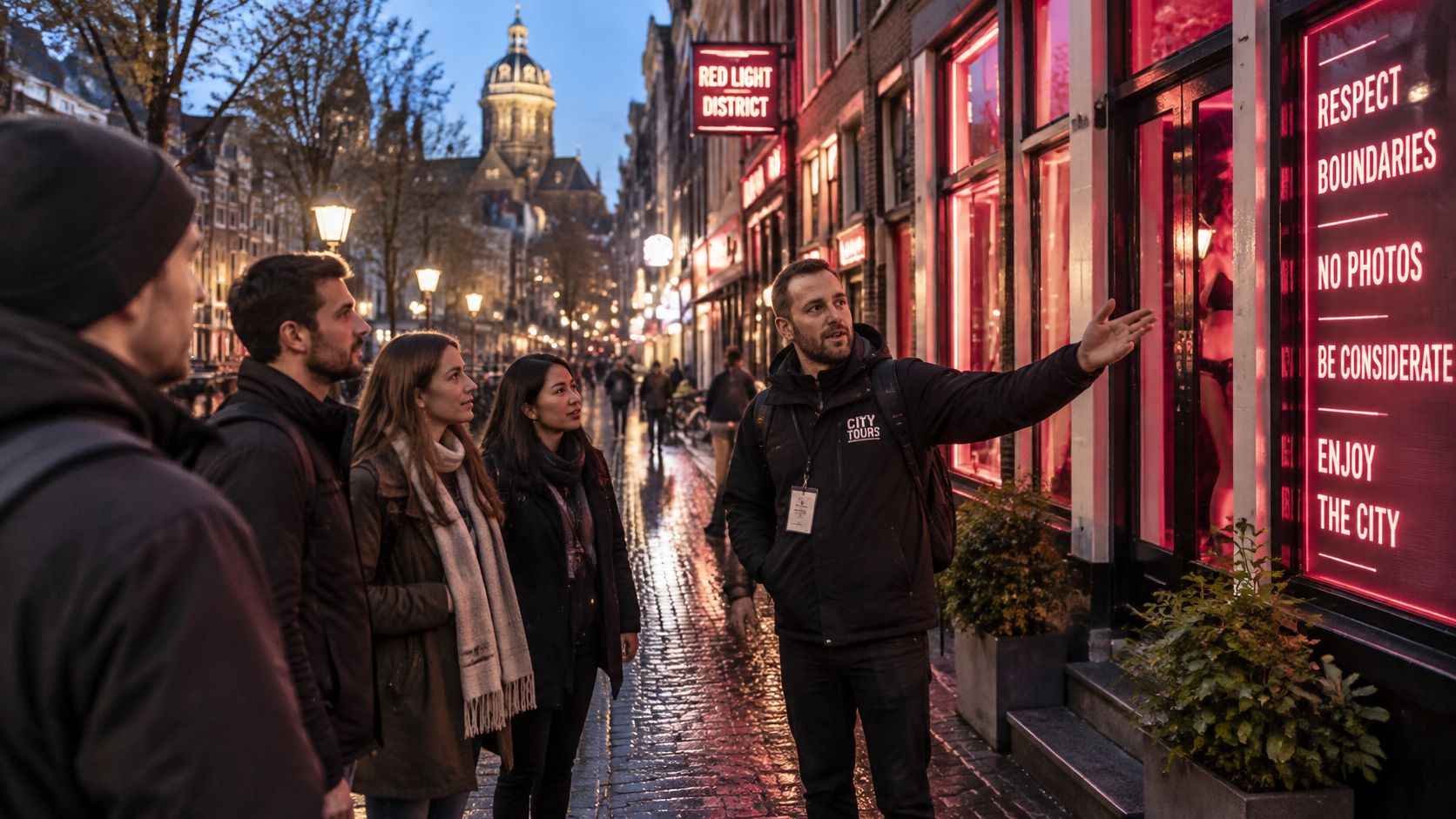
Keep cameras away from windows, doorways, and people. Do not photograph sex workers or their windows, tap on glass, call out, or stare inside. Organized tours cannot pass directly along sex workers' windows under rules that took effect in 2020. The Red Light District visitor information explains that educational walks should use surrounding streets or focus on the area's history.
Keep voices low on residential streets, and leave doorways clear. Public drinking and public cannabis smoking are prohibited or restricted, so keep drinks inside venues and smoke only where permitted. Use a toilet rather than the street.
A useful group rule: If a host or staff member asks the group to move on, do so promptly and without argument.
A good guide explains the district through its streets, history, and changing legal context, rather than treating the windows as a viewing attraction. For practical guidance on personal conduct and awareness, read this guide to staying safe in Amsterdam's Red Light District.
Accessibility and Comfort Questions to Ask
A route can be short and still be tiring if it includes uneven paving, tight passages, or long periods of standing. Match the walk to the group's needs by asking specific questions before booking.
- Is the route step-free? Ask where steps or kerbs appear, so guests can assess whether the walk will work for them.
- Are there cobblestones, narrow alleys, or crowd bottlenecks? Ask which parts may feel tight and when they tend to be busiest.
- Where can the group sit down? Check whether there is a planned rest stop for anyone who cannot stand comfortably for long.
- How long is the walk, realistically? Ask whether the route can be shortened if someone gets tired.
- Can everyone take part without drinking alcohol? Clarify how non-drinkers can join in comfortably.
Nearby does not necessarily mean accessible. The museum's visitor access information notes narrow stairs and limited lift access, with wheelchair access largely restricted to the ground floor (the museum's visitor access information). Consider that distinction when choosing nearby stops: a venue's location alone tells you little about access inside.
Common Mistakes That Spoil the Night
Venue door policies can differ, even within one evening. Bring valid photo ID, and don't assume a group booking guarantees entry. A crawl can also run longer than expected: plan the rest of the night with enough room to stay for the club finale or leave without rushing.
Keep the group together between stops. Before setting out, agree on what to do if someone falls behind or wants to leave early; in De Wallen's busy streets, wandering off to find the others can be difficult. For practical preparation, read these Amsterdam pub crawl tips.
One more mistake is treating the district as a backdrop for photos. Don't photograph people working in the windows, and keep voices and behaviour considerate around residents. A night out should fit the neighbourhood, not disrupt it.
How to Book Your Hosted Night Out
Start with the purpose of the evening. Choose a walk if the group wants history and cultural context, a hosted crawl if the priority is a social night out, or a private arrangement if a celebration needs its own plan. Then confirm the group size and check which rules apply to the activity.
Next, check the details that could change the experience for your group: meeting arrangements, route, accessibility, what's included, and the applicable terms. The Red Light District Pub Crawl costs €20 per person, while the 2 Night Pass, covering both the Red Light District and Leidseplein pub crawls, also costs €20 per person. Pub crawls include 30 minutes of unlimited free shots at kick-off, plus a free drink or shot at every stop. These are nightlife options, not guided history tours.
For a single-night stay, choose the one-night option that fits the group. If the trip includes several nights, compare the available options before committing. Popular dates can fill up, so it's sensible to check availability early, particularly for weekends and peak summer travel. Confirm current dates, prices, inclusions, and cancellation terms on the provider's website before paying, since booking details can change.
For groups sharing plans across several people, a multi-link QR code can make it easier to keep meeting details, booking information, and route notes together. Those considering that approach can test a multi-link QR setup before sharing it with the group.
One practical next step: choose the format, confirm the group's needs, and check the current official city rules before travel. If any question about group size or access remains, ask the provider before booking.
Ultimate Party Amsterdam offers hosted pub crawls for visitors who want a social night out, alongside canal and group experiences for a different pace. Compare the available options and plan a night that fits your group at Ultimate Party Amsterdam.
🍻
Experience it Yourself
Skip the planning — join Amsterdam's biggest pub crawl and get 6 bars, free drinks and VIP club entry for €20.