The most popular advice for solo travel in Europe is to stay in a hostel and let the friendships happen. That leaves too much to chance. A better approach is to choose accommodation for sleep, social activities for company, and evening plans that don't depend on strangers deciding when everyone goes home.
The advantage of travelling alone isn't doing everything alone. It's being able to join a group without handing over control of the whole trip.
Table of Contents
- Why Solo Travel in Europe Works Better Than You Think
- Planning Your Solo Europe Trip Week by Week
- Meeting People on Your Own Without a Party Hostel
- Alcohol Age Rules and the ID You Need to Carry
- How to Judge a Night Out Before You Commit
- Getting Around Amsterdam at Night and Budgeting for a Solo Trip
- Rail Delays and Your Passenger Rights Between Cities
- Choose Your First Night Out in Amsterdam
Why Solo Travel in Europe Works Better Than You Think
Solo trips can be social by design. A traveller can spend the afternoon alone, join a group that evening, and leave the following day completely unplanned. There's no need to commit to either constant company or complete independence.
The 2026 European Travel Trend Survey reported by Travel News Nordic found that nearly 30% of respondents were likely to travel alone during the following twelve months, with Germany, Sweden and France showing the strongest national interest. The same survey found that solo travellers booked longer stays, averaging 10.4 days compared with 8.9 days for travellers overall.

That extra breathing room is useful. Changing cities constantly means repeatedly finding accommodation, understanding transport and starting conversations from scratch. Staying longer gives a traveller the option to return to a favourite café or accept an invitation without rearranging a departure.
Decide how much company belongs in the trip
Before booking, a traveller should answer these questions:
- Company: How many evenings would feel better with other people?
- Geography: Which cities matter most, rather than fitting along the rail route?
- Time: How much of the holiday can reasonably go into transfers?
The answers determine which activities deserve advance bookings. Someone seeking occasional conversation needs a different itinerary from someone hoping to go out every night.
Solo doesn't mean socially unsupported. A hosted evening, a daytime tour and a quiet night in can all belong to the same holiday. The useful skill is choosing between them deliberately rather than treating an empty evening as a planning failure.
Planning Your Solo Europe Trip Week by Week
Solo Europe planning timeline
| Timing | Task | Why it matters |
|---|---|---|
| 8–12 weeks before | Check passport validity and the ID to carry | Identity documents determine boarding eligibility and what can be shown at venues |
| 6–8 weeks before | Book accommodation and compare tax-inclusive prices | Amsterdam adds a 12.5% tourist tax to the accommodation price excluding VAT, according to the City of Amsterdam |
| 4–6 weeks before | Book intercity rail and keep each ticket and confirmation | These records support a delay compensation claim |
| 2 weeks before | Arrange travel insurance and check medical cover abroad | Unexpected medical or cancellation costs won't be shared with a companion |
| Before departure | Share the itinerary with a trusted person and save addresses offline | Someone knows the plan, and accommodation details remain accessible without a connection |
| Each city | Allow three to four nights where practical | This suggested pace reduces transfers and leaves time to meet people |
These timings are planning recommendations, not booking deadlines. A shorter-notice trip needs the same decisions compressed, not omitted. Insurance deserves attention as soon as money becomes non-refundable, rather than being treated as a final packing task.
Documents come first because a cheap booking isn't useful without the right paperwork. Accommodation comes next because its location determines the practical cost of evenings out. A distant room may look economical until repeated late-night taxi fares erase the saving.
Compare the whole stay, not the headline rate
Check whether accommodation taxes are already included in the displayed total. Then compare the room saving against realistic return transport, luggage storage needs and the inconvenience of reaching an early departure.
Phone access belongs in the preparation too. Travellers comparing connection options can use BubblyPhone's advice to prevent surprise roaming bills abroad, then download booking confirmations and essential addresses regardless of the connection chosen.
- Check the final morning: An early train or flight should influence the previous evening's plans.
- Check cancellation terms: A flexible room can be worth more than a small headline saving.
- Leave breathing room: Every city doesn't need an activity booked for arrival night.
Planning rule: A cheap room with an expensive journey home isn't automatically a cheap stay.
Meeting People on Your Own Without a Party Hostel
Pick a social activity the way you pick accommodation: by what it commits you to. The three variables that matter are structure, alcohol expectations and control over leaving. A bar recommendation identifies a place to stand. It says nothing about how a newcomer joins a conversation or whether the crowd will still be there on arrival.
Hostelworld findings reported by Trade Magazin found that 71% of solo travellers actively seek social connection, while 24% worry about difficulty meeting people. That makes the choice of format a real planning task, one that belongs in the trip timeline rather than being left to a decision made on the night.
Match the format to the evening
Social options for solo travellers in Europe
| Option | Group size | How the evening is structured | Alcohol expectation | Easy to leave |
|---|---|---|---|---|
| Hosted pub crawl | Large, mostly strangers | Host-led route through several venues | Drinking expected socially, never an obligation | Yes, between venues |
| Shared boat trip | Mixed group | Fixed-length cruise with a set start and end | Check the booking's drinks policy | At the end of the trip |
| Daytime walking tour | Small to medium | Guided route with a set finish | None | At the finish point |
| Communal dinner | Small shared table | Shared meal with conversation | Optional | After the meal |
| Language exchange | Small conversation groups | Conversation sessions in a set place | None | At the end of the session |
These are format descriptions, and capacity, departure arrangements and booking conditions still need checking before paying. The middle two columns do the main work: structure decides how easily conversations start, and the exit column decides how much freedom a solo traveller keeps.
A hosted pub crawl suits first-time solo visitors who want a ready-made reason to talk to strangers. Moving as a group creates repeated openings for conversation, while loud music and drinking can make it a poor match for anyone hoping for a quiet discussion. Ask whether the environment sounds enjoyable, not whether you are outgoing enough for it.
A shared boat trip removes the question of where to go next. Its fixed duration appeals to travellers who prefer a contained activity, although the same structure rules out spontaneous exits. Anyone who wants the option to leave at any moment should pick a format with natural breaks instead.
Make joining easier without forcing friendship
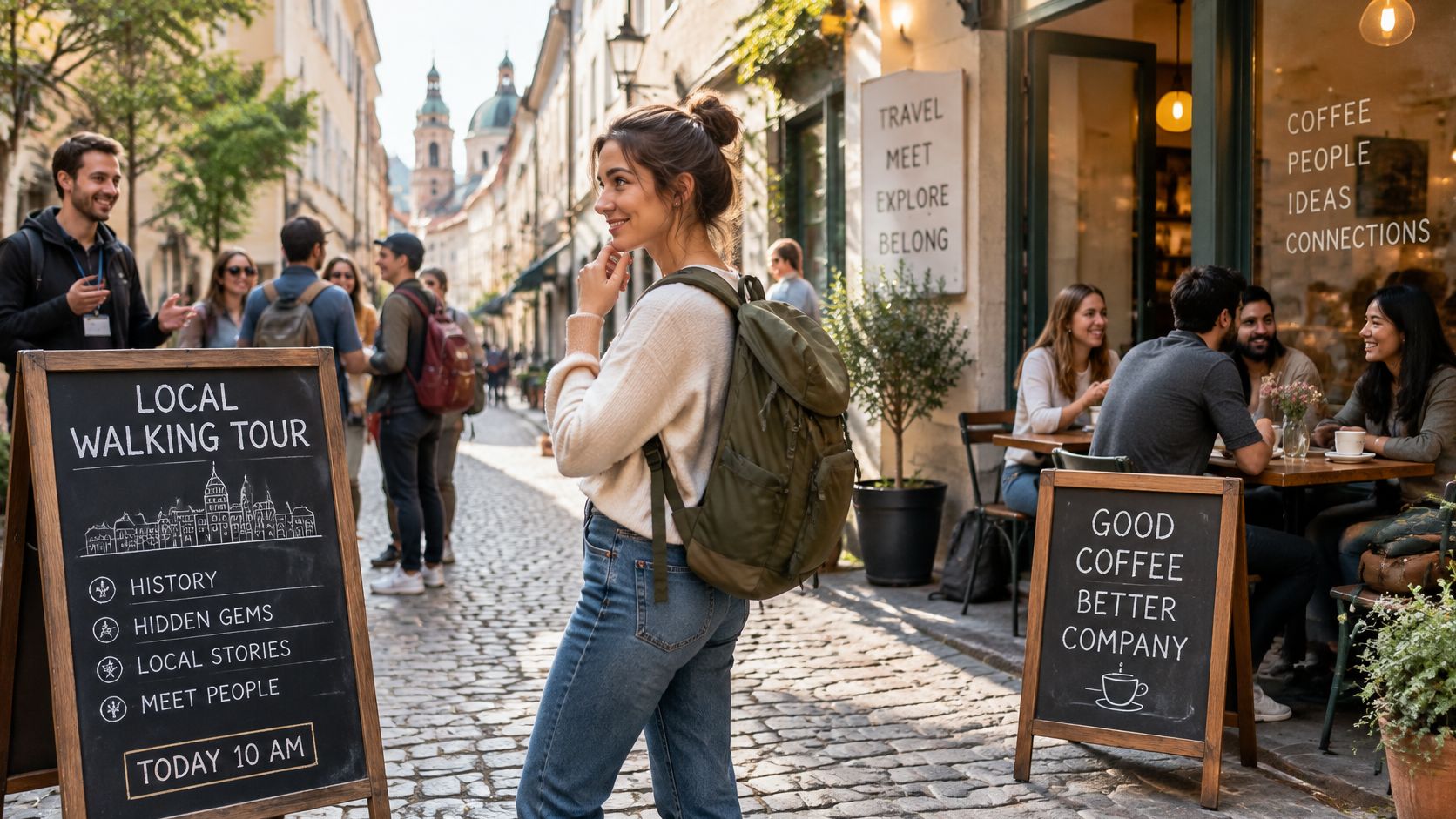
Daytime walking tours provide a shared subject before anyone needs to make small talk, which suits travellers who want company without sacrificing sleep. Communal dinners favour slower conversation, and language exchanges give participants a clear reason to approach each other.
Costs need comparing by what the booking covers. A dinner may replace a meal already in the budget, whereas an activity ticket can leave food and drinks entirely separate.
- Arrive early: A short margin allows time to locate the meeting point without entering an established conversation late.
- Introduce the situation: Telling the host that a participant has arrived alone makes the first introduction straightforward.
- Keep the next stop clear: Before moving, note the next venue rather than relying on following a stranger through a crowd.
Travellers who find introductions awkward can prepare with these practical tips for making friends on a pub crawl.
Booking one structured activity for the first or second night breaks the ice while leaving every remaining evening open, and a solo traveller who has already talked to strangers once tends to find the next introduction easier.
Alcohol Age Rules and the ID You Need to Carry
The Netherlands' alcohol rules cover more than ordering at a bar. The Dutch government's alcohol guidance sets the minimum purchasing age at 18 and also prohibits underage possession in public, with fines of €50 for those under 16 and €100 for those aged 16–17.
That public-possession rule includes streets, parks, shopping centres and pubs. It applies to beer, wine, spirits and mixed drinks; lower-strength drinks get no exception. The same guidance permits underage public possession of alcohol-free or low-alcohol drinks containing no more than 0.5% alcohol.
The practical consequence for a solo traveller is simple: carrying a drink between venues is only legal if you meet the age rule, and the can in your hand matters more than where you bought it.
Carrying ID for venue entry
Carry an original, valid passport or an identity document the venue accepts. A phone photograph works as a backup record, but door staff can insist on the document itself. Keep it in a zipped pocket or a secure bag compartment you can reach without emptying everything at the door.
- Check activity eligibility: A legal drinking age doesn't establish every organiser's admission policy, so read the terms before booking.
- Check document acceptance: A foreign driving licence shouldn't automatically be assumed acceptable wherever identification is requested.
- Plan for younger companions: An evening that suits an adult traveller may exclude a younger friend entirely.
Buying a drink for a younger companion doesn't work around the rule, because possession itself is restricted. If your group spans ages, choose an activity everyone can legally join and save the bar round for the adults-only nights.
At the door: Valid ID supports an age check. It isn't a promise of admission.
Venues can refuse entry for behaviour, dress codes or other admission conditions, and one refusal shouldn't end the evening. Keep a second option in mind: another venue nearby, or a different plan entirely, so a closed door stays a small detour.
Before departure, check the current official government guidance and the specific activity's terms. Rules about alcohol, acceptable identification and participation are easier to settle at a desk than outside a venue at midnight.
How to Judge a Night Out Before You Commit
A safety check should ask how an evening works. Solo travellers consistently put safety near the top of their criteria when choosing where to go, yet the choice of city settles nothing about the night itself. The important questions sit one level lower: who leads the group, where it goes, and how easily anyone can leave.
A structured evening takes care of route-finding and the social cold start. Risk remains either way, and a host only adds value when the meeting point and the group's movements between venues are clear.
Run the five-criteria night test
Night plan scoring criteria
| Criterion | Green flag | Red flag |
|---|---|---|
| Host presence | Named host and a clear meeting point | No one leads the group, or the host leaves mid-route |
| Group continuity | Participants stay together between venues | The group splits at every stop |
| Route or transport | Route and return options explained in advance | Participants must improvise every transfer and the journey home |
| Venue density | Several venues close to the planned exit point | Long walks between bars late at night |
| Independent exit | Leaving between stops doesn't require permission | Leaving requires the host to stop the whole route |
Score a plan against the table before paying. Three or more red flags means changing the plan or skipping it. The format matters less than the answers: a hosted crawl, a bar's quiz night or a loose group formed that afternoon all face the same five questions. The test works as a screening habit, exposing missing arrangements while walking away is still cheap, before money or social pressure raises the cost of leaving.
An independent exit means leaving stays possible at any point, without surrendering access to belongings, transport or accommodation.
Turn the assessment into habits
Set a personal drinking limit before ordering and hold it when new acquaintances suggest another round. Eat beforehand, keep drinks in sight and refuse pressure to catch up.
- Protect phone access: Charge the phone and carry a backup power source when practical.
- Separate emergency money: Keep a small cash reserve apart from the main wallet.
- Recognise the exit signal: Repeated pressure to drink, unexpected separation or a missing host are reasons to stop and reassess.
For city-specific context, an Amsterdam safety guide covers the local picture; the five criteria still govern any single evening.
Leaving early is a planning decision.
These habits belong to every traveller, men and repeat solo visitors included.
The final test stays simple: could the traveller get home independently late at night if the evening stopped being enjoyable?
Getting Around Amsterdam at Night and Budgeting for a Solo Trip
Work out the return journey at the accommodation, while the phone is charged and there is time to compare options. Check the actual service for the planned departure time, since a tram or metro journey can become a night-bus journey later in the evening, and confirm it through the transport operator's official information before leaving.
A central location can still leave a long walk between hotel and venue. Judge the route to the accommodation entrance itself. Bridges, luggage, weather and tiredness can make a journey that looked short on the map unattractive after a night out.
Save a usable journey home
- Record the destination: Save the accommodation address and entrance instructions offline.
- Choose a pickup point: Use an official taxi or a ride-hailing booking from a clearly identifiable location.
- Keep a fallback: Know which Amsterdam night bus runs toward the accommodation and where the nearest official taxi rank sits, so a stopped service never leaves the evening dependent on a stranger's offer of help.
Avoid stepping into cycle lanes while checking directions or waiting for transport. Move to a clear pedestrian space before opening the route.
Budget for costs that aren't shared
A solo traveller pays the whole room bill and taxi fare unless sharing is explicitly arranged. Compare the final accommodation total, check overseas card charges and reserve money for food before setting an evening drinks allowance. Food, the room and the ride home are fixed lines; drinks are the flexible one.
For longer-term preparation, a guide to automating vacation savings can help turn a trip target into a regular saving habit.
A guide to experiencing Amsterdam nightlife on a budget adds practical context for comparing evening spending. For any activity, separate the ticket price from optional purchases and the journey afterwards. One guided pub crawl in the city is priced at €20 and bundles six bars, complimentary drinks and VIP club entry, while food, extra drinks and the ride home still sit outside the ticket.
A cruise or crawl should never be assumed to cover meals, every drink ordered or transport to the hotel. Read the stated inclusions before comparing it with a self-organised evening.
Rail Delays and Your Passenger Rights Between Cities
Under the EU rail passenger-rights guidance, standard delay compensation is 25% of the ticket price for arrival 60–119 minutes late, rising to 50% for 120 minutes or more, subject to the applicable conditions. These rules generally cover rail journeys within the European Union.
The passenger must continue the journey rather than choose a ticket refund, and no listed exception can apply. Approved compensation must be paid within one month of the request. A delayed train doesn't automatically mean every additional expense or missed activity is reimbursable.
Preserve the evidence before leaving the station
- Keep the ticket and confirmation. Save the original booking and any replacement journey details.
- Record actual arrival. Note when the train reaches the final destination, rather than relying only on an earlier delay estimate.
- Check eligibility. Compare the actual delay with the applicable threshold and review exceptions.
- Submit the request. Use the railway undertaking's compensation process and retain the submission confirmation.
The European Parliament's passenger-rights factsheet explains that a standard reimbursement and compensation form is available for delayed or cancelled rail services. It also describes operators' obligations to provide disruption information.
Protect the evening before protecting the claim
The important nightlife decision happens before the train is booked. A service arriving close to an activity's meeting time leaves no room for platform changes, accommodation check-in or finding the departure point.
- Prefer an earlier connection: Compensation won't recreate a missed evening.
- Read activity terms: A transport delay doesn't automatically override an unrelated booking's cancellation policy.
- Avoid an arrival-night bottleneck: Put a must-do activity on a day without a demanding transfer where possible.
A buffer of an hour or more before a booked evening event is a sensible starting recommendation, not a guarantee. Allow additional time when luggage storage, check-in or unfamiliar local transport sits between the station and the meeting point.
Choose Your First Night Out in Amsterdam
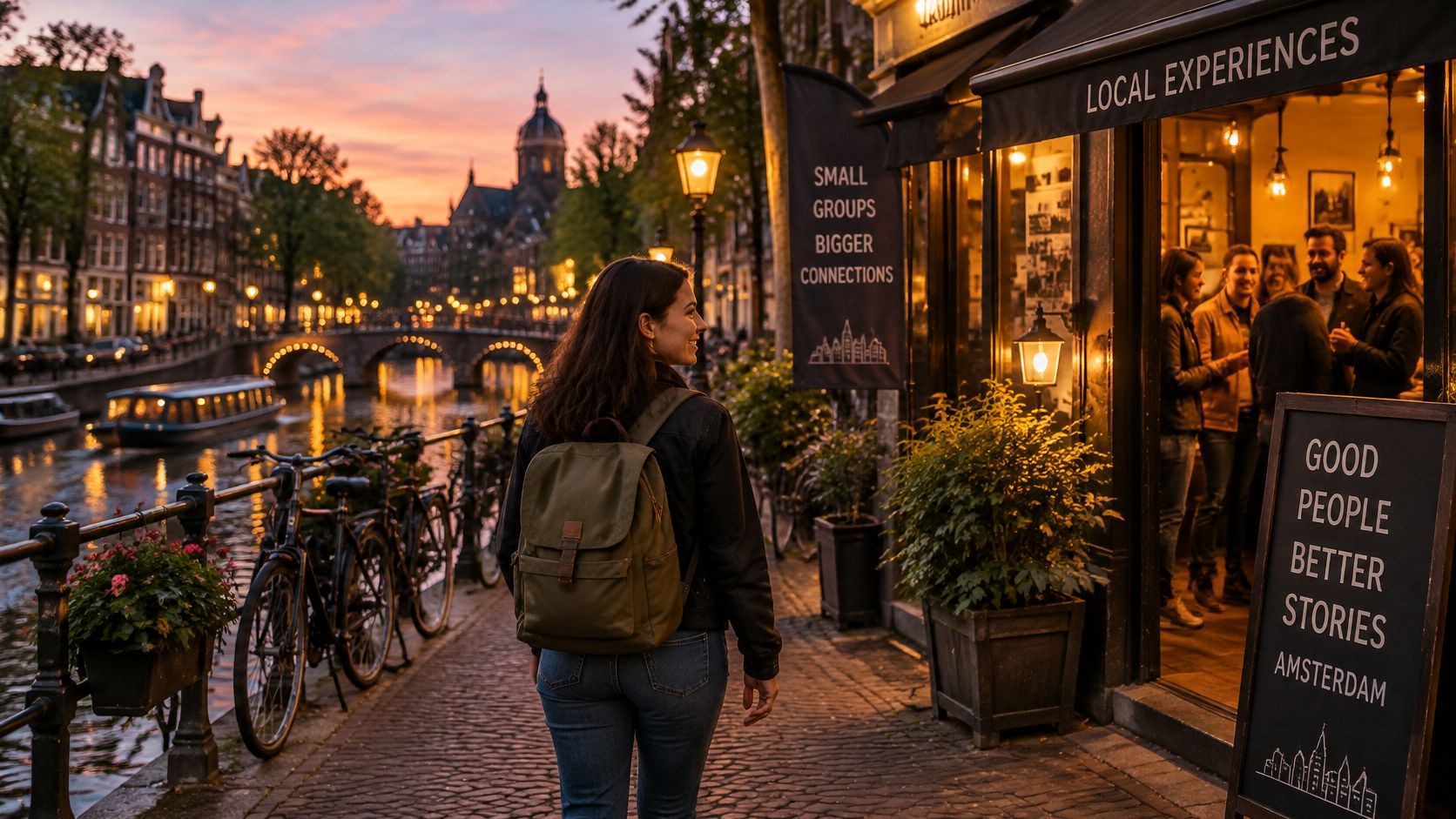
A structured evening early in an Amsterdam stay gives a solo visitor company without locking them into a full-trip commitment. The right choice comes down to one honest question: does moving between venues sound energising, or does a single contained activity feel more comfortable?
Ultimate Party Amsterdam's Red Light District Pub Crawl costs €20 per person, with a hosted route, bar-hopping, games and a club finale. The Leidseplein Pub Crawl offers a dance-focused alternative, while the Shared Booze Cruise includes an hour of unlimited drinks and welcomes solo travellers, couples and groups. All entry fees are included in the pub crawls, with no venue cover charges.
Choose the commitment that feels comfortable
The Red Light District option suits someone who wants an organised route and an easy introduction to fellow travellers. Leidseplein fits someone whose priority is dancing. A shared cruise works best for someone who prefers one defined activity on the water over a sequence of venue decisions.
Pick the format that matches how you spend evenings. Someone who dislikes loud conversation gains nothing from a dance-focused crawl booked purely because travelling alone feels like a reason to become a different person.
- Check the logistics: Confirm the current meeting point, start time and expected finish before paying.
- Read beyond the headline: Distinguish stated inclusions from additional purchases, particularly meals and onward transport.
- Match the next morning: Keep demanding sightseeing or an early departure in mind when choosing the evening.
Book a social opening, not the whole holiday
An early-trip booking leaves room for later invitations without making the rest of the itinerary depend on them. It also avoids placing the only planned social activity immediately before departure, when a late night collides with packing and an early train. One hosted evening in the first days gives a solo traveller contacts and local orientation while every later night stays open.
The practical next step is to compare the current official schedules, prices and inclusions against the preferred format, then confirm all details during booking. A worthwhile night out fits the plans you already have.
Ultimate Party Amsterdam offers hosted pub crawls and shared canal booze cruises for travellers who want company during a solo Amsterdam stay. Visit Ultimate Party Amsterdam to compare current options and book the evening that fits the preferred atmosphere, timing and level of commitment.
🍻
Experience it Yourself
Skip the planning — join Amsterdam's biggest pub crawl and get 6 bars, free drinks and VIP club entry for €20.