The group chat has agreed on a night out in Amsterdam, but nobody has agreed on where to start. Some friends want dancing, someone wants a relaxed bar, and the cheapest-looking plan hasn't accounted for club entry or the journey back to the hotel. Choosing a nightlife area before choosing individual venues makes that evening much easier to organise.
A good party Amsterdam itinerary starts with three decisions: the area, the night and the group format. Dress rules, arrival times and door policies then become practical checks rather than surprises outside a club. Ultimate Party Amsterdam has offered pub crawls and booze cruises since 2006, and the useful lesson for visitors is straightforward: a workable route matters more than a long list of venues.
Table of Contents
- Compare Leidseplein, Red Light District and Rembrandtplein
- Going Out in Amsterdam Without the Guesswork
- Red Light District After Dark and What to Expect
- Dance Bars at Leidseplein and Late Finishes at Rembrandtplein
- Safety and Getting Home After Midnight
- Guided Pub Crawls and How to Book Your Night
Compare Leidseplein, Red Light District and Rembrandtplein
| Area | Best nights | When it fills up | Dress and door policy | Crowd and feel |
|---|---|---|---|---|
| Red Light District | Every night; weekends busiest | Late evening into the early hours | Casual clothing and comfortable shoes suit bar hopping; each club controls admission | Mixed international crowd, closely packed bars and clubs |
| Leidseplein | Thursday to Saturday; weekends busiest | Evening drinks develop into a later dance crowd | Smart-casual is a sensible weekend choice; individual venues set entry charges and clothing rules | Dance bars and an energetic weekend atmosphere |
| Rembrandtplein | Weekends and busy event nights | Later in the evening into the early hours | Clean, smart-casual clothing is a useful starting point; check the specific club's policy | Larger bars and clubs around a square, with scope for a relaxed finish |
The plain verdict for each area
Red Light District is the practical choice for the widest choice on any night. It suits first-time visitors and mixed groups that haven't agreed on a particular music style. The trade-off is that busy pedestrian streets can make an otherwise short move between bars feel slow.
Leidseplein suits dancing and a weekend feel. Thursday through Saturday is the stronger planning choice for friends who want the evening to become progressively louder and more energetic. It's less useful to choose the area because someone has heard its name, then discover that the group wants conversation over drinks.
Rembrandtplein suits a later, more relaxed finish. Larger bars and clubs around the square give a group room to make a final decision without planning another cross-city move. Relaxed describes the itinerary, not a promise of quiet music or an easy door.
Compare the bill, not just the first drink
There isn't a reliable area-wide drinks tariff or standard club cover charge. Typical costs are a combination of entry, drinks, optional extras and transport, with the venue and event setting the actual bill.
For independent bar hopping, a menu check before the first round is more useful than an unsupported average beer price. A group should also establish whether a venue charges admission, whether that ticket permits re-entry and whether a cloakroom adds another cost.
- Red Light District: Closely spaced venues make comparison practical, but extra stops can mean extra rounds.
- Leidseplein: Allow for a possible cover charge before committing to a dance bar or club.
- Rembrandtplein: Check the event price rather than assuming every door around the square works the same way.
Planning rule: A nearby alternative is more useful than a famous venue across town when the first choice doesn't fit.
Crowd peaks, opening hours and door rules change by venue, season and night. These are planning patterns, not promises. The sensible order is area first, night second and group format third.
Going Out in Amsterdam Without the Guesswork
A night out becomes harder to manage when every decision is left until the group reaches the street. The following sequence keeps the important choices connected without turning the evening into a rigid timetable.
Choose the area around the mood. Visitors wanting dance bars should favour Leidseplein, while a group seeking broad choice can start with De Wallen. A later square-based finish points towards Rembrandtplein, because the setting should support the evening rather than compete with it.
Match the night to that area. A Thursday-to-Saturday dancing plan is a different proposition from a quieter midweek outing. The group should check the actual event programme before committing, because a neighbourhood's reputation doesn't identify the music playing inside a particular club.
Set a complete budget per person. Entry, extra drinks, food and the return journey all belong in the calculation, because a cheap opening round says little about the final bill. Ultimate Party Amsterdam's guide to experiencing Amsterdam nightlife on a budget provides a useful starting point for separating essentials from optional spending.
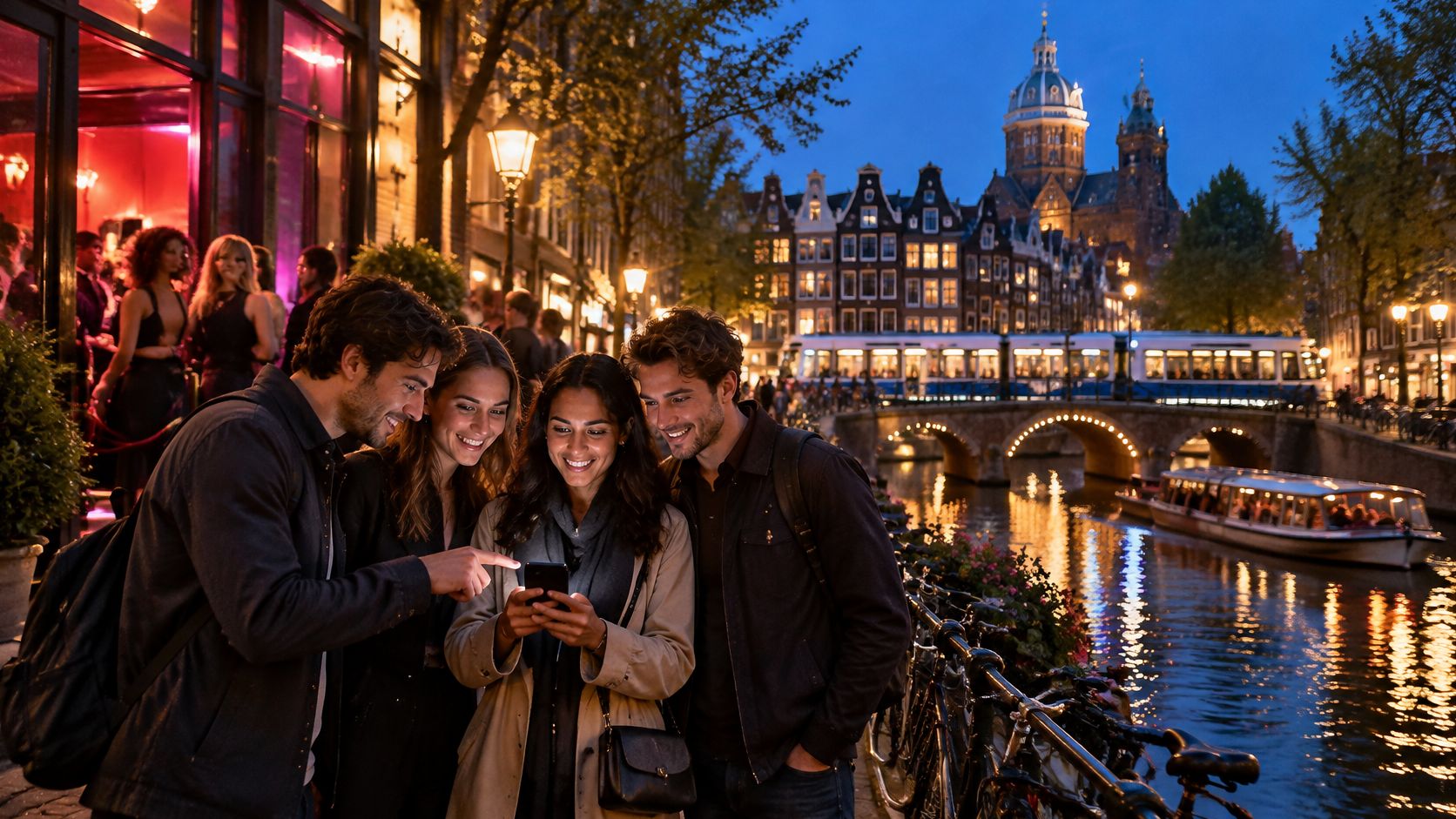
Agree on a meeting point and intended final venue. Both should be saved offline with a street address, because a venue name alone can be difficult to locate with a weak connection or low battery. A clear fallback meeting point also prevents a split group from wandering in opposite directions.
Check clothing and admission requirements before leaving. Some clubs may refuse sportswear or particular trainers, especially on busy nights, so clean smart-casual clothing is a safer starting point than gym kit. A ticket or reservation shouldn't be treated as permission to ignore venue conduct rules.
Decide the return journey before drinking. The group should identify a workable route to its actual accommodation, not the nearest central transport stop. This matters particularly when friends are staying at different addresses and assume everyone will travel together.
Treat New Year's Eve as a separate event plan. The New Year's Eve visitor guide describes Amsterdam's prohibition on setting off fireworks and reports a national consumer-fireworks ban scheduled to take effect in 2026, so visitors should verify the applicable rules and use organised public celebrations rather than private fireworks in the centre. A New Year's Eve pub crawl is another format to consider, with the departure time checked on its current product page rather than assumed from a regular-night schedule.
Before leaving the accommodation
- Valid identification: All Ultimate Party Amsterdam events are 18+, with valid ID required.
- Payment backup: A card plus some cash prevents a single payment problem from disrupting the evening.
- Charged phone: An offline address and enough battery for the return journey matter more than another photograph.
- Saved meeting point: Every participant should have the same location, not a different interpretation of the nearest square.
The strongest plan leaves room for a change of venue while keeping spending, meeting arrangements and transport clear.
Red Light District After Dark and What to Expect
De Wallen developed around Amsterdam's medieval harbour, where trading activity created demand for taverns and lodging, as described in Lonely Planet's history of the Red Light District. Its identity developed further during the Golden Age as maritime commerce made Amsterdam an international centre, helping explain the close mixture of canals, hospitality businesses and window-lit streets.
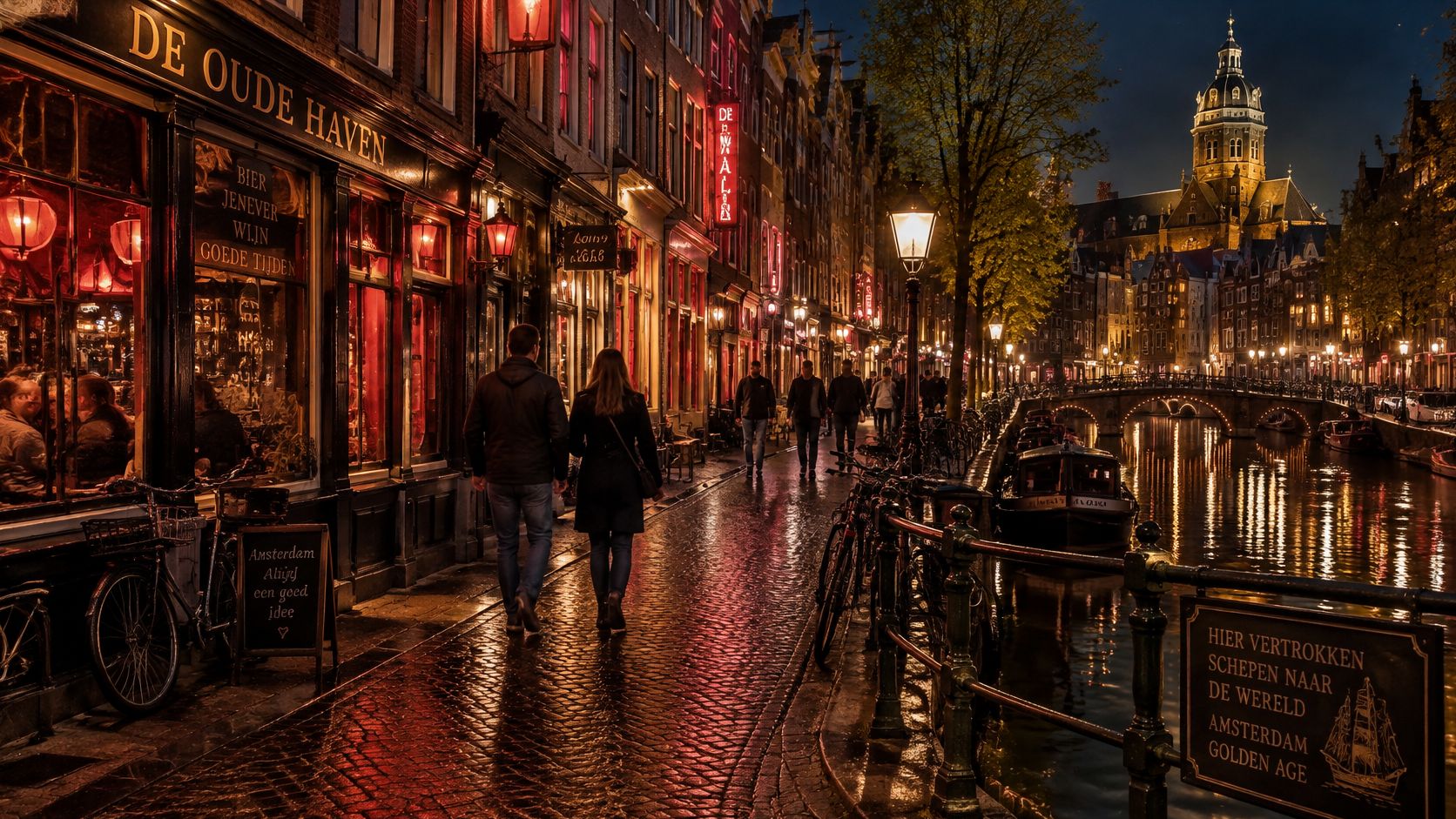
For a first-time group, the contrast between an early-evening arrival and a later weekend visit can shape the whole experience. Earlier, there's more opportunity to understand the street layout, choose a first bar and establish where everyone is heading. Later, narrow passages and people stopping to look around make keeping the group together more demanding.
The district suits visitors who want options without selecting a specialist club night in advance. Large groups that drift without a fixed route tend to lose members in the narrow passages, so a loose evening still needs a few agreed points: where to meet, roughly when to move on, and which venue closes the night.
A workable arrival scenario
Say a group reaches the area before its intended bar-hopping start. The useful first move is to find the meeting address, rather than ordering drinks somewhere that merely looks close on a map.
Casual clothes and comfortable shoes make sense for walking between stops, particularly when cobbles are wet. A bar's relaxed appearance doesn't establish the dress policy of the club planned for later, so the final venue deserves its own check.
Three street rules keep the visit respectful and practical:
- Keep walkways clear: A group discussion belongs out of the pedestrian flow, not across a narrow passage.
- Respect window workers: People working in the windows shouldn't be photographed.
- Carry valid ID: Admission checks remain relevant even when the evening starts in an informal bar.
The door is still a decision point
Queues can form at popular venues after midnight, and neither a casual outfit nor a confident approach guarantees entry. Door staff weigh group size, demeanour and how full the room already is, and two groups in identical clothes can get different answers.
A better group strategy is to identify an acceptable alternative before joining a queue. If the music, price or door conditions don't suit the group, changing direction early is easier than arguing after a long wait. Because the district is compact, the fallback venue is usually a short walk away rather than a transport problem.
A compact district still rewards planning. The first meeting address and the final destination both need to be clear before the evening starts.
Ultimate Party Amsterdam runs nightlife experiences every night, and its guided Red Light District pub crawl suits visitors who would rather follow a set route through the area than organise each stop independently. The format handles the meeting point, the sequence of bars and the club finale as one booking, which removes most of the coordination work described above.
Dance Bars at Leidseplein and Late Finishes at Rembrandtplein
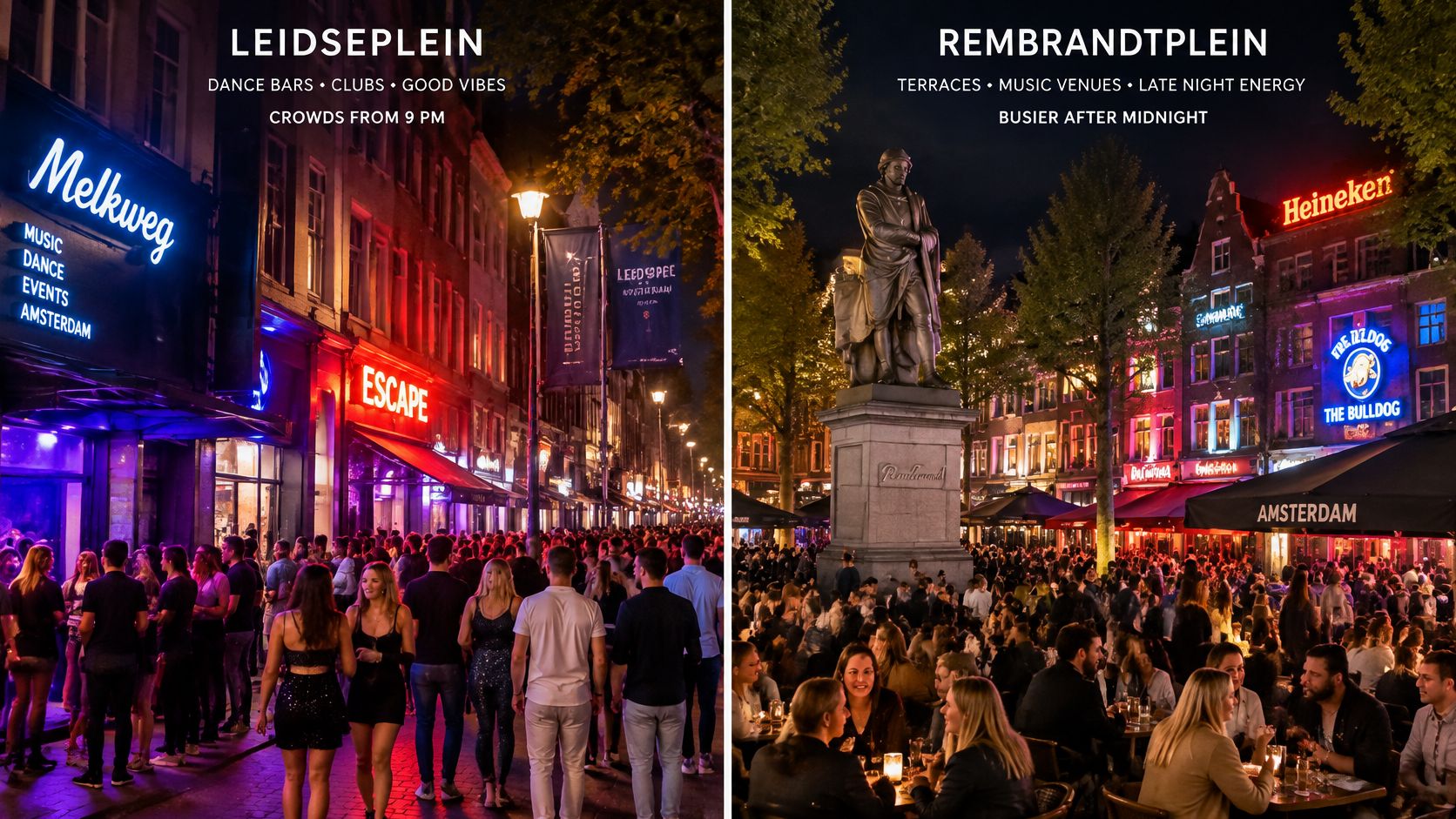
A dancing-led night needs two decisions in the right order: where the group builds momentum, and where it ends. Leidseplein handles the first job well, Rembrandtplein the second. What follows is about timing, dress and spending, not another comparison of the areas themselves.
Leidseplein for a dancing-led evening
Atmosphere: Dance bars and clubs suit friends who want an energetic weekend night. The practical advantage is a shared direction: the group is there to dance, so nobody has to renegotiate the plan after every drink.
Timing: Meet early enough to settle in before committing to the later club stage. Thursday to Saturday is the clearest fit for this style of outing, but the actual event programme should decide the final venue.
Dress and doors: Smart-casual is a sensible weekend default. Clean shoes, trousers or neat jeans and a suitable top reduce avoidable problems, although no general outfit advice overrides a club's own requirements.
Spending: Busy dance bars get expensive through repeated rounds, even without a dramatic admission price. Set a spending cap and agree on shared rounds before the first order, because assuming everyone wants the same pace is how budgets drift.
Rembrandtplein for a flexible finish
Atmosphere: The square works best when the group has not committed to one final venue. Several options sit within a short walk of each other, so a slow door or a poor music fit costs a change of direction rather than the whole evening. If the group wants a terrace seat, confirm it with the venue on the day rather than assuming outdoor seating is open.
Timing: Treat Rembrandtplein as a later-evening destination, particularly when the group wants to avoid another major move after its last venue. Ultimate Party Amsterdam's two regular pub crawls both end at Rembrandtplein, which makes the square relevant when arranging the journey after an organised route finishes.
Dress and doors: Each venue sets its own policy. An easy entrance at the previous bar says nothing about the next club, and special events may run separate ticket arrangements.
Spending: Check admission, drinks and extras at the venue itself. Read the event listing for the music before paying a cover charge, since the fee only confirms the price of getting in.
Avoid the midnight decision trap
- Choose the music before the queue: An event description is more informative than a busy doorway.
- Confirm cover charges: Nobody should discover an unexpected entry fee after the group has committed.
- Keep the final address realistic: A late drink is less relaxed when the accommodation route hasn't been checked.
According to GVB's visitor transport guide, trams generally stop at about 00:30, while night buses operate approximately 00:30 to 07:00; the guide also states that GVB day tickets work day and night and describes contactless check-in and check-out.
Decide on the dancing first and the finish second, and the last hour largely plans itself: Leidseplein carries the early momentum, Rembrandtplein absorbs whatever the group still wants after midnight.
Safety and Getting Home After Midnight
Only 28% of women feel safe travelling home at night, compared with 61% of men, according to the Amsterdam Nightlife Culture Index findings reported by Pollstar, which also identifies lower feelings of safety on nightlife-area streets than inside venues. Those findings challenge the idea that a comfortable experience inside a bar automatically means an equally comfortable journey home.
A hosted group can reduce navigation problems and isolation, but it can't remove every risk. Clear boundaries, a manageable drinking pace and a return arrangement still matter.
Separate venue safety from street safety
Inside a venue, a participant can approach staff if someone behaves aggressively, follows them or makes them uncomfortable. Outside, the immediate priority is reaching a populated, identifiable place and reconnecting with trusted companions rather than continuing alone while distracted.
- Stay connected: Anyone leaving early should tell a companion rather than disappearing without notice.
- Protect valuables: Phones and wallets belong in secure pockets or closed bags, especially in dense crowds.
- Decline street dealers: Offers from strangers aren't a useful shortcut to a better night.
- Respond early: A person feeling unwell or unsafe needs attention before the group moves to another venue.
Ultimate Party Amsterdam's Amsterdam safety guide offers further context for visitors weighing nightlife plans against personal comfort.
A safer finish: The last venue should be chosen partly for how the group will leave it, not only for what happens inside.
Make the return route usable
A night-bus plan needs a destination, a stop and the correct direction of travel. A central stop name isn't enough if the accommodation is outside the centre, and the group should allow time to locate the departure point without rushing.
Where a day ticket is being used, passengers should confirm it covers the intended service. Contactless users should keep the same card or device available for checking in and out, rather than switching payment methods midway through a journey.
A taxi can be a practical choice when a group member feels uncomfortable walking or the accommodation route is awkward. Cycling after drinking shouldn't be treated as the default alternative.
This planning matters particularly for solo travellers, women and LGBTIQ+ visitors, as well as anyone choosing between walking, cycling and a taxi. The avoidable mistake is leaving the return decision until the last round, when patience, phone batteries and concentration may all be lower.
Guided Pub Crawls and How to Book Your Night
A guided pub crawl fixes the route, the start time and the included drinks before the evening begins. A host leads the group between venues, entry fees are settled in advance, and everyone moves together. Extra drinks and the journey home still need their own budget.
Shared crawls suit solo travellers and pairs looking for company. Private and custom formats suit groups that arrive with their own crowd and care more about pace and venue type than about meeting strangers.
Match the crawl to the available night
The Red Light District Pub Crawl runs every night, with arrival between 8:00 and 9:30 PM. It costs €20 per person, 20% off the regular €25, and includes six stops, bar games, six free shots, all venue entry fees and a final club.
The check-in window is wider than the drinking window. The unlimited-shots opening covers only 8:00 to 8:30 PM, so arriving at 9:15 still gets the route, the games and the club, just not the open-shot half hour. Included alcohol carries no obligation to drink it.
The Leidseplein Pub Crawl runs Thursday to Saturday, with check-in between 8:30 and 9:45 PM. It also costs €20 per person, 20% off the regular €25, with five stops, five free drinks, a club finale with VIP entry and an unlimited-shots opening from 8:30 to 9:00 PM.
VIP entry means an organised arrival at the door, not an exemption from house rules. Door staff still check ID and can refuse entry on dress or behaviour, so the group should arrive presentable even late in the evening.
For a longer stay, the 2 Night Pass costs €20 per person against a regular €40 and gives full access to both crawls across any two nights, consecutive or separate. The chosen dates still need to match each crawl's operating schedule: the Leidseplein route only runs Thursday to Saturday.
Both crawls finish at a club on Rembrandtplein, so the last venue and the departure point for the journey home are known before the night starts.
Private groups and specific venue wishes
The Private Red Light District Pub Crawl gives one group an exclusive route with a dedicated host and a chosen start between 6:00 and 9:00 PM. An earlier start works well for groups with dinner plans or a long travel day behind them.
Customize Your Own Crawl hands over more control: venue types from 17 categories, typically three to six stops, and the group's own start and end times. The builder sends the plan to Ultimate Party Amsterdam through WhatsApp for availability checks and a personal quote.
A custom request is not a confirmed booking, and this format has no fixed price. Groups should wait for confirmation before arranging other activities around the proposed route.
| Group | Best-fit format | Why it fits |
|---|---|---|
| Solo traveller or backpacker | Red Light District Pub Crawl | Nightly departures and a group to join |
| Two friends on a short stay | 2 Night Pass | Full access to both crawls on any two nights |
| Friends who want dancing | Leidseplein Pub Crawl | Thursday-to-Saturday dance bars and a club finale |
| Stag or hen party | Private Red Light District Pub Crawl | Own group, dedicated host and chosen start time |
| Group with specific venue wishes | Customize Your Own Crawl | Choice of venue types, stops and times, with a personal quote |
One free evening points to the nightly Red Light District route because it always runs. Two-night stays get more from the pass, and a group built around dancing should aim for a Thursday-to-Saturday Leidseplein night.
Bookings are made online, all participants must be 18+ with valid ID, and pub crawls can be cancelled free of charge up to 24 hours before the start. Groups still comparing formats can check dates and meeting instructions on the Amsterdam pub crawl overview.
🍻
Experience it Yourself
Celebrate with Amsterdam's biggest New Year's Eve pub crawl — unlimited shots, four bars and a midnight countdown near Dam Square. From €65 p.p.