Eight weeks before the wedding, the group chat has fourteen people in it, and nobody can agree on whether Saturday should end at a canal-side bar or a club at 3am. Someone has already asked what it costs. Someone else has gone quiet, which usually means the number is too high. And the bride has said, twice, that she doesn't want a fuss, which tells you almost nothing.
The hen parties that run smoothly in Amsterdam aren't the ones with the cleverest theme. They're the ones where the organiser built the plan backwards from the night itself, wrote the rules into the schedule early, and made half the itinerary optional so nobody had to opt out loudly. That's the whole method, and the rest of this guide is how to apply it.
Table of Contents
- Work Backwards From Your Hen Party Date
- How to Plan a Hen Party in Six Steps
- Set a Budget Everyone Can Accept
- Build an Itinerary Everyone Can Join
- Canal Cruises and Pub Crawls by Group Size
- Age Checks, Meeting Points and Night Safety
- Confirm the Terms Before You Pay
Work Backwards From Your Hen Party Date
Six months is the working benchmark, and it isn't arbitrary. Groups booking hen celebrations in 2023 reserved an average of 179 days ahead, roughly six months, according to the 2023 hen party industry report. That number matters because it tells you when the good accommodation and the private nightlife slots are taken, which is before most groups have agreed a date.
Who holds the plan matters too. The same report found 46% of celebrations were organized by the maid of honour and 29% by a bridesmaid, with the bride organizing 17%. If you're reading this as the one with the spreadsheet, you're in the majority. Assume the decision rights are yours rather than waiting for a consensus that never arrives.
| When | Task | Why it matters |
|---|---|---|
| 6 months out | Lock the date, set the budget range and draft the guest list | Accommodation and nightlife slots fill first |
| 4-5 months out | Send the invite with cost, start time, dress code, transport and age rules | Guests can plan money and travel |
| 3 months out | Book accommodation, transport and any private crawl or cruise, paying deposits as you go | Group bookings and deposits come before non-refundable commitments |
| 1 month out | Collect dietary, access and budget details | The final headcount sets venue and boat sizes |
| 7-14 days out | Reconfirm attendance, venue rules, transport and cancellation terms | Last chance to fix gaps before departure |
| Night before | Share the final itinerary, meeting points and emergency contacts | Everyone knows where to be and who to call |
Read that table as a sequence of commitments rather than a to-do list. Each row exists because the row below it depends on it. The headcount you collect a month out decides whether you're booking a small boat or a licensed passenger vessel, and the invite you send at four months is what makes that headcount honest instead of hopeful.
How the Calendar Shifts for Local and Visiting Groups
An Amsterdam-based hen party drops the travel steps entirely. There's no flight to coordinate and no apartment to book, so the four-to-five-month row collapses into three. The weekend and summer dates don't relax though. Saturday nights in June and July are the first to go, and a group that decides in May for a July date will be choosing from what's left.
A group flying in works the other way round. Flights and rooms come first, because they set the dates everyone else has to fit into, and the nightlife booking slots in afterwards. Fixing the date before checking flight prices is how a cheap weekend turns expensive.
The test: if a task has no deadline attached to it, it isn't on the plan yet. Give every row a date and an owner before you move to the next one.
How to Plan a Hen Party in Six Steps
The method below is the one that survives contact with a real group. Six steps, in this order, with the failure each one prevents.
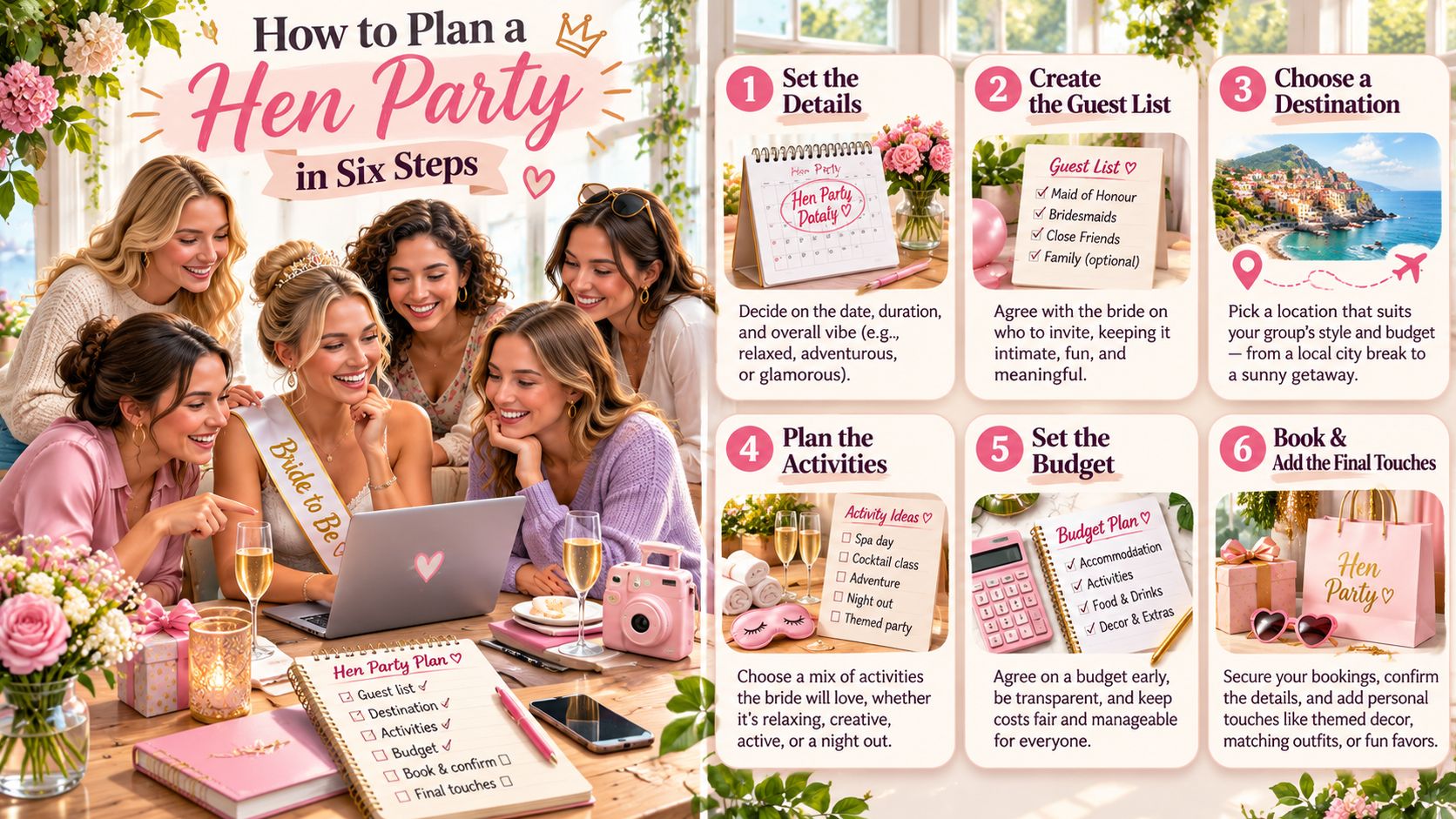
1. Confirm the bride's priorities privately. Dates she can make, activities she wants and wants to skip, her ceiling on cost. Do this before the group chat exists. A chat that opens with twelve opinions turns her preferences into one voice among many.
2. Build a realistic guest list. Industry data puts the average hen group at approximately 13 to 14 people, so plan for that rather than for the tidy group of six in your head. It changes transport, restaurant tables and, in Amsterdam, boat choice. The common slip is booking around an assumed small group and then discovering you're thirteen.
3. Collect availability, dietary, accessibility and budget answers through one anonymous survey with a deadline. Anonymity is the point. People won't state a real budget ceiling in front of the bride's sister, and they shouldn't have to explain a medical or faith reason in a group chat either.
4. Shortlist activities against those constraints, not against the loudest suggestion. Two or three options, checked against the survey answers. The slip here is accumulation: every idea gets added, and the day ends up with five stops and no time to eat.
5. Publish one written itinerary from one lead organiser, with payment deadlines and emergency contacts. One document, one owner, one deadline per task.
6. Treat the final reconfirmation as a checkpoint, 7 to 14 days before departure. Silence isn't attendance. Ask each person to confirm in writing.
The pressure points are well documented. A 2024 industry survey of 504 people who had planned or attended hen parties found 40% considered agreeing the date, location and budget difficult, 39% found incorporating everyone's suggestions stressful, and 37% found finalising the guest list and activities challenging. All three are coordination problems, not imagination problems, which is why the fix is centralised decisions rather than more ideas.
Practical rule: one organiser issues the itinerary, the group supplies requirements through a deadline-based survey, and suggestions that arrive after the deadline get a polite no.
The Amsterdam-specific controls that hang off these steps, the 18-plus requirement, valid photo ID, venue capacity and the boat-size threshold, are set out in the sections that follow. Book them into the plan rather than discovering them on the night.
Set a Budget Everyone Can Accept
Start with a ceiling the bride approves, then split every euro into core and optional before anyone books anything. Most budget arguments aren't about the total. They're about people discovering at 11pm that the taxi and the bar tab were never in the number they agreed to.
| Cost category | What it covers | Decide before booking |
|---|---|---|
| Accommodation | Rooms or apartment, deposits and cleaning fees | Who books, and whether the bride's share is paid, hosted or divided |
| Transport | Trains from Schiphol, taxis and rides between stops | Whether taxis are shared and how late-night rides are paid |
| Activities | Pub crawl, canal cruise, private crawl or concierge bookings | Which options are core and which are optional |
| Drinks | Bar tabs beyond any included drinks | Whether each guest pays their own or the group uses a pooled tab |
| Food | Dinner and snacks between stops | Whether dinner is hosted or split |
| Contingency | Late fees, replacement bookings and lost items | How much buffer to hold back |
What Each Line Item Forces You to Decide
Accommodation forces the bride question. Someone has to say out loud whether her share is covered by the group, hosted by a family member, or split like everyone else's. Deciding it in month five is a two-minute conversation. Deciding it in a bar in month six is an argument.
Transport is where hidden costs live. Trains from Schiphol are cheap and predictable, taxis at 2am are neither, and a group of thirteen needs three of them. Either agree that rides are shared and pooled, or state clearly that everyone sorts their own way back.
Activities need a core and an optional tier. One shared hosted night is the core. A daytime cruise, a long dinner or an extra bar is optional, priced separately, and skippable. The private charter costs page is worth reading before you set the per-person range, because boat pricing behaves differently from bar pricing and it's the line item groups most often guess wrong.
Say ten guests agree on a per-person figure covering the hosted night out and the shared taxi home. Dinner stays optional, and anyone who wants a second bar after the last stop pays their own way. The invite states the core figure and names the extras as opt-in. Nobody is surprised on the night, which is the only budget outcome that counts.
No one pays until they know the total they're committing to. Deposits come after the per-person number is written on the invite, never before.
Build an Itinerary Everyone Can Join
The single-format hen night, one long drinking session ending in a club, is the default assumption and the most common reason a guest spends the weekend uncomfortable. There's no rule that says the celebration has to work that way, and the groups that get it right design parallel options instead of one compulsory track.
Take a group of twelve where three guests don't drink and two can't manage a late night. The plan that works is a shared dinner at 7pm in De Pijp or the Jordaan, a clear meeting point afterwards, and an evening crawl that four people join and five skip without anyone making it a thing. The bride gets her night out. The guest who was dreading it gets a nice dinner and an early train. Both of them were at the hen party.
What the Invitation Has to Say
Write these into the invite, not the small print:
- Expected cost, as a per-person figure with the optional extras named separately.
- Start and finish times, so people can arrange transport and know what they're committing to.
- Transport, including the route back from the final stop.
- Accessibility information, meaning steps, narrow staircases and whether venues have step-free access. Amsterdam bars are old buildings and this matters more than visitors expect.
- Dress code and theme, stated plainly.
- Whether alcohol or adult-themed entertainment is involved, so nobody has to ask.
Ask people to share only what they choose, through a private form with a question like "tell us what you need" rather than a list of medical categories. Health, pregnancy, faith and sobriety information belongs to the individual. Treat adult-themed entertainment as fully optional and easy to skip without comment, and don't schedule it as the finale everyone is expected to attend.
The group chat is where this plan usually dies. Important details get buried under two hundred messages, the budget question gets asked three times and answered once, and half the group stops reading. The problems with group text messaging are predictable enough that the fix is structural: one document, one link, one deadline, and the chat for chat. If the group needs icebreakers for people who've never met, plan a couple of stag and hen party games for the dinner table rather than the bar.
If the activity list only works for the drinkers, the plan isn't finished.
Canal Cruises and Pub Crawls by Group Size
Group size decides the format before anything else does. Get this wrong and you'll be rebooking a month out.
| Group size or need | Option that fits | What to check |
|---|---|---|
| Up to 12 passengers | Pleasure craft with a skipper | Count the bride, guests and organiser; the skipper runs the boat |
| 12 or more passengers | Licensed passenger vessel with a skipper | An ordinary pleasure craft is not an option at this size |
| Mixed group comfortable with shared company | Shared pub crawl with hosted stops | Check start time, number of stops and whether any drinks are included |
| Hen group wanting its own route | Private pub crawl with a dedicated host | Confirm start time, stop count and any optional extras |
| Group wanting a private boat for longer | Private charter with a minimum guest count | Confirm minimum guests, duration and included drinks in writing |
The 12-Passenger Rule in Plain Terms
Amsterdam's boating safety rules limit a pleasure craft to 12 passengers plus a skipper, and groups of 12 or more must use a licensed passenger vessel with a skipper. Count everyone: the bride, every guest, and the organiser. A group of thirteen cannot squeeze onto a small self-operated boat, and turning up expecting to is the kind of mistake that ends a Saturday afternoon on a jetty.
The same guidance is clear that alcohol must not be consumed by whoever is operating a vessel. On a skippered cruise, navigation belongs to the skipper and the group's job is to sit down. That's the argument for a skippered cruise over a self-drive boat with a larger party: you get the canal, the group gets each other, and nobody has to stay sober enough to steer.
Pub Crawls, Shared and Private
Shared crawls suit smaller groups who are happy to mix with other travellers. You get a host, a fixed route and a start time, and you meet people from other countries in the process. Private crawls suit a single hen group that wants its own route, its own host and a start time that fits around dinner.
The trade-off is real in both directions. Shared is cheaper and more social, but the route isn't yours and the pace is set by the group. Private costs more per head and gives you control over timing and stop count, which matters when half the party wants to eat at 7pm. Longer private charters usually carry a minimum guest count, and short shared cruises often don't, so a group of nine may find the economics point one way and a group of twenty the other.
Before you pick a date, get three things in writing: the group-size limit, any minimum guest count, and what drinks are included. Verbal answers change.
Age Checks, Meeting Points and Night Safety
Amsterdam treats the 18-plus rule seriously, and a hen party with a mixed-age guest list needs to settle it before booking rather than at the door.
The Netherlands' minimum legal drinking age is 18. Alcohol may not be bought by anyone under 18, and possessing alcohol in a public place while under 18 is punishable under the Licensing and Catering Act, according to Government of the Netherlands guidance on the alcohol age limit. Public places include streets, parks, shopping centres and pubs, which covers most of a hen night's route.
Every guest should carry valid photo ID: a passport, identity card or driving licence. A photo on a phone is not ID, and a venue that refuses service has no obligation to be patient about it. Mixed-age groups should confirm an 18-plus rule across the whole party before booking anything, because venues can and do refuse service when age is uncertain, and one refused guest ends the night for everyone who stays with them.
Night-Of Arrangements That Actually Work
- One meeting point and one finish point, both shared as location pins before the group splits up.
- A participant list held by two people, not one, with emergency numbers saved offline as a screenshot rather than a bookmark.
- A buddy system agreed in pairs, so nobody is unaccounted for between stops.
- A welfare lead who is not the organiser and not expected to manage the whole party.
- A no-judgement exit rule: anyone who feels unwell leaves with their buddy, and the rest of the group carries on.
On a hosted Amsterdam pub crawl, guests meet their host at the first bar. That makes the exact address and time the single most important line on the itinerary, because a guest who can't find the start misses the whole night rather than one drink.
Agree the exit before you need it. A group that has already said "if you're done, say so and take a buddy" doesn't spend twenty minutes negotiating with someone who just wants to go home.
Confirm the Terms Before You Pay
Choose the format, get the terms in writing, then pay. In that order, every time.
The shortlist is usually one of three things: a shared pub crawl for a smaller group comfortable with mixed company, a private crawl with a dedicated host for a hen group that wants its own route and start time, or a licensed, skippered canal cruise for a larger party. Ultimate Party Amsterdam runs a Red Light District Pub Crawl and includes free cancellation up to 24 hours on pub crawl bookings, which is the kind of term worth knowing before you collect deposits from thirteen people.
Get the Terms in Writing First
A request or an enquiry is not a confirmed booking. Until availability is confirmed back to you in writing, you don't have a slot, and you shouldn't be holding anyone's money. Quotes expire, dates get taken by the group that paid first, and a screenshot of a chat isn't a reservation.
Ask four questions before any money moves:
- Who is the lead contact on the day, and how do we reach them?
- What is the final route and timing, including the start and finish points?
- What is included in the price, and what gets charged on the night?
- When is the cancellation deadline, and what happens if numbers drop after it?
Get the answers in writing, and confirm that every attendee is 18 or over and will carry valid photo ID. Keep the first deposit as small as the terms allow. Pay only once the per-person total is on the invite and the cancellation deadline is written down somewhere everyone can see it.
The deposit is the point of no return. Groups that treat it as a formality are the ones who discover a week later that the headcount changed, the terms don't allow it, and someone is out of pocket. Groups that ask the four questions first spend the same money and get a night that runs to plan.
Ultimate Party Amsterdam has been running hosted nights in the city since 2006, with pub crawls in the Red Light District every night of the week, private crawls with a dedicated host and start time of your choice, and electric canal cruises with a skipper and a bar on board. If you're organising a hen party and want one point of contact for the night itself, the team can confirm availability, route, inclusions and cancellation terms in writing before anyone pays a deposit. Take a look at the options and check your date at Ultimate Party Amsterdam.
🍻
Experience it Yourself
Make it your night — a private pub crawl with your own dedicated party host, 6 stops and 6 free shots for €30 p.p.