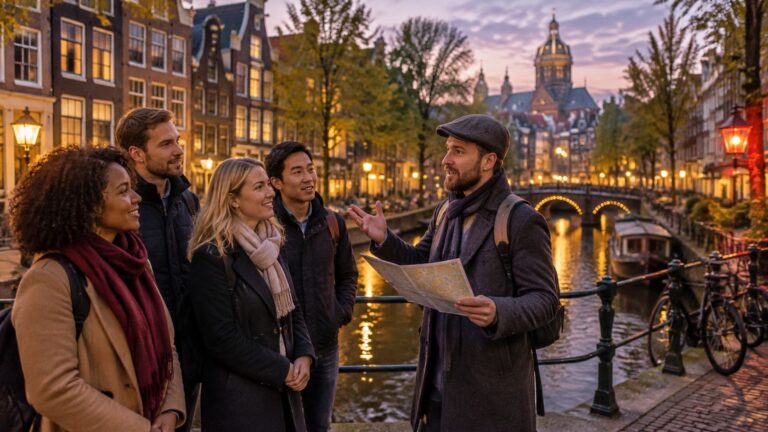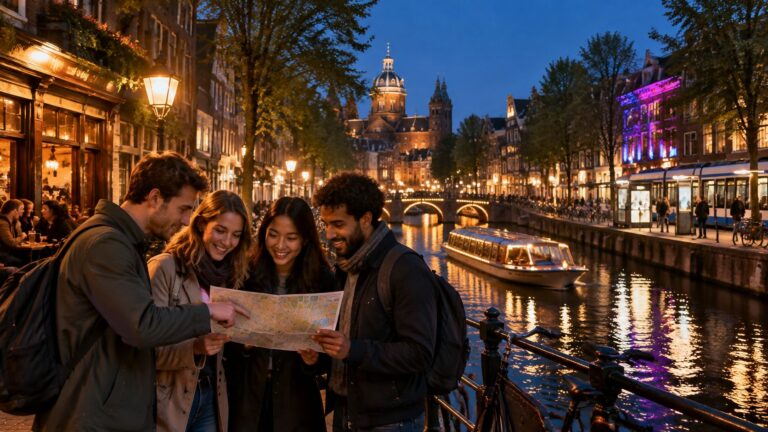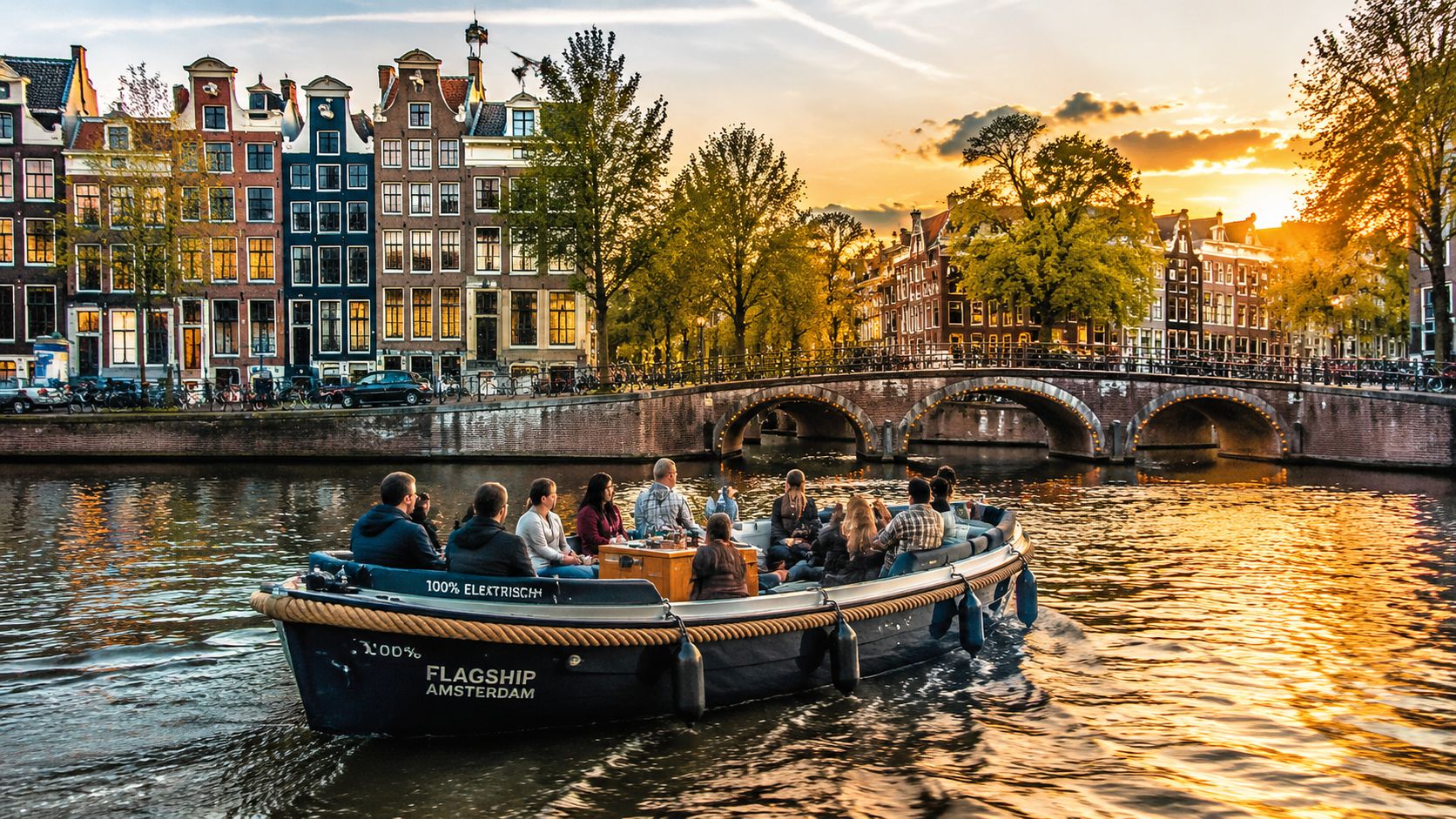
You've got one evening in Amsterdam, a group chat full of opinions, and a canal cruise tab open beside dinner reservations and nightlife plans. The choice looks simple until the practical questions appear. Should the group book a quiet sightseeing loop, a hosted booze cruise, or a private boat? Will the vessel enter the historic center, and what happens if the weather changes?
An Amsterdam boat tour can be a sightseeing activity, a floating dinner, or the first social event of a night out. The right format depends on the group, the noise level, the time available, and whether the boat is shared or reserved exclusively. Amsterdam's zero-emission rules also matter more than many visitors realize, because propulsion now affects which vessels can legally operate in the central canals.
Table of Contents
- What an Amsterdam Boat Tour Actually Looks Like
- How the Amsterdam Canal System Shapes Every Tour
- Main Amsterdam Boat Tour Types Compared
- Shared and Private Booze Cruises on the Canals
- Which Amsterdam Boat Tour Fits Your Group
- Electric Boats and the 2025 Zero-Emission Canal Zone
- Booking Tips and Common Mistakes to Avoid
- Choosing Your Amsterdam Boat Tour and Next Steps
What an Amsterdam Boat Tour Actually Looks Like
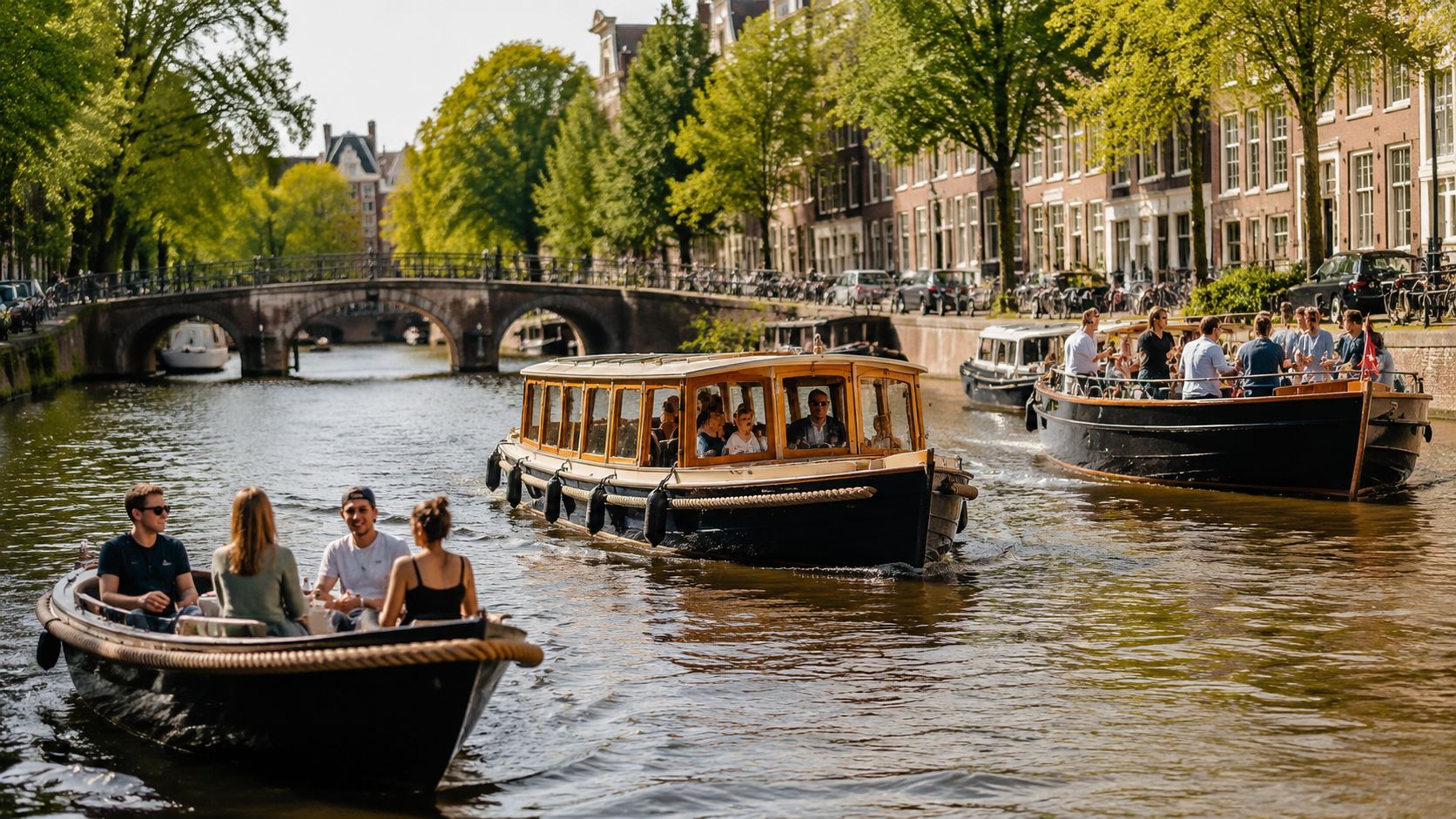
At golden hour, the canal changes character. Low light slides across the façades along Herengracht, bicycles rattle over bridges, and the boat moves slowly enough for passengers to notice details that disappear from street level. On a compact open saloon boat, the captain's commentary competes with conversation while glasses clink at the rear and houseboats pass close to the rail.
That atmosphere varies sharply by format. A classic sightseeing cruise usually keeps attention on the architecture and route. A candlelit dinner cruise turns the water into a moving restaurant, while a shared open-bar booze cruise feels more like a floating pub, with a host managing the energy between drinks and viewpoints. Private charters give a group more control, and themed party boats place the social experience ahead of detailed narration.
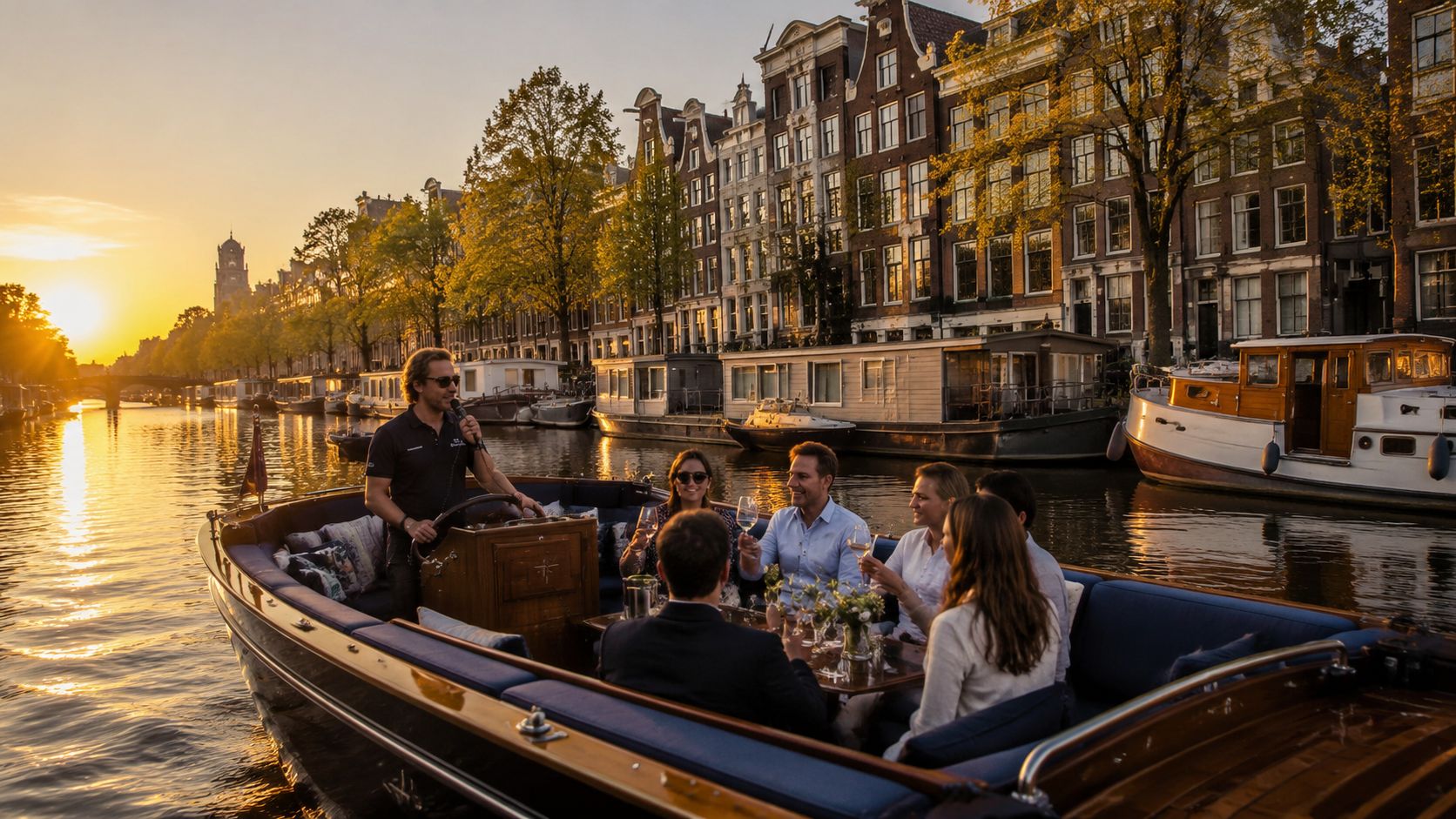
The same canals, different evening
A short sightseeing loop feels structured and efficient. Passengers look outward, take photographs, and listen for landmarks. A longer dinner cruise slows the pace further, because seating, serving, and clearing food become part of the experience. The boat becomes less of a viewing platform and more of a venue.
A shared booze cruise sits between those two moods. It has enough sightseeing to make the route feel distinctly Amsterdam, but the main appeal is the shared table, flowing conversation, and hosted group dynamic. Operators planning food-led experiences can also find useful guidance through resources such as sell tickets for culinary events, particularly when the event depends on timed boarding and coordinated service.
The five formats visitors will encounter most often are:
- Classic sightseeing cruises, suited to first-time visitors and short stays.
- Candlelit dinner cruises, designed around an evening meal and a slower pace.
- Shared open-bar booze cruises, useful for solo travelers and mixed groups that want an easy social setting.
- Private charters, preferred when a group needs exclusive use of the boat.
- Themed party boats, where music, drinks, and group energy take priority over quiet sightseeing.
The canal is never just background scenery. The route, vessel size, lighting, seating, and host all determine what the night feels like.
How the Amsterdam Canal System Shapes Every Tour
Amsterdam's canals work as a transport environment, a historic district, and a nightlife setting at the same time. The three principal canals, Herengracht, Keizersgracht, and Prinsengracht, were dug during the Dutch Golden Age, and the planned canal ring was recognized by UNESCO in August 2010 as the Seventeenth-Century Canal Ring Area of Amsterdam inside the Singelgracht. The layout was developed as part of a planned port city at the end of the 16th and beginning of the 17th centuries, which is why the waterways still feel ordered rather than accidental. The history and scale of Amsterdam's canals are documented here.
The network extends for more than 100 kilometres, includes around 90 islands, and has about 1,500 bridges, according to the same reference. Another Amsterdam canal overview describes 165 canals with a combined length of 100 kilometres and notes more than 1,000 bridges, illustrating the scale of the waterways from different counting methods. Dutch Amsterdam provides a separate overview of the canal network.
Why boats stay low and move slowly
A canal boat can't be designed like a broad river cruiser. Historic bridges, narrow bends, moored boats, and low clearances reward a vessel with a shallow profile and controlled speed. That geometry explains why Amsterdam tours often feel intimate, even when the route passes through busy parts of the center.
The canal belt also shapes where visitors board. Central Station and the Jordaan sit close to major routes, making them practical starting areas, while other departures cluster around central nightlife districts. A visitor staying near a hotel in the Jordaan may be close to the water but still need to allow walking time to a specific pier.
The route controls the mood
A boat doesn't travel in a straight line from one attraction to another. Bridges, traffic patterns, local restrictions, and the captain's permitted route influence the loop. Sightseeing operators may prioritize architectural landmarks, while a nightlife cruise needs a route that supports conversation, serving drinks, and a reliable return to the evening itinerary.
That's why a “one-hour cruise” isn't only a time estimate. It reflects the vessel's speed, the route available, boarding procedures, and the need to return to the same general area. Visitors should check the exact meeting point rather than assuming every central canal departure leaves from the same pier.
Practical rule: Choose the boarding location as carefully as the boat type. A cruise that ends near the next planned activity is easier to enjoy than one that creates a rushed cross-city walk.
Main Amsterdam Boat Tour Types Compared
The cheapest-looking boat isn't always the best value, and the most elaborate option can be wrong for a group that mainly wants to talk. Tour types differ in how much attention they demand, how much control passengers have, and whether the boat functions as transport, dining space, or nightlife venue.
The table below uses qualitative price tiers rather than invented booking prices. Exact rates, inclusions, capacity, and schedules vary by operator and date, so travelers should verify those details before paying.
Amsterdam Boat Tour Types at a Glance
| Tour Type | Duration | Price per Person | Group Size | Atmosphere | Best For |
|---|---|---|---|---|---|
| Classic sightseeing cruise | Short loop, often around an hour | Lower tier | Shared group | Narration, landmarks, quieter conversation | First-time visitors and limited itineraries |
| Candlelit dinner cruise | Extended evening experience | Upper tier | Shared dining group | Seated meal, gentle pace, occasion-focused | Couples and travelers marking an event |
| Shared booze cruise | Short hosted cruise | Mid-range tier | Shared social group | Open-bar setting, conversation, hosted energy | Solo travelers, friends, and mixed groups |
| Private charter | Flexible scheduled cruise | Highest tier, paid for exclusive hire | Group determined by vessel | Private music, drinks, and route preferences | Celebrations, corporate teams, and families |
| Themed party boat | Short to extended event | Mid to upper tier | Shared or event-specific group | Music-led, lively, less focused on commentary | Stag and hen groups and party-focused travelers |
Match the format to the night
A classic cruise works when the canal itself is the priority. It gives first-time visitors a broad visual introduction without committing the whole evening to a meal or party. A dinner cruise asks for more planning, because the group needs to arrive on time and accept a fixed dining rhythm.
A shared booze cruise works differently. The group doesn't need to create its own entertainment, because the host, drinks service, and shared seating provide a social framework. That can help solo travelers and smaller friend groups, but it won't offer the privacy or control of a charter.
Private boats make sense when the group has a clear reason to control the experience. A birthday group may want its own music and conversation, while a corporate team may need a calmer setting and organized catering. The trade-off is cost, because exclusive use generally requires the group to carry the boat hire rather than paying only for individual seats.
Party boats suit groups that want the canal to support a night out rather than replace it. They can be lively, but passengers looking for detailed historical commentary or quiet photographs may find the atmosphere too active.
Shared and Private Booze Cruises on the Canals
A hosted booze cruise begins before the boat leaves the pier. The group checks in, boards with other passengers or a private party, settles into the available seating, and receives the drinks arrangement from the host. Once underway, the route supplies the scenery, but the host determines whether the experience feels organized, awkward, relaxed, or social.
A shared departure is usually built around a short loop. Guests don't control every turn or stop, and they shouldn't expect a private event just because drinks are included. The advantage is lower commitment and an immediate social setting. The disadvantage is that the group shares the atmosphere, volume, and seating arrangement with people it hasn't chosen.
A private charter changes the operating logic. The group hires the boat, so music, conversation, serving pace, and sometimes route preferences can be coordinated around the occasion. It still has to follow canal regulations and the captain's route, but the passengers aren't negotiating the evening with strangers.
Shared versus private booze cruise, what passengers actually get
| Feature | Shared Booze Cruise | Private Booze Cruise |
|---|---|---|
| Booking model | Individual seats on a shared departure | Exclusive boat hire for one group |
| Social setting | Mixed passengers and hosted interaction | Private conversation and group control |
| Drinks | Confirm the exact bar and serving policy before booking | Confirm the exact bar and serving policy before booking |
| Route | Operator-led loop | Operator and captain determine the permitted route |
| Best use | Solo travelers, smaller friend groups, and flexible plans | Birthdays, stag and hen groups, and corporate gatherings |
| Main trade-off | Less control over atmosphere | Higher total commitment for the group |
An open Dutch bar commonly refers to beer, wine, and soft drinks, with basic spirits or sparkling wine included on some services. It doesn't automatically mean every premium drink is available, and the phrase can cover different service methods. Travelers should check whether drinks are poured by a host, served from a self-service station, or limited to specified categories.
The shared and private booze cruise options from Ultimate Party Amsterdam illustrate the two planning paths. The shared booze cruise is designed around a hosted group setting, while a private option is more appropriate when the entire boat needs to belong to one celebration.
Timing and boarding matter
Central Station, Leidseplein, and Rembrandtplein are natural reference points for nightlife planning, but the exact pier still matters. A group leaving a hotel near one district can lose the benefit of a short cruise if members arrive separately and search for the boat at the last minute.
Photo opportunities around well-known bridges can be enjoyable, but passengers shouldn't expect the captain to stop wherever the group requests. Canal traffic and route rules control the pace. The practical choice is simple: select shared boarding when flexibility and social contact matter more than control, and choose a private boat when the group's identity and schedule are the main event.
Which Amsterdam Boat Tour Fits Your Group
The right tour depends less on age or occasion than on group size, desired noise level, and control over the evening. A solo traveler who wants conversation has different needs from a couple celebrating, even if both are searching for an Amsterdam boat tour.
Solo travelers and first-time visitors
Solo backpackers often benefit from a low-commitment shared format. A sightseeing cruise gives a clear introduction to the city, while a shared booze cruise adds a hosted social setting without requiring the traveler to organize a group. A central departure near the main station area can also simplify arrival after a day of museums or walking.
First-time visitors with limited time should prioritize route clarity and boarding convenience. A short sightseeing loop is usually easier to fit around fixed attraction reservations than a meal-led cruise.
Couples and smaller friend groups
Couples generally need to decide whether the evening is about intimacy or activity. Dinner cruises and smaller electric boats can create a calmer mood, while a shared open-bar departure suits couples who want to meet other travelers. A private charter offers more control, but the total hire cost needs to make sense for the group rather than only the couple.
Friend groups in the 6 to 12 person range can compare a shared departure with a private quote, but no assumption should be made about capacity or per-person value without checking the current vessel and booking terms. Noise rises with an open social deck, while privacy improves when the group controls the boat.
Celebrations and organized groups
Stag and hen groups often need a private setting, especially when the group wants to play its own music, manage drinks, or keep the party together. A shared cruise can work for a mixed group seeking a social hour, but the event's tone will depend partly on other passengers.
Groups planning a bachelorette weekend should coordinate the cruise with dinner, nightlife, and walking routes rather than treating each booking as a separate task. This Amsterdam bachelorette planning guide can help structure the wider itinerary.
Corporate and family groups usually place more weight on seating, communication, catering, and predictable timing. A private charter can support those needs, but the organizer should ask about accessibility, toilets, weather cover, and boarding conditions before confirming. The more varied the group, the more important those practical details become.
Electric Boats and the 2025 Zero-Emission Canal Zone
The central canals now have a compliance issue that travelers can't see from a booking photo. From 1 April 2025, only electric, hydrogen, or manually propelled vessels are allowed inside the emission-free area, which covers the center within and including Singelgracht, subject to route exclusions. Amsterdam's official explanation of the zero-emission canals makes clear that propulsion is a legal entry condition, not merely a marketing feature.
The city also states that passenger vessels must be emission-free on Amsterdam's inland waterways by 2025, with enforcement beginning through warnings and fines following the initial period. Some existing petrol and diesel boats with multi-year permits have temporary exemptions until 2030, as reported in coverage of Amsterdam's new emission-free zone.
Zero-Emission Canal Zone, what changed for boat tours
| Aspect | Before 2025 | From 2025 |
|---|---|---|
| Central-zone propulsion | Combustion vessels could operate under applicable permits | Electric, hydrogen, or manually propelled vessels are permitted, subject to exclusions |
| Hybrid boats | Could use combustion systems under previous conditions | Must operate in zero-emission mode inside the zone |
| Booking question | Focused mainly on route, time, and inclusions | Also requires confirmation of compliant propulsion |
| Onboard atmosphere | Engine noise and fumes varied by boat | Electric craft can offer a quieter, cleaner-feeling ride |
| Operator planning | Fleet choice was primarily commercial | Charging, battery management, and compliance affect scheduling |
Electric propulsion can improve the experience. Passengers may hear the guide more clearly, and covered boats avoid the diesel smell associated with combustion engines. Smaller low-noise craft can also feel better suited to narrow waterways, although vessel design still determines seating, toilets, accessibility, and weather protection.
The transition creates trade-offs. Battery capacity, charging windows, and route planning influence availability, particularly during busy evening periods. Hybrid boats may remain part of the market, but compliance depends on zero-emission operation in the regulated area. Travelers booking a central sightseeing or booze cruise should ask a direct question: Does this boat enter the zero-emission zone, and is it compliant for the full route?
A technical licensing briefing also describes a strong economic incentive for electric craft. It states that petrol or diesel boats average about €60 per square metre per year, while electric boats of the same size pay about 0.3 times that amount, implying roughly a 67% annual fee discount for electric propulsion. The technical briefing also discusses Amsterdam boat dimensions and licensing.
Booking Tips and Common Mistakes to Avoid
A smooth Amsterdam boat tour starts with the booking details, not the postcard image. Travelers should compare the departure point, vessel type, drinks or meal inclusions, cancellation terms, weather cover, and whether the cruise is shared or private. Direct operator websites, accommodation staff, and established activity marketplaces can all be useful, but the final terms should come from the actual booking page.
Peak travel periods from April through September require earlier planning than quiet weekdays. Exact availability changes by operator, boat, and date, so no universal advance-booking window applies. Cancellation policies also vary, although some services use a 24 to 48-hour window for a full refund. Treat that as a term to verify, not a guaranteed industry standard.
People comparing reservation systems and tour operations may find a 2026 tour booking platform review useful for understanding how booking tools handle schedules, customer communication, and changes.
Build the evening around the pier
Boarding areas near Central Station, Leidseplein, and Damrak can look close on a map while taking longer on foot with luggage, bicycles, or a distracted group. Hotels in the Jordaan may be near the canals but not near the assigned departure point, so the organizer should share a meeting location and arrival buffer with every passenger.
Weather affects comfort more than legality. Light rain may be manageable on a covered vessel, while an open boat can become unpleasant quickly. Travelers should check whether the boat has an enclosed section, whether umbrellas are practical onboard, and what happens if the operator changes the vessel.
Common planning mistakes include:
- Booking conflicts: Don't place the cruise immediately against a fixed museum or brewery reservation.
- Wrong event type: A shared booze cruise isn't a private party, even when the drinks are included.
- Late-night assumptions: Dinner cruises may finish earlier than a nightlife group expects.
- Walking gaps: Allow time between the hotel, the pier, dinner, and the next venue.
- Dress mismatch: Comfortable layers and shoes work better than clothing chosen only for photographs.
- Host etiquette: Tipping a hosted guide or drinks attendant is optional, but a genuine thank-you is appropriate when service has been attentive.
Before booking any nightlife activity, travelers can also review practical guidance on whether Amsterdam is safe, especially when coordinating a group returning from a central pier after dark.
Choosing Your Amsterdam Boat Tour and Next Steps
The decision can be reduced to four signals. First-time visitors with limited daylight should choose a sightseeing cruise that fits cleanly into the itinerary. Couples marking an occasion may prefer dinner or a quieter private format. Solo travelers and mixed groups that want an easy social hour can choose a shared booze cruise, while celebrations and corporate groups needing privacy should investigate an exclusive charter.
The budget question isn't only the ticket amount. Shared tours charge by passenger and reduce organizational work, while private charters give control but make the group responsible for the full booking commitment. Meal cruises add structure and service, while booze cruises leave more room for conversation and a later nightlife plan.
Before paying, identify the format, shortlist two or three operators with recent reviews, and compare inclusions line by line. Confirm the boat's zero-emission compliance, check the exact pier, ask about toilets and accessibility, and choose the earliest evening departure that fits the rest of the itinerary. A backup indoor plan also helps when weather makes an open boat less comfortable.
For a practical next step, travelers can review the Amsterdam nightlife and canal cruise options from Ultimate Party Amsterdam, then match the shared or private format to the group's schedule and social energy. A clear choice made early usually leaves more time to enjoy the canals rather than solve logistics on the night.
Ultimate Party Amsterdam offers guided pub crawls, shared booze cruises on electric boats with unlimited beer, wine, and soft drinks, and private canal charters with an open Dutch bar. Visit Ultimate Party Amsterdam to compare the available nightlife and boat-tour formats and plan the canal experience around the rest of the group's Amsterdam itinerary.
🍻
Experience it Yourself
Skip the planning — join Amsterdam's biggest pub crawl and get 6 bars, free drinks and VIP club entry for €20.