The usual advice to choose an Amsterdam Rhine river cruise by its prettiest itinerary misses the most important booking question: what happens if the ship can't sail that itinerary? Before paying a deposit, travelers need to establish whether they want a multi-day river journey or an evening on Amsterdam's canals, then examine the route, total cost and disruption terms.
Those are different holidays, not different versions of the same boat trip. For groups combining sightseeing with Amsterdam nightlife, getting that distinction right prevents an expensive mismatch between the booking and the celebration.
Table of Contents
- Where Amsterdam Rhine Cruises Go
- Amsterdam Canal Cruises Are a Different Trip
- Shared, Private and Full Versus Short Trips
- What Rhine Cruises From Amsterdam Cost
- Low Water and Itinerary Changes to Plan For
- Choose Your Amsterdam Plan Before You Book
Where Amsterdam Rhine Cruises Go
Amsterdam is the gateway to the Rhine, reached through connected Dutch waterways. Ships begin or end their journeys in the Dutch capital, then travel through canals and rivers to join the main river corridor. The Rhine route guide identifies Cologne, Koblenz, Rüdesheim, Strasbourg and Basel as common calls, while making clear that the precise sequence follows the individual itinerary.
Expect a Dutch-waterways opening rather than immediate castle scenery. The Amsterdam-Rhine Canal provides an engineered connection to the wider network, though a departure labeled Amsterdam doesn't establish every waterway segment the ship will use.
Read the route as a sequence of experiences
The familiar southbound pattern connects Amsterdam with Cologne, Koblenz, the Rhine Gorge, Rüdesheim, Strasbourg and Basel. Some programs substitute Heidelberg, Speyer or Breisach for other sightseeing stops. A destination name can also describe an excursion rather than the berth where the ship docks, so read the port list alongside the shore program.
Typical Amsterdam Rhine route patterns
| Route pattern | Typical length | Key ports |
|---|---|---|
| Classic Amsterdam to Basel | 7 nights | Amsterdam, Cologne, Koblenz, Rhine Gorge, Rüdesheim, Strasbourg, Basel |
| Amsterdam to Basel with substituted ports | 7 nights | Heidelberg, Speyer or Breisach in place of some stops |
| Shorter Rhine program | 4 to 6 nights | Selected ports within the advertised river section, not necessarily both Amsterdam and Basel |
| Longer Rhine program | 8 to 9 nights | The published core route plus additional calls or longer stays |
These are comparison patterns, and departures vary within them. A shorter program won't necessarily contain the full classic route compressed into fewer days. A longer one doesn't automatically mean more Rhine Gorge sailing. Ask which stretch of the river each itinerary covers and how much of the sailing happens by day.
Infrastructure descriptions need the same care. The Amsterdam-Rhine Canal overview describes an approximately 72-kilometre waterway with four locks, while the navigation information page lists approximately 82.7 kilometres and two locks. Conflicting descriptions like these are reason to request the specific waterway segments and lock transits for the booked voyage, rather than treating a generic canal measurement as an itinerary specification.
Check the boarding location before arranging flights
An Amsterdam embarkation label isn't a transfer plan. Get the exact berth, boarding window and final boarding deadline, then work out the journey from Amsterdam Centraal or Schiphol with luggage.
For international arrivals, book a buffer night instead of depending on a same-day flight connection. If arrival and embarkation must share a day, have the operator explain the procedure for a delayed passenger before the flight is purchased.
Finish the route review with three practical checks:
- Match the destinations. Confirm that the places motivating the booking appear in the program itself, not just its promotional photographs.
- Count accommodation nights. Align the ship's embarkation and disembarkation dates with flights and any Amsterdam hotel stay.
- Clarify the status of port calls. Establish which stops are scheduled commitments and which are indicative, subject to operational changes.
Amsterdam Canal Cruises Are a Different Trip
Many travelers searching for an Amsterdam Rhine river cruise want a short boat trip through the city. A canal cruise is an Amsterdam experience; a Rhine cruise is a traveling holiday. Booking the former won't provide a cabin, an international itinerary or transport to the Rhine Gorge.
The city's waterways also operate under their own boating rules. The City of Amsterdam's safe-boating guidance sets a normal maximum speed of 6 kilometres per hour, with 7.5 kilometres per hour permitted on specified stretches including the Amstel, Oosterdok, Nieuwe Herengracht and Kostverlorenvaart; it also states that pleasure craft may carry no more than 12 passengers plus a skipper, while groups of 12 or more require a licensed passenger vessel with a skipper.
Amsterdam canal cruise versus Rhine river cruise
| Feature | Amsterdam canal cruise | Rhine river cruise |
|---|---|---|
| Route | Central Amsterdam canals | Selected sections of the river, often from Amsterdam to Basel |
| Typical length | A short evening trip | Commonly 4 to 9 nights |
| Passenger rules | Pleasure craft carry up to 12 passengers plus a skipper; licensed passenger vessels have their own approved capacity | The ship's certified passenger capacity and applicable navigation rules |
| Speed rules | 6 km/h normal, 7.5 km/h on specified stretches | Limits and operational instructions for each waterway segment |
A quick test for the right booking
A port list and overnight cabin schedule point to a river cruise. Departure from and return to central Amsterdam during the same evening point to a canal trip. Anyone choosing the river journey needs to build Amsterdam arrival and departure arrangements around the ship, rather than treating embarkation like a flexible sightseeing activity.
Neither replaces the other. An urban canal boat won't deliver the Rhine Gorge experience, and a large river ship can't tour Amsterdam's narrow central canals.
Planning rule: A boat trip chosen for an Amsterdam night out should fit the evening's meeting points and dinner plans, not an international port schedule.
For a social evening, a shared Amsterdam canal cruise belongs in the city-break category. It can fit before dinner or a later night out, provided the group checks the actual departure point and allows time to reach the next booking.
That distinction matters for celebrations. Friends looking for conversation, drinks and city views shouldn't commit to a river holiday merely because both products appear under cruise searches.
Shared, Private and Full Versus Short Trips
Two decisions shape a Rhine booking before price ever enters the discussion. The first is whether to join a published sailing or arrange a charter for a group. The second is how much of the holiday should follow the ship's schedule. Treat them separately, because they solve different problems.
A shared river ship suits solo travelers and couples who want organized sightseeing and meals without coordinating every stop themselves. Meals and excursions may form part of the package, so the written inclusion list has to establish exactly what is covered. A published schedule also means passengers give up control over departure times and the onboard rhythm.
The Rhine itinerary press kit describes a river approximately 1,233 kilometres long and programs commonly ranging from four to nine nights, each covering selected sections rather than the entire river. A word like Rhine tells you the river, not which towns you will see.
Compare control with convenience
A private or small-group charter gives a group more influence over timing, ports and onboard pace, subject to the vessel and navigation conditions. It generally requires more planning and can mean a higher per-person commitment. A small-group booking on a shared departure keeps the vessel and schedule in the operator's hands, so a group that wants real control needs a charter contract, not extra cabins on an existing sailing.
Shared and private Rhine options compared
| Option | Best for | Trade-off |
|---|---|---|
| Shared river ship | Solo travelers and couples seeking a published package with sightseeing and meals included | Less control over route, timing and onboard pace |
| Private or small-group charter | Groups wanting their own cabins and negotiated port calls | Higher per-person cost, more control |
| Short river program, 4 to 6 nights | Travelers with a limited time window | Fewer ports; squeezing it into an unchanged holiday can also reduce Amsterdam time |
Before committing group money, the organizer should obtain the vessel size, cabin inventory and proposed route. Flexible port calls should be described as negotiated possibilities, never unrestricted freedom.
A useful group checklist goes beyond the headline passenger count:
- Cabin allocation. Establish which cabins are included, how occupancy works and who pays if someone withdraws.
- Shared meals. Confirm whether friends can sit together rather than assuming a group booking creates a reserved dining area.
- Celebration suitability. Disclose a stag or hen party before paying, and confirm the onboard atmosphere and conduct expectations.
- Booking scope. Identify whether the contract covers the entire vessel, selected cabins or places on a shared sailing.
A private Amsterdam canal charter serves a different purpose entirely. It is a 60-minute private electric boat for one group, with an open Dutch bar of unlimited beer, wine and soda, and it belongs to an Amsterdam evening rather than a river itinerary. Choose it when the group's priority is time together in the city rather than successive overnight destinations.
Choose the trip length around the reason for traveling
A full Amsterdam-to-Basel journey gives more room for a sequence of ports. A shorter sailing preserves more independent Amsterdam time only if the total holiday length stays the same. Cutting the entire holiday creates no extra city time at all.
The decisive trade-offs: scenery against rerouting risk, a fixed schedule against an Amsterdam stay that can change day by day, ship-based sightseeing against land trips to selected towns. A train or coach visit can deliver time in a destination without delivering the experience of sailing there.
Pick the full Rhine cruise when the Gorge is the main attraction, flights have flexibility and a replacement coach transfer would be acceptable. Pick a shorter Netherlands or Belgium program when onward travel is fixed or predictable days matter more than the classic river scenery. No sailing is disruption-proof, so plan on that basis.
If the cruise changed in the final week, would the remaining holiday still justify the cost?
A clear yes is a better foundation for booking than enthusiasm for an itinerary that must remain untouched.
What Rhine Cruises From Amsterdam Cost
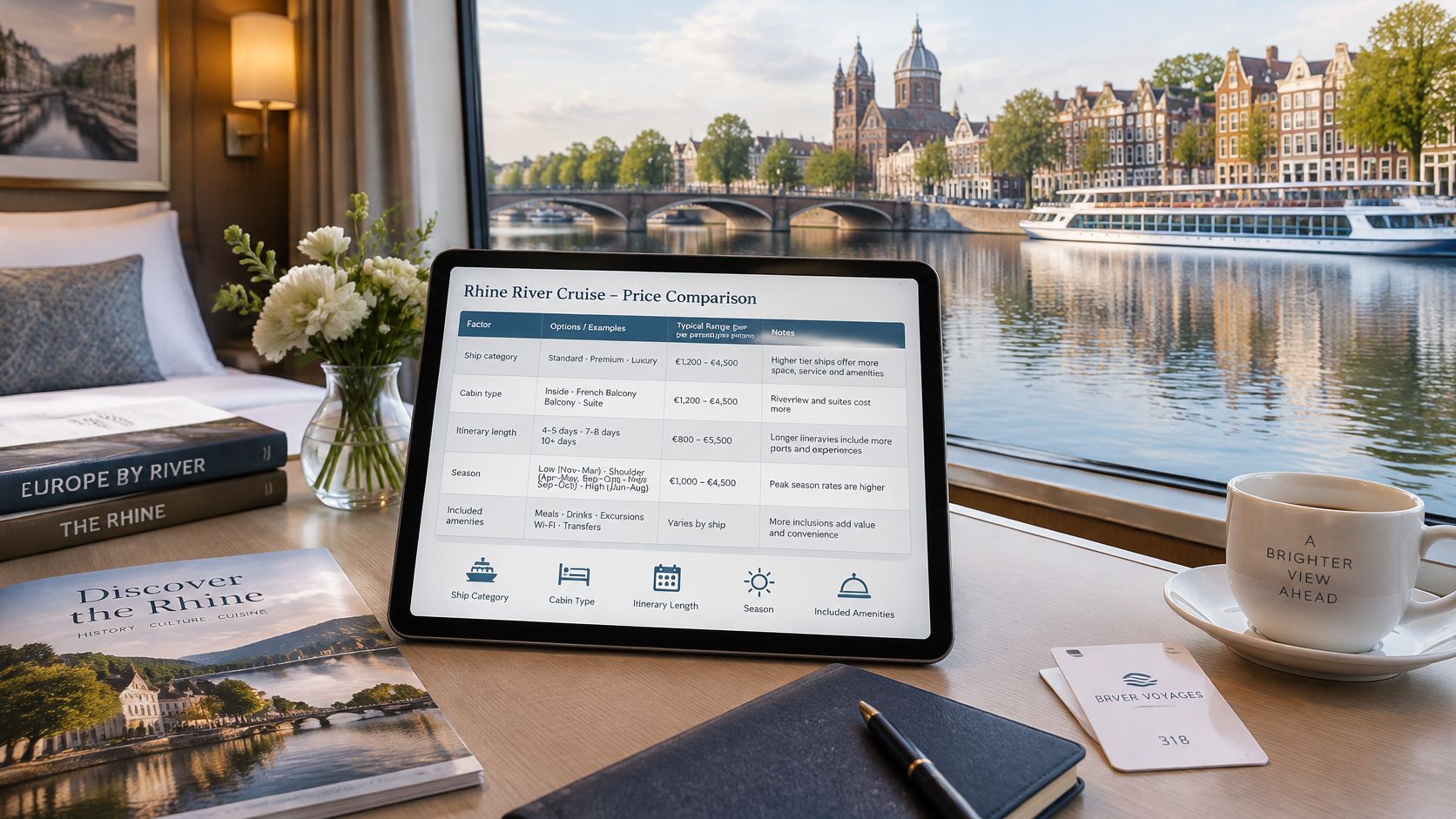
Compare the total cost per night and the inclusions, not the headline fare. There's no single reliable price for an Amsterdam Rhine river cruise: ship category, cabin type, season, duration and package contents all affect the quotation. An apparently cheaper departure can become the more expensive holiday after transfers, excursions and accommodation are added.
The Rhine itinerary planning guide identifies approximately seven nights as the classic Amsterdam-to-Basel benchmark. That's a useful basis for comparing like-for-like offers, not a reason to assume every package includes the same experience.
Build a complete quotation comparison
A comparison sheet should separate the cruise fare from the cost of reaching it. Each offer needs the same currency, occupancy basis and cabin assumptions before the arithmetic becomes useful.
- Calculate the nightly figure. Divide the quoted total by the number of nights, and label whether that total covers a person or a cabin. A per-cabin quote shouldn't sit beside a per-person quote without adjustment.
- List the inclusions. Record meals, drinks, excursions, transfers and any service charges separately. A named excursion in a brochure isn't proof that it's included.
- Add the surrounding holiday. Include flights, airport transfers and Amsterdam accommodation before or after sailing. Add the cost of luggage storage or independent transport if the flight and boarding arrangements leave a gap.
- Resolve taxes and port charges. Obtain written confirmation of whether they're included, payable later or excluded from the advertised fare.
Avoid paying for an assumption
Comparing a full classic journey with a short sailing purely by total price hides the difference in accommodation and sightseeing. Forgetting the transfer from the final port to the airport can distort the budget just as much. A ticket for an Amsterdam canal trip covers neither of those river-cruise arrangements.
For groups, the organizer should also establish deposit deadlines, final-payment dates and the consequences of a passenger cancellation. A friend dropping out can affect cabin occupancy and the remaining travelers' costs, so that question belongs before money changes hands.
Popular departure dates can fill early, but availability pressure isn't a reason to skip cancellation and rebooking terms. A discount has little value if the group can't accept the conditions attached to a revised sailing.
Deposit test: The departure date, scheduled ports, nights, inclusions and applicable change terms should all be identifiable in the written booking documents.
The sensible booking is the one whose full cost and contractual limits are understood, not the one with the smallest advertised number.
Low Water and Itinerary Changes to Plan For
Low water at Kaub in the Middle Rhine can force a change of ship or a coach transfer around an affected stretch. A published gauge reading isn't the actual channel depth, and travelers shouldn't use a single reading to decide whether their particular vessel can sail. That decision requires the operator's assessment of the ship and route.
Travel trade reporting on river-cruise disruption identifies Kaub as a critical bottleneck and describes adjusted sailings, future-cruise credits, later departures and cancellation credits, with changes sometimes confirmed only days or weeks before departure. None of those outcomes establishes an automatic entitlement for another booking.
Low-water scenarios, what changes and what to check
| Scenario | What may change | What to check |
|---|---|---|
| Low water at Kaub | Ship swap, coach transfer or reversed route | Written disruption policy and notice period |
| Cancellation before departure | Credit, rebooking or later departure | Refund and credit terms in the booking |
| Amsterdam embarkation affected | Extra hotel nights or changed arrival time | Flight change terms and hotel cover for the first night |
| Late confirmation of changes | Plans altered days or weeks ahead | When the operator will notify passengers |
Prepare before a disruption becomes urgent
The booking policy should explain more than the operator's right to change the route. Passengers need to understand the practical replacement, the notification process and the options if the revised trip no longer meets their needs.
- Read the written disruption policy before booking. Identify how the contract treats missed ports, land transport, replacement accommodation and cancellation.
- Establish the decision timetable. Ask when route reviews happen, how passengers receive updates and which contact remains available during travel.
- Check official gauges for the departure week. Use the relevant waterway authority's readings as context, then obtain the operator's interpretation for the booked vessel. Gauge height alone isn't a passenger cancellation threshold.
- Protect connecting travel. Choose flexible or refundable flights where appropriate, or leave a buffer day. Check the actual conditions rather than assuming a ticket described as flexible permits every change without cost.
- Keep the paper trail. Save confirmations, disruption notices, revised itineraries and receipts together.
Test the replacement against the onward journey
Consider a traveler due to fly home from Basel who learns that the final sailing segment will become a coach transfer. The immediate question isn't whether the coach reaches Basel eventually. It's whether the revised arrival, luggage collection and airport journey still allow the traveler to catch the booked flight.
The traveler should request the proposed timing and rebooking options in writing before accepting the change. Compensation, credits and refunds follow the booking's terms and applicable rights, not a universal river-cruise policy.
Before paying, every passenger needs clear answers to these questions: What happens if the river is low? Who covers an onward flight if the route changes? An unclear answer is a reason to pause the deposit.
Choose Your Amsterdam Plan Before You Book
The right order is experience first, itinerary second, contract third, transport last. Starting with flights and then trying to fit a river departure around them leaves less room to fix an unsuitable route or a restrictive change policy.
A final booking check should follow that order:
- Confirm the experience. Identify whether the booking is a river holiday or an Amsterdam canal night.
- Approve the schedule. Match ports and accommodation nights to the group's priorities.
- Accept the conditions. Save cancellation, rebooking and low-water terms before paying.
- Connect the transport. Check flights, transfers and boarding arrangements against the written schedule.
Keep the Amsterdam evening separate
Ultimate Party Amsterdam is based in Amsterdam, The Netherlands, and has offered Pub Crawls and Booze Cruises since 2006. Its Party on the Water shared booze cruise costs €33.05 per person, covering an hour on the water with unlimited drinks for solo travelers, couples and groups. Travelers planning city activities around embarkation can use the Amsterdam day-to-night planning guide to think through the time available without overloading arrival day.
Current listings, dates, meeting points and inclusions still need checking before payment. A late-arriving ship or a rushed airport transfer is a poor foundation for a tightly timed evening reservation.
For travelers juggling separate flight and hotel bookings, MyAirlinesTrip offers a resource for help managing existing travel reservations. Any assistance should be checked against the actual ticket conditions and the cruise operator's revised schedule.
The final action is practical: save the route, nights, cancellation terms and disruption policy alongside the confirmation, then compare Amsterdam arrival and departure times with the river schedule. Run that check first, then book.
Ultimate Party Amsterdam offers pub crawls and canal booze cruises for the Amsterdam part of a holiday, separate from any Rhine sailing. Travelers adding a social evening before or after their river journey can visit Ultimate Party Amsterdam to check current experiences, departure details and inclusions before booking.
🍻
Experience it Yourself
Skip the planning — join Amsterdam's biggest pub crawl and get 6 bars, free drinks and VIP club entry for €20.