Twelve friends land at Schiphol at 18:00, drop bags in three different Airbnbs, and open WhatsApp to find twelve opinions about where to drink first. One person wants the Red Light District, another has saved cafés in De Pijp, and nobody knows whether the whole group can sit together. That's the moment when a list of “best bars in Amsterdam” becomes less useful than a workable night plan.
Amsterdam can be excellent for groups, but the right answer usually isn't a single address. The city's nightlife is divided by canals, tram routes, district rules, venue capacity, and changing crowd patterns. The practical question is which format fits the group, then which neighbourhood and venues support it.
Table of Contents
- Why Amsterdam Needs a Different Approach for Groups
- Amsterdam Group Rules That Shape Your Night
- Red Light District vs Leidseplein for Groups
- Hosted Pub Crawls and What They Actually Solve
- Canal Booze Cruises as a Group Format
- Common Group Planning Mistakes and Safety Realities
- Putting It All Together for Your Group Night
Why Amsterdam Needs a Different Approach for Groups
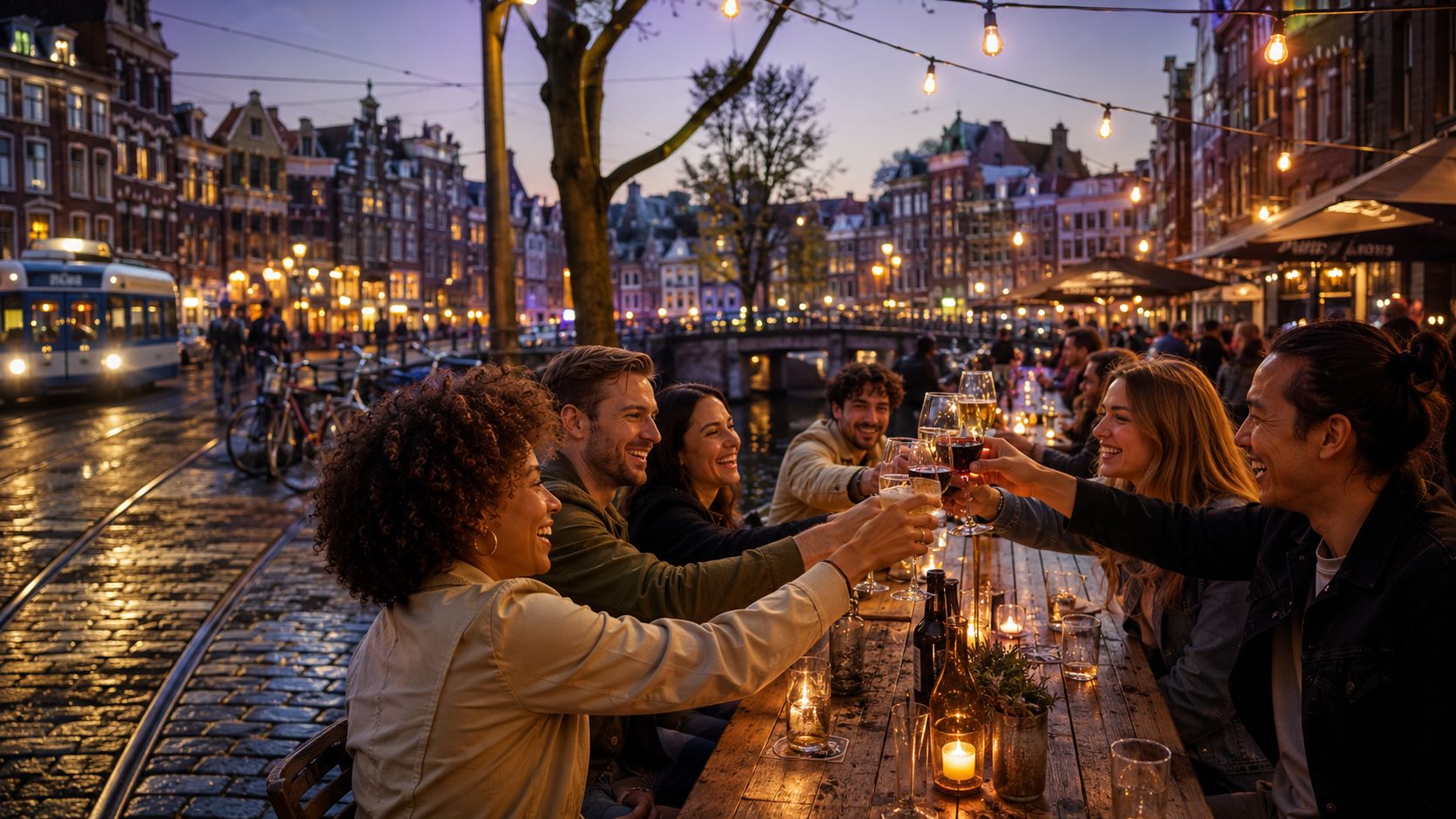
A couple can drift through Jordaan, find a brown café, and make the evening work. A group of twelve can't rely on the same method. One delayed drink, a full doorway, or a split decision at the next junction leaves half the party behind and the organiser negotiating with staff instead of enjoying the night.
Many central venues feel spacious when viewed from outside, yet their usable group capacity is much smaller once ordinary customers, walkways, toilets, and bar access are considered. A reservation for a few friends is one thing. Coordinating a large party on a busy Saturday is another, especially when everyone expects to sit together.
The address-first mistake
The common mistake is choosing attractive bars first and asking logistical questions later. That approach ignores whether the group needs a moving route, one guaranteed base, a private boat, food between drinks, or a host who can keep decisions from multiplying.
Amsterdam's social drinking economy is substantial. IBISWorld's market overview estimates the U.S. bars and nightclubs industry at $38.6 billion in 2026, with 69,948 businesses and a 2.8% CAGR from 2021 to 2026. Those figures describe the United States, not Amsterdam, but they show why group nightlife has become a serious hospitality format rather than a minor add-on. Venues compete on convenience, atmosphere, and how easily a party can book and move through the night.
Practical rule: Choose the structure before choosing the bar names.
For Amsterdam groups, the main options are straightforward:
- A hosted pub crawl, useful when the party wants movement, social energy, and fewer queue decisions.
- A canal cruise, suited to celebrations and groups that want everyone together in one place.
- A private booking, better when the occasion, privacy, accessibility, or neighbourhood preference matters more than spontaneity.
- A single base bar, practical for groups that value conversation and don't want to keep relocating.
Venue layout matters too. Anyone planning tables, stools, or standing areas can learn from this practical resource on bar seating for Cape Town events, especially the way furniture placement affects circulation. In Amsterdam, that circulation is often the difference between a comfortable group stop and a blocked entrance.
Amsterdam Group Rules That Shape Your Night
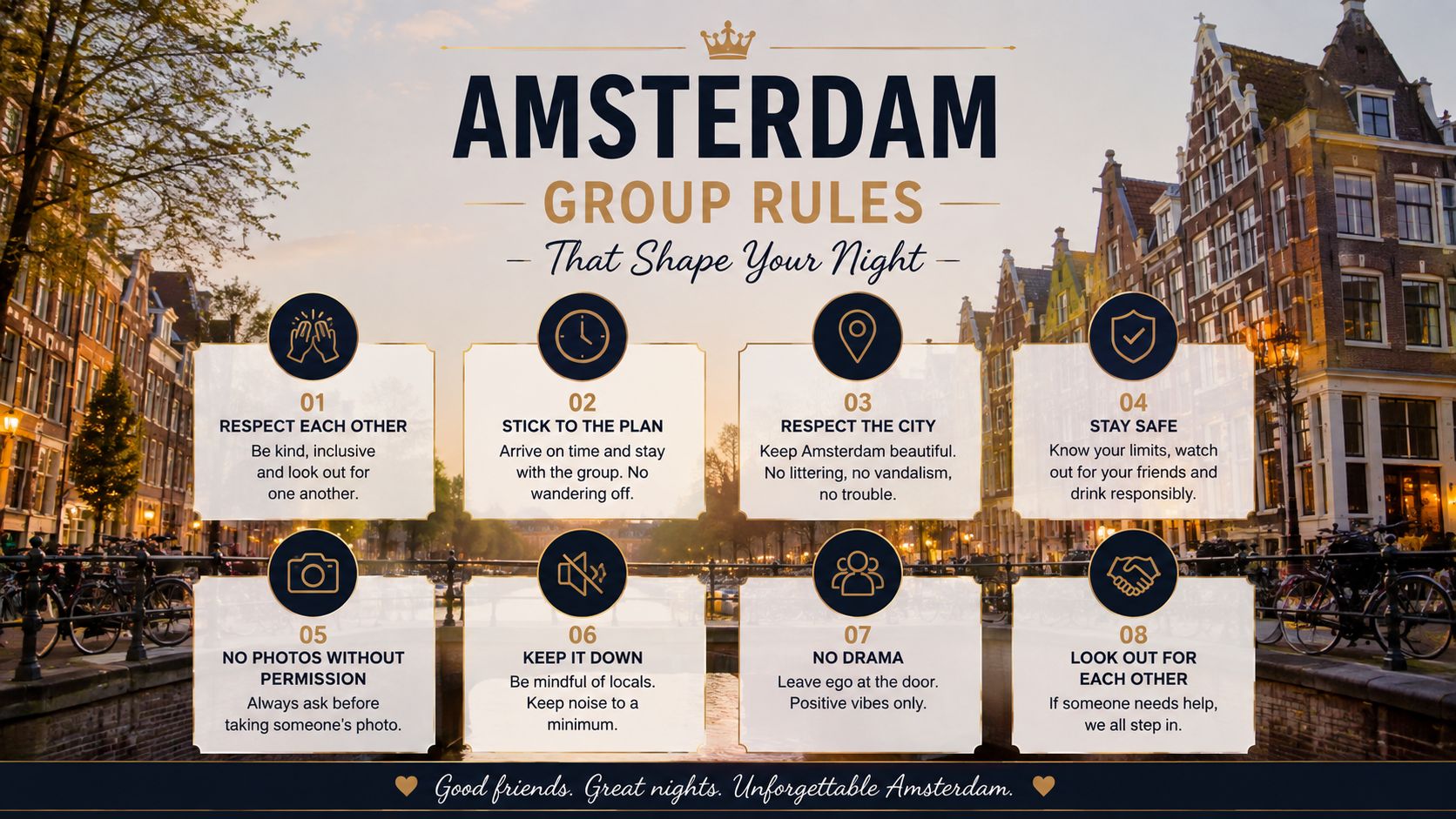
Group nightlife in Amsterdam isn't governed only by what a venue advertises. Municipal rules, district restrictions, route design, and responsible crowd behaviour can all affect the plan. A group that treats the city like an open-air party venue may be stopped, redirected, or refused service.
The clearest confirmed rule concerns guided tours in the centre. Amsterdam caps guided groups elsewhere in the centre at 15 people, requires tours to run between 08:00 and 22:00, and prohibits routes from passing prostitution windows or recruiting participants in public places, according to the municipal rules for guided tours. Organisers must also prevent participants from loitering around shop, house, bar, and restaurant entrances.
What that means for a group night
A responsible hosted route needs a defined meeting point, an orderly pace, and a route that respects local restrictions. The city's rules make a large, noisy, self-led procession a poor operating model, particularly around the Red Light District.
Groups should also separate three ideas that are often confused:
- A casual night out, where friends travel independently and meet at venues.
- A hosted nightlife experience, where an operator manages the route and group behaviour.
- A guided tour, which may fall under municipal rules depending on its organisation, route, and purpose.
Amsterdam's Red Light District restrictions have been in place for years. A municipal measure reduced the maximum guided group size elsewhere in the centre from 20 to 15 people, while organised tours in the district were banned and late-night group excursions, sound amplification, and alcohol or drug consumption in the area were restricted, as reported by TheMayor.EU's overview of Amsterdam's group-tour rules. The city's later guidance confirms the 22:00 finish time and the prohibition on routes passing window streets.
Canal plans have their own compliance question. From 1 April 2025, Amsterdam's central pleasure-boat zero-emission zone allows electric, hydrogen, or manually powered boats, with some temporary exemptions, as explained in Amsterdam's canal emissions update. Groups should ask what type of boat is booked rather than assuming that “canal cruise” describes the operating conditions.
Red Light District vs Leidseplein for Groups
The Red Light District and Leidseplein can both work for group nightlife, but they create different operating problems. Choosing between them by atmosphere alone is a mistake. The better choice depends on how tightly the party needs to stay together, how late the night will run, and how much flexibility the venues can offer.
The Red Light District has compact streets and short walking distances between many stops. That sounds ideal until a group meets a bottleneck, blocks a doorway, or tries to move through a busy pedestrian lane together. The area also has stronger steward presence and stricter expectations around behaviour, so a group needs a quieter, more controlled rhythm.
Leidseplein offers a broader nightlife setting, with more open movement around the square and useful tram and taxi access. It can suit groups that want to combine bars, dance venues, food, and a later finish without repeatedly navigating narrow streets.
| Factor | Red Light District | Leidseplein |
|---|---|---|
| Atmosphere | Dense, central, visually distinctive, and highly regulated | Broader nightlife zone with a mixed bar and club environment |
| Movement | Short routes, but tighter pedestrian spaces | More room to spread out and regroup |
| Group control | Requires disciplined behaviour around entrances and busy streets | Easier to manage a mixed-format evening |
| Late-night exit | The district can empty faster, making the final departure feel abrupt | More varied transport and venue options |
| Planning fit | Better for a compact, clearly organised route | Better for groups wanting flexibility and variety |
Groups choosing the Red Light District should read the practical details on the Red Light District pub crawl route before deciding whether that structure matches their party. The important question isn't whether the district looks exciting. It's whether everyone can follow the same route without stopping in restricted areas or spilling across doorways.
Leidseplein generally works better for parties with mixed preferences. Some members can focus on conversation while others look for dancing, and the district's layout makes regrouping less awkward. The Red Light District can work well for a compact hosted experience, but it's less forgiving when the group is loud, late, disorganised, or unfamiliar with local expectations.
Hosted Pub Crawls and What They Actually Solve
A hosted pub crawl solves the coordination problem that group organisers usually underestimate. It doesn't magically make every venue suitable for every party, but it can remove the repeated tasks that consume the evening: confirming the next stop, handling queues, explaining local expectations, and getting twenty people to leave at the same time.
A properly structured crawl usually gives the group a meeting point, a host, a planned sequence of venues, and a clear pace. Depending on the product, inclusions may involve welcome drinks, venue entry, drink tokens, discounts, games, or a club finish. Those details vary, so the booking page and operator should be checked before payment.
What the host handles
The host's value is operational rather than theatrical. A good host keeps the group moving, communicates with venue staff, notices when people fall behind, and explains what happens next before the group reaches the doorway.
For international visitors, the host can also reduce language friction. That matters when a party has dietary questions, needs to clarify payment, or has members who aren't comfortable navigating a crowded venue alone.
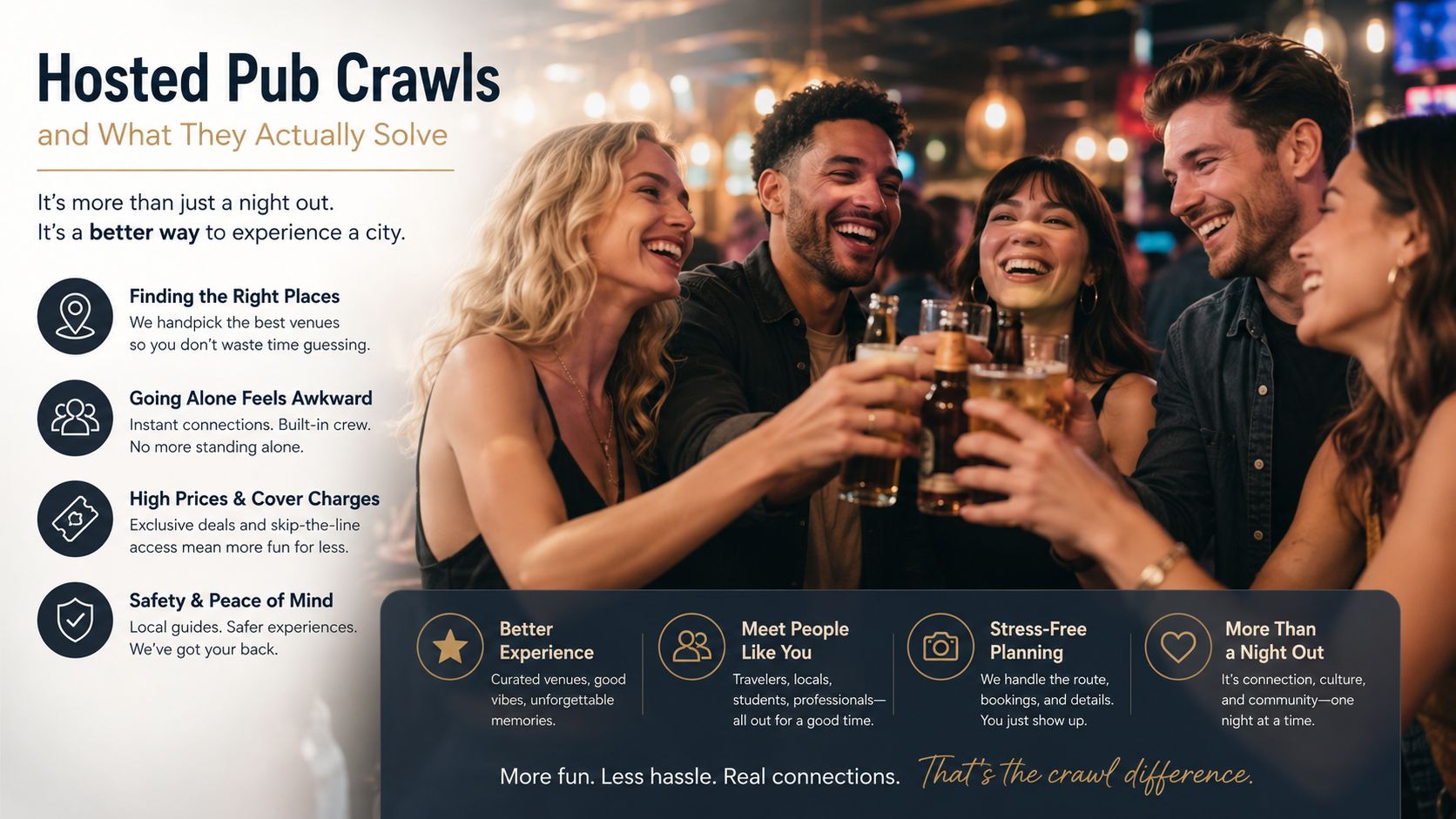
Amsterdam's wider bar market is already social by nature. One industry compilation reports that 70% of bar visits happen with friends or groups, while 28% of patrons visit alone. It also reports that 40% of bar customers use a mobile app to find or book bars, which supports the practical shift toward planning nightlife before arrival. These figures are reported in bar nightlife industry data, and they help explain why hosted, bookable group formats have a clear behavioural foundation.
When joining works better than DIY
A shared crawl is usually a strong fit when:
- The group wants structure, but doesn't need a private room.
- The organiser wants fewer decisions, particularly on a short city break.
- The party enjoys meeting other travellers, rather than staying entirely within its own circle.
- The group has no single must-visit venue, district, or music style.
A crawl is less suitable when the group includes non-drinkers with specific needs, has serious mobility limitations, wants to remain in one neighbourhood, or needs a private atmosphere. A host can manage movement, but can't turn a shared route into a bespoke event without the right booking arrangement.
Ultimate Party Amsterdam offers hosted pub crawls in Amsterdam, including routes focused on the Red Light District and Leidseplein. The company's published crawl information describes multi-venue experiences with hosted movement, included drinks or shots, venue cover charges, queue skipping, and club access, but groups should confirm current inclusions and operating details before booking. Practical preparation also matters, so the Amsterdam pub crawl survival guide is useful reading for anyone joining a shared route.
Canal Booze Cruises as a Group Format
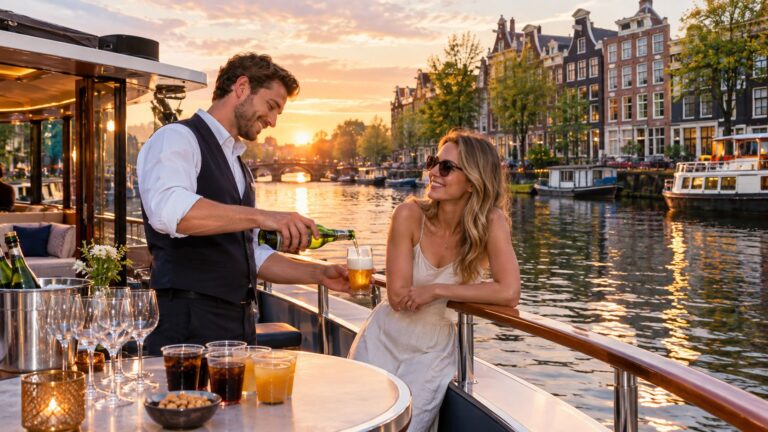
A canal booze cruise changes the group problem completely. Instead of moving twelve or twenty people through several doorways, the organiser puts everyone in one controlled setting with a fixed departure, a fixed route, and a defined end point.
That simplicity makes cruises attractive for birthdays, hen and stag groups, corporate socials, and mixed-age parties. It also creates risks that don't appear on a walking route, particularly the way drinks accumulate while the boat keeps moving and nobody has to walk between stops.
The format in practical terms
Boat size, capacity, duration, drinks policy, and weather arrangements vary by operator. Smaller boats can suit intimate groups, while larger charters accommodate bigger parties, but capacity should never be judged by the maximum headline figure alone. Seating, toilet access, standing room, boarding points, and the ability to keep everyone together matter more than a brochure number.
The core comparison looks like this:
| Boat size | Capacity | Duration | Typical price range | Best for |
|---|---|---|---|---|
| Small boat | 8 to 12 | 90 minutes to 2 hours | Varies by operator and inclusions | Smaller celebrations and private groups |
| Mid-size boat | 15 to 25 | 90 minutes to 2 hours | Varies by operator and inclusions | Friend groups and organised socials |
| Large party boat | 30 to 50 | 90 minutes to 2 hours | Varies by operator and inclusions | Larger events requiring central coordination |
The figures in this table are planning categories from the format brief, not universal Amsterdam limits. Operators may use different boat classes, capacities, durations, and pricing structures, so written confirmation is essential.
Electric boats and earlier planning
Amsterdam's central canal rules now make propulsion part of the booking conversation. Since 1 April 2025, the centre's zero-emission zone has required pleasure craft entering the zone to be electric, hydrogen-powered, or manually powered, with some existing permit holders temporarily exempt until 2030 and historic museum boats also exempt, as reported in Amsterdam's canal policy coverage.
For visitors, the practical conclusion is simple. Ask whether the boat is electric, which route it will take, where it boards, and what happens if weather affects the departure. Electric vessels can offer a quieter experience, but the rules also reduce the number of boats that can operate on some central routes. Summer weekends therefore deserve early attention rather than a last-minute assumption that any suitable boat will be available.
Boarding creates its own coordination challenge. Groups often arrive from different hotels, restaurants, or train connections, and boats won't wait indefinitely for late guests. The organiser should set one meeting point, build in arrival time, and make sure everyone knows whether drinks are supplied, allowed as bring-your-own, or handled through catering.
Cruise alone or cruise as the finale
A cruise can stand alone when the group wants one shared experience without nightlife hopping. It can also work as the closing element of a longer evening, provided the group is still capable of boarding on time and behaving appropriately on the water.
The choice between a shared and private cruise comes down to control:
- Shared cruise: lower planning burden, social atmosphere, less control over music, route, timing, and fellow passengers.
- Private cruise: greater control over guest list, drinks arrangement, route priorities, branding, and the pace of the event.
- Cruise finale: useful when the group wants to finish together, but only if transport and arrival timing are handled in advance.
- Cruise first: better when the party is fresh, punctual, and wants to use the boat as the evening's anchor.
A shared electric canal experience may suit groups that want a simple, social activity. A private charter is more appropriate when the event has a clear purpose beyond drinking, such as a company gathering, milestone celebration, or private family occasion.
When private planning earns its place
Private booking becomes more defensible when the group's needs are specific enough that a standard route would create compromises. Common triggers include:
- More than fifteen guests with fixed venue preferences, where a generic route won't satisfy the party.
- Corporate or celebration events, where branding, speeches, photography, or private space matters.
- Mixed-age groups, where not everyone wants the same late-night intensity.
- Accessibility requirements, which need to be discussed before venues and transport are chosen.
- Bachelor or hen parties with a planned route, where timing and venue acceptance should be coordinated openly.
- Returning visitors, who may prefer a particular neighbourhood instead of a general city-centre itinerary.
A private host or concierge can book tables, sequence several stops, manage tabs, and adapt the pace when the group's energy changes. That flexibility normally costs more per person than a shared format, but the trade-off is fewer compromises and one contact responsible for the moving parts.
Before paying, the organiser should ask:
- What happens if the group size changes?
- What are the cancellation and weather terms?
- How many hosts or guides are assigned?
- Which neighbourhoods and venues are included?
- Are food, photography, transport, or private spaces included?
- How are deposits, minimum spends, and separate tabs handled?
Ultimate Party Amsterdam lists a private Amsterdam booze cruise as a private electric-boat format. Groups should still confirm the current duration, drinks arrangement, boarding location, capacity, and cancellation terms directly before booking.
Common Group Planning Mistakes and Safety Realities
The biggest mistake is assuming that a large group becomes safer because everyone knows one another. Research on nightclub patrons identified five distinct risk profiles across groups, with romantic pairs showing less risk, while groups marked by greater familiarity, stronger safety concern, and higher consumption expectations showed more risk, as described in the peer-reviewed nightclub group study. Familiarity can make people drink more confidently and notice problems later.
Three planning failures appear repeatedly.
Starting too late
A group that begins with its first proper stop at 23:00 has already lost the useful part of the evening. Tables, queues, food, and transport all become harder to manage as the night progresses. A stronger plan gives the party time to settle, eat, and make the first venue decision before everyone is tired or heavily intoxicated.
Hiding the group's real character
A booking request should state whether the party is a birthday group, corporate team, hen or stag event, mixed-age gathering, or a quiet group of friends. Concealing the occasion can create an obvious mismatch between the venue's expectations and the behaviour at the door.
Treating mobility as an afterthought
The risk isn't only inside the bar. It's the person who gets separated on a narrow street, the guest who can't manage a long walk, or the final transport plan that disappears after the group leaves a venue. Phones should be charged, the meeting point should be agreed before the first drink, and at least one person should know how the group is getting back.
Food is part of safety planning, not an interruption. A proper meal or a bitterballen stop gives the group a reset and makes it easier to notice when someone needs water, a quieter venue, or a route home.
A group leader's job isn't to police the night. It's to make the safe choice easy before the night becomes complicated.
For venue bookings, organisers can also review practical guidance on online restaurant reservations for restaurateurs. The broader lesson applies to bars too: confirm the actual table arrangement, arrival conditions, payment method, and cancellation policy rather than relying on a generic booking confirmation.
Putting It All Together for Your Group Night
A workable Amsterdam night starts with decisions in the right order. The organiser should confirm the date, final group size, and realistic spend before choosing a district or messaging venues. Summer dates deserve early planning, particularly when the party wants a private boat or a route with specific stops.
A usable planning sequence
- Fix the essentials. Record the date, expected attendance, budget approach, dietary needs, mobility requirements, and preferred finish.
- Choose the format. A hosted crawl suits groups seeking movement and structure. A canal cruise keeps a celebration together. Private planning fits corporate events, milestone occasions, and parties with specific requirements.
- Select the district. Leidseplein offers flexibility and transport access. The Red Light District provides a dense atmosphere but demands tighter route and behaviour control.
- Confirm the capacity. Ask each venue about table layout, standing space, minimum spend, door policy, and whether the full group can arrive together.
- Plan the return. Arrange the meeting point and transport strategy before the first round, especially if guests are staying in different parts of the city.
- Brief everyone clearly. Share the start time, meeting location, dress expectations, payment method, food plan, and what happens if someone leaves early.
- Assign practical responsibility. One decision-maker for roughly every ten guests can keep communication manageable without turning the night into a military operation.
Fresh booking data also points toward more planned, experience-led group outings. A 2025 to 2026 venue-booking dataset reports that March 2025 bookings rose 57% over February, June rose 41% over May, nearly 80% of events had fewer than 150 attendees, and bars and other food-and-beverage venues represented 13.7% of bookings, according to the venue-booking benchmark analysis. The figures concern a broader events market, but they reinforce a useful planning principle: groups increasingly need bookable formats, not just lists of places.

For groups still deciding, the simplest test is this: if everyone wants the same style of night and can follow a clear route, a hosted crawl may work. If the party needs privacy, a fixed schedule, or one shared setting, a private cruise or custom arrangement will usually create fewer compromises.
Ultimate Party Amsterdam organises hosted Amsterdam pub crawls, shared and private canal booze cruises, and concierge support for groups that need help coordinating nightlife details. For a route-led evening or a private group arrangement, visit Ultimate Party Amsterdam and choose the format that matches the party's size, pace, and plans.
🍻
Experience it Yourself
Skip the planning — join Amsterdam's biggest pub crawl and get 6 bars, free drinks and VIP club entry for €20.