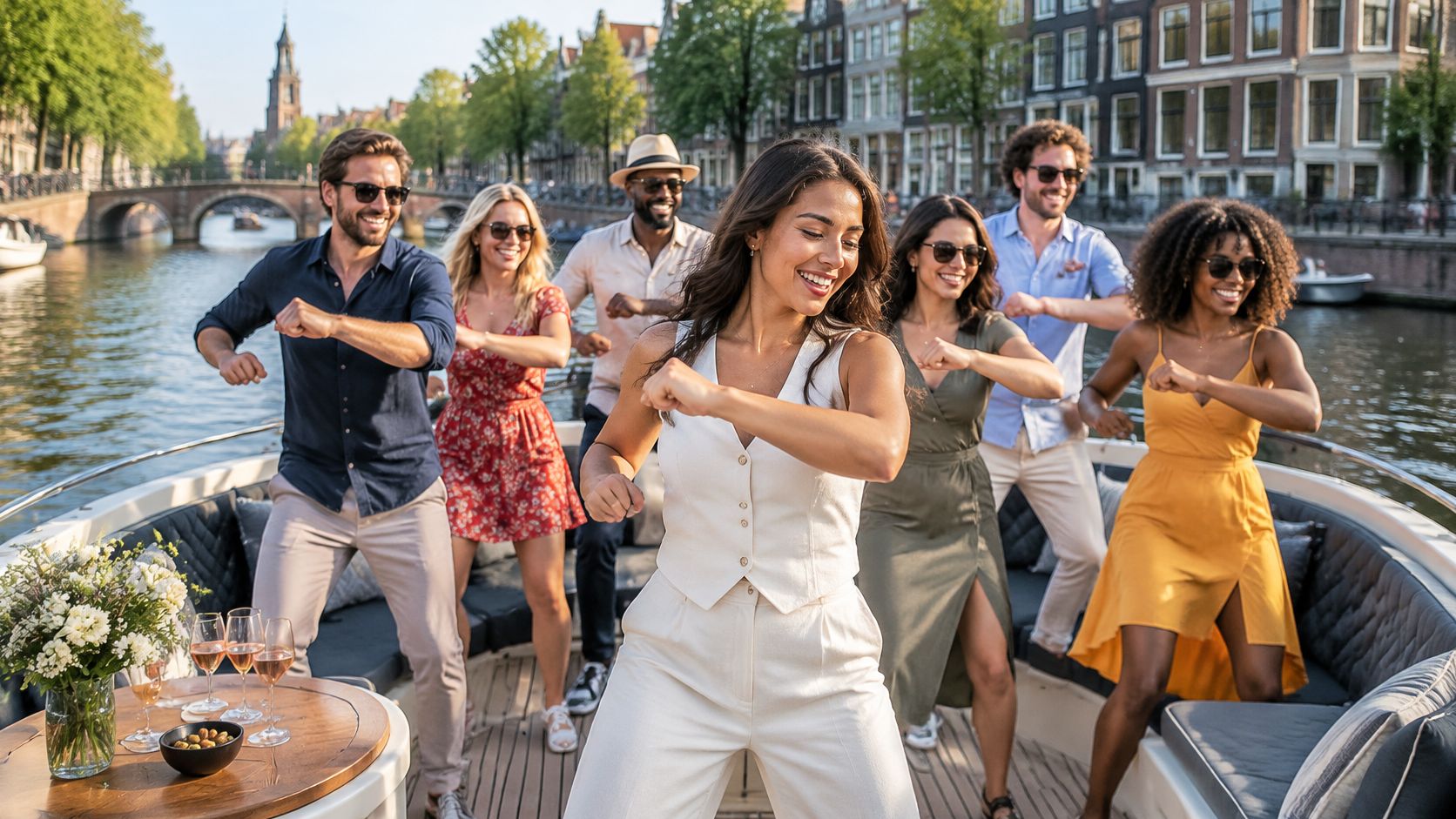
You're three weeks out from a stag do in Amsterdam. Someone in the group chat has found a canal boat with an open bar and a sound system, someone else has volunteered to teach a line dance to the entire group, and the plan has already been named. Then the practical questions arrive. Will there be room to dance on a boat that size, and will anyone be allowed to do it once the drinks are flowing?
Line dancing on a canal cruise works, but not in the way most groups picture it. It isn't a nightclub floor that happens to float. It's a short, controlled, low-impact routine led by a host, run in a small space, on a boat that turns and passes under low bridges while people hold drinks. That combination is exactly why the format succeeds with mixed groups and exactly why it fails when nobody plans the space.
What follows is the practical version. What the cruise is, where the risks sit once alcohol is involved, which canal rules still apply to a party boat, and what to confirm with an operator before anyone pays a deposit.
Table of Contents
- What to Expect on a Booze Cruise Line Dance
- Why Line Dancing Suits a Mixed Group on the Water
- Dance Moves and Space Rules Once Drinks Are Flowing
- Drink, Music and Conduct Rules on the Canals
- Age Checks and Accessibility Before You Book
- Book the Right Booze Cruise for Your Group
What to Expect on a Booze Cruise Line Dance
A booze cruise line dance is a canal cruise where drinks, music and group dancing run together, with line dancing as the activity that keeps everyone in rows and moving to the same count. It is a format built around a short cruise, not a floating nightclub. The boat is small, the bar is on board, and the dancing happens in whatever floor space the layout leaves open.
| Element | What to expect | Why it matters |
|---|---|---|
| Format | Short canal cruise with drinks, music and group dancing | Sets the tone for the whole night |
| Duration | Around 60 minutes on the standard shared format | One fixed block inside a longer evening |
| Boat | Canal boat, with much of Amsterdam's fleet now electric | The dance area is small and fixed |
| Dance style | Line dancing in rows when the operator provides a host | Rows keep dancers aligned in narrow space |
| Drinks | An included package on some boats, a paid bar on others | Shapes the real cost per person |
| Age and ID | 18 and over, with valid ID | Applies to every passenger in the group |
How the Hour Fits Into a Night Out
The cruise is one fixed block inside a longer evening. A stag group might board at eight, spend the hour dancing between the tables, then move on to bars or a club while everyone is still standing and still talking. Plan the rest of the night around a set start and finish, and eat before boarding. An hour of drinks on an empty stomach changes how any dance floor behaves.
Boat design matters more than people expect. Amsterdam's commercial canal fleet has been shifting to electric power, and a 2020 industry report on electric boating in the Netherlands stated that approximately 75% of the city's 550 canal boats were already emission-free, with roughly 100 charging stations planned along the canals. A quieter motor means the host's calls carry over the music. The floor space stays whatever the hull allows.
Drink packages differ between operators. On Ultimate Party Amsterdam's shared cruise, the hour runs on unlimited beer or wine, and the format is open to solo travellers, couples and groups. Other boats work on a welcome drink plus a paid bar, so the answer is worth having before anyone pays a deposit.
Dance style is the most variable row in that table. Line dancing only happens when the operator puts a host on board to lead it and count the steps. A boat with a DJ and a bar runs a party cruise; a line dance session needs a caller. That single question, host or no host, decides whether the night is a line dance at all.
The trade-off between bar service and usable floor exists on party boats everywhere, and the deck layout of a Tiki Time Bay Tours party cruise in San Diego is one concrete example to compare against an Amsterdam canal boat. Space is the constraint in every city. The boats that work for a line dance are the ones where a host leads the steps and the crew keeps a clear patch of floor once drinks are served.
Why Line Dancing Suits a Mixed Group on the Water
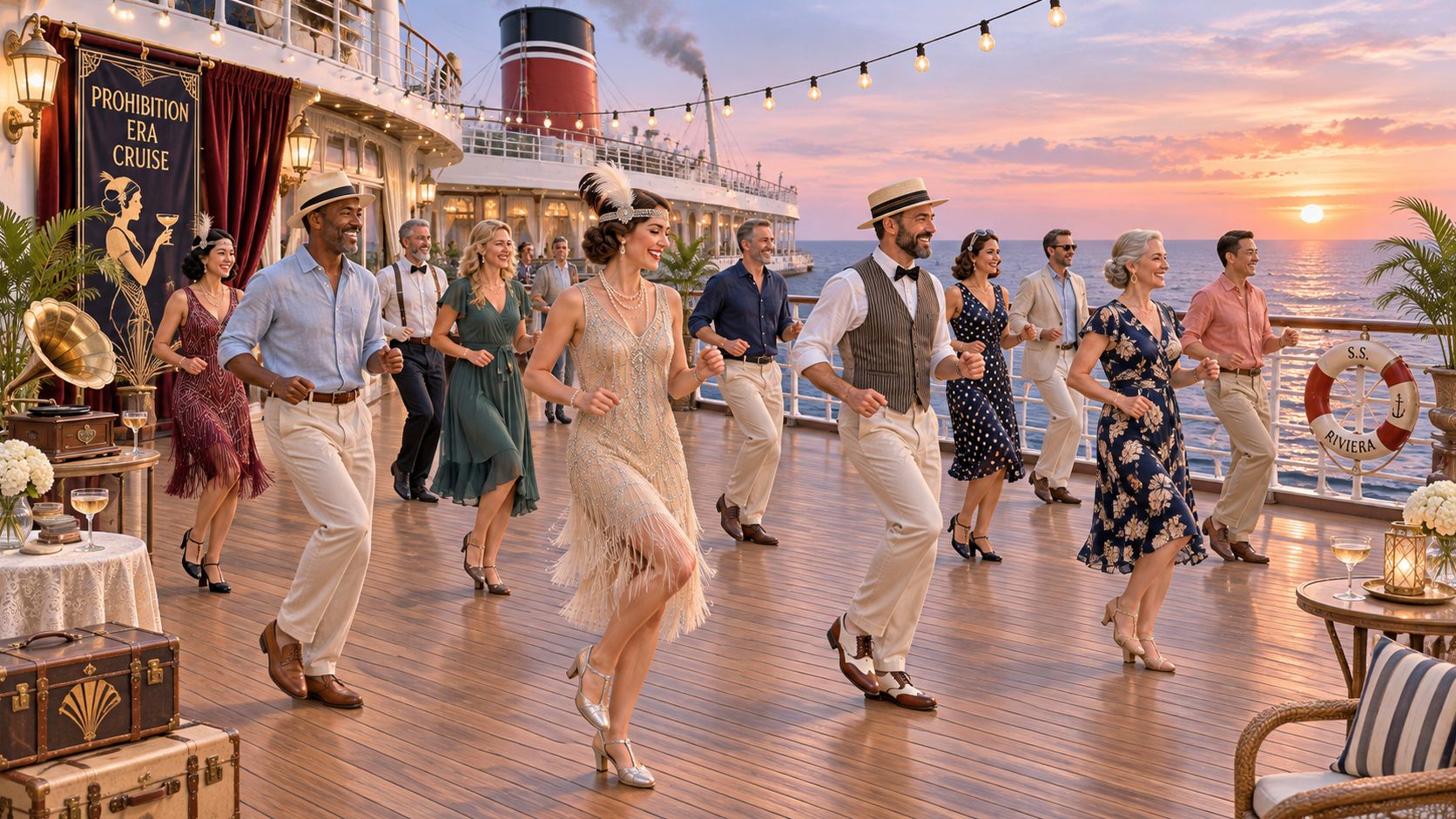
The format has two separate histories that happen to fit together. Alcohol-centred cruises date back to American Prohibition, when the Volstead Act took effect on January 17, 1920, banning the manufacture, sale and transportation of alcohol on land but leaving international waters outside its reach. Ships sailed offshore, served legally, and turned short voyages with music and dancing into a recognisable product, as Cruise Insider's history of the booze cruise sets out. Prohibition ended in 1933; the format stayed.
Line dancing took its modern shape later. It became a distinct commercial and social format mainly through the 1970s and 1980s, drawing on European folk dances, American square dances and country-western social tradition, then reached mass audiences in the 1990s. Billy Ray Cyrus's 1992 hit "Achy Breaky Heart" pushed western line dancing into bars, clubs and social venues well beyond specialist dance halls, according to the documented history of line dance. The style also absorbed pop and other genres as it moved into mainstream nightlife.
The structural feature that makes it work on a boat is simple. Dancers stand in rows and repeat one sequence together. Nobody needs a partner, nobody needs prior skill, and nobody needs room to spin.
Think of a stadium wave. One visible leader sets the rhythm, the rows follow, and the group reads as a single moving object rather than thirty separate dancers.
That suits solo travellers, couples and strangers who met at the dock ten minutes ago, since the steps are easy to follow after one run-through.
Here's the test to apply on the day: if everyone in the group can see the leader and the steps repeat within a few minutes, the routine will work on a moving deck. If either condition fails, it won't, no matter how good the playlist is.
Dance Moves and Space Rules Once Drinks Are Flowing
Alcohol changes coordination on a boat before it changes the volume of the music. On a canal boat that shift costs more, because the floor is already moving and every row shares a narrow strip of deck.
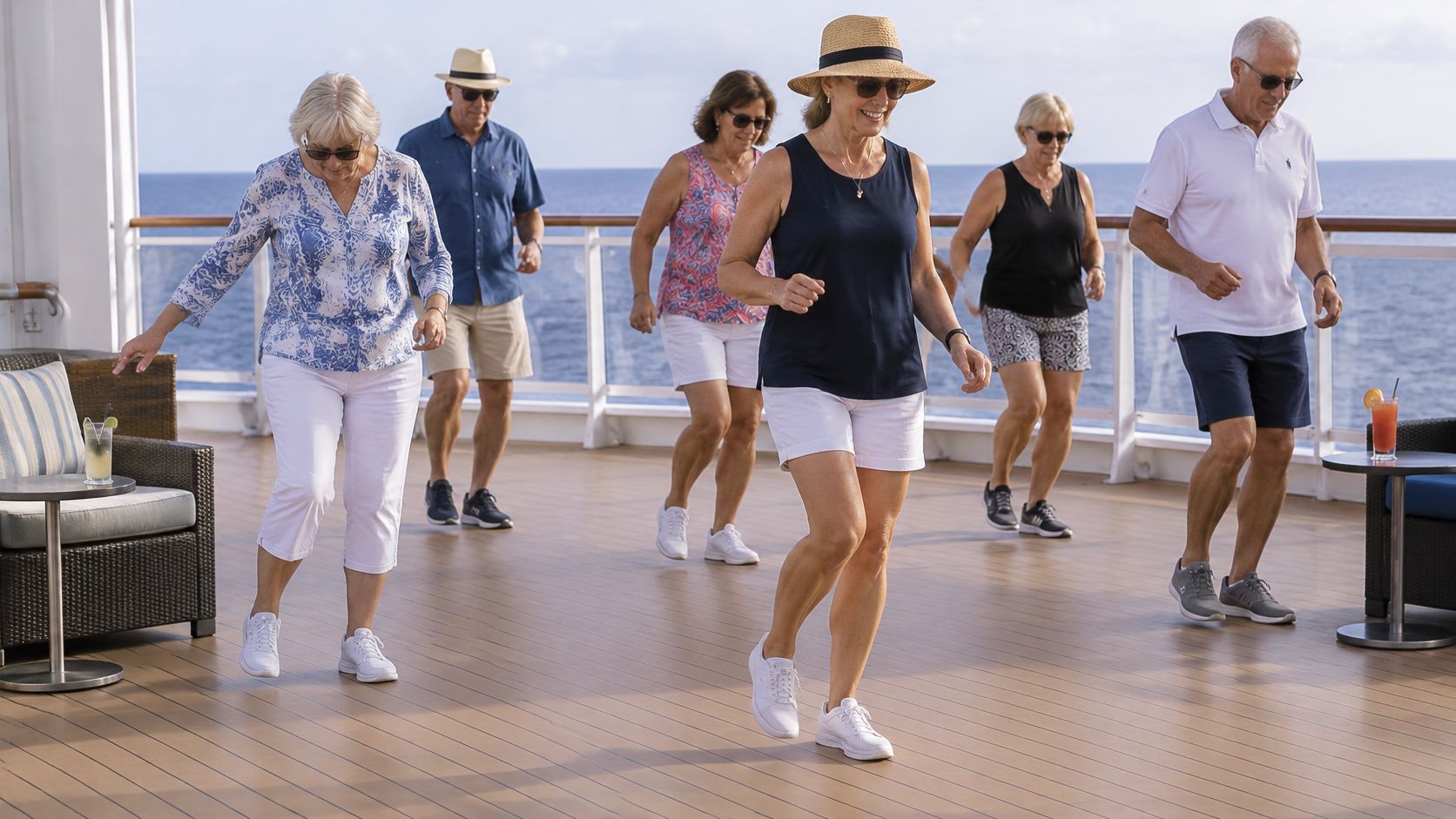
What Alcohol Changes Before Guests Notice It
A controlled human study on alcohol and motor control found that rising blood alcohol concentration increased motor impairment and behavioural disinhibition compared with placebo, with the effects most relevant during the ascending phase, while levels are still climbing. The study's review of 28 studies on alcohol and motor control placed skilled motor-performance and coordination tasks among the functions most vulnerable to low blood alcohol concentration, with impairment reported at or below 0.05% BAC in nine studies. That is a level many guests would describe as barely tipsy.
Visual-motion processing degrades even earlier. Safety+Health's summary of a NASA Ames Research Center and San Jose State University study reported that some eye-movement and coordination measures worsened by more than 20% at BAC levels as low as 0.015%, after participants drank the equivalent of less than half a beer for a person of about 75 kg.
On a moving deck, that shows up in specific ways. A guest misreads which way the leader turned, reacts a beat late to the row in front, or drifts sideways into a neighbour while still chatting normally and looking completely fine. Disinhibition usually arrives before the person feels impaired, so reckless dancing is the early warning sign, and it shows up well before anyone stumbles.
Matching Moves to the Deck
| Move | Risk on a moving boat | Safer choice |
|---|---|---|
| Spins and fast turns | High: loss of balance near rails and steps | Half turns on the spot with hands at your sides |
| Kicks and jumps | High: wet or sloped deck and shifting footing | Step-touch and heel taps |
| Fast footwork sequences | Medium to high: timing slips as alcohol takes effect | Slow eight-count routine repeated three or four times |
| Arm waves and claps | Low: you stay in place | Main movement during the cruise |
| Partner lifts or physical contact | High: unstable footing and risk-taking | Skip; hosts demonstrate without touching |
The pattern is consistent: the moves that look best in a bar are the first to fail on a deck. Boat choreography favours low-complexity, repeatable movement over rapid footwork, spins, lifts and partner manoeuvres. Arm work keeps the group visually synchronised while every dancer's centre of gravity stays over their own feet.
The Set-Up and the Stop Rules
Positioning does most of the safety work before anyone starts dancing. One clearly visible leader at a fixed spot, wide spacing between rows, short sequences repeated several times, verbal counts and large arm signals rather than music cues alone. Keep the dance area clear of railings, steps, exits, passenger circulation routes and crew working zones, and check the flooring for grip rather than assuming it.
I'd confirm two things with the operator before booking: where on the deck the dancing will happen, and who calls a stop when conditions change. On a private boat, that answer shapes the whole routine.
Stop rules: pause coordinated dancing during docking, sharp manoeuvres, poor weather, or when the crowd is visibly destabilised. A skipper who says stop means stop, and the group can restart the count in thirty seconds.
A fixed number of drinks can't predict who is safe to dance, because effects vary with dose, body composition, food intake, sex and drinking speed. Guest habits cover the rest. Eat before boarding, take water between routines, sit out any sequence that feels difficult, and treat the boat as a floor with edges rather than a dance hall.
Drink, Music and Conduct Rules on the Canals
An open bar still comes with conduct limits, and groups regularly get that wrong. Passengers are generally free to drink on board, while the person steering the boat stays sober or within a strict limit. Noise, disorderly conduct, littering and unsafe behaviour create problems on the canals whatever the ticket included, and open boats tend to carry tighter music and behaviour limits than enclosed, licensed vessels.
"Unlimited drinks" gets heard as "anything goes": dancing on the benches, chanting across the water, a Bluetooth speaker at full volume. The skipper's safety authority and Amsterdam's noise expectations decide what flies. The bar package doesn't.
The Four Questions Guests Actually Ask
Can we bring our own alcohol? That sits with the operator's policy, and the answer changes between shared and private boats. Confirm it at booking, before anyone buys bottles at an off-licence.
Is glass allowed? Treat plastic as the default on an open deck. Glass, a moving boat and a dance floor add up to cut feet.
What happens if someone gets disruptive? A guest who ignores crew instructions can be put off the boat. Every group has one person who needs to hear this, and the host would rather say it once at the quay than mid-canal.
Can we keep dancing under low bridges? Amsterdam's bridges drop the headroom fast, and the deck tilts as the boat turns into position. Sit or duck the moment the crew calls it, and the routine picks up again once the boat clears.
The Driver Still Has a Limit
If the group is driving to the departure point, someone stays under the legal threshold: 0.05% for drivers on a regular licence and 0.02% for new drivers, under the Government of the Netherlands guidance on alcohol and driving. The workable answer is a driver who drinks nothing, or trams and taxis for the whole group.
Groups that want a high-energy session without a removal or a fine should book the format built for it. An Amsterdam open bar cruise with a host and a skipper on board gives the dancing a structure to sit inside, which is the point.
Age Checks and Accessibility Before You Book
In the Netherlands, alcohol may legally be purchased only by people aged 18 or older, and the same minimum age applies to possessing alcohol in public. The rule covers beer, wine, spirits and mixed drinks rather than only high-strength alcohol, as the Government of the Netherlands explains on the legal age for alcohol. Expect verification at boarding and carry a valid passport or ID card, especially when drinks are included in the ticket.
Sellers are also required to ask for identification when a customer appears young, under the Dutch rules on selling alcoholic beverages to young people. An 18-plus policy with ID checks is an operational requirement on the water, so crews check at the gangway rather than on the dance floor.
Accessibility is the part most party-cruise content skips. Some Amsterdam operators run wheelchair-accessible boats with wide gangways, lifts and crew assistance at boarding, but those features usually have to be arranged when you book rather than on the day.
Accessible boarding and a dance-ready deck are separate things. A boat can take a wheelchair or mobility aid and still offer limited turning space, uneven boarding conditions, no suitable handrails or a deck that turns slippery in rain. Ask about both.
Three Questions to Ask Before Booking
- Which ID does the crew accept at boarding? A passport or national ID card is the reliable answer; a photograph of a licence on a phone is a gamble.
- What does boarding involve? Ask about gangway width, steps, lifts and crew assistance, and how much notice the operator needs to have them ready.
- Is there an accessible toilet on board? Boats of this size vary, and an hour on the water is a long time when the answer is no.
Guests with balance problems, older travellers, pregnant guests and anyone prone to motion sickness or falls should plan a seated role rather than assume they will stand in a row. Mobility and balance needs are worth raising with Ultimate Party Amsterdam before booking, because boarding and deck space differ from boat to boat. The private canal tour options in Amsterdam show how much layouts vary.
Book the Right Booze Cruise for Your Group
The decision comes down to one question: does the group want to join a crowd or have its own boat? Solo travellers, couples and small mixed groups do better on a shared cruise, where the social mix is part of the appeal. Stag and hen parties, birthdays and corporate teams usually want a private charter, because they set the pace, the playlist and the guest list.
| Group | Best fit | Check before booking |
|---|---|---|
| Solo traveller or couple | Shared booze cruise | Drink package and departure time |
| Stag or hen party | Private booze cruise | Minimum group size for the private format |
| Birthday or celebration | Private booze cruise with extras | Which extras are available and what they cost |
| Corporate team | Private booze cruise | Start time, duration and headcount limits |
| Group wanting a dance-led session | Ask the operator first | Whether a crew member leads line dancing, confirmed in writing |
Ultimate Party Amsterdam runs both formats: the Party on the Water shared booze cruise at €33.05 per person, which includes an hour of unlimited drinks and is open to solo travellers, couples and groups, and a Private Booze Cruise at €52 per person on a fully private luxury electric boat with an open Dutch bar of beer, wine and soda.
Both cruises run their open bar for 60 minutes, so the useful questions are what the package covers and what happens on deck once the drinks start. On a private charter, raise the minimum group size and the available extras early, because those two details decide whether the per-person price still works for your headcount.
If a line dance session is the main reason for booking, say so in writing before you pay. A hen party that expects the host to teach choreography because the boat has speakers and a bar ends up with music and drinks and nobody calling the steps. Arrive at the dock earlier than you think you need to.
For a different city and a different crowd, the best Bournemouth cruises for bridal groups show how hen parties elsewhere structure a private boat booking. The questions are the same everywhere: space, timing, drinks and who is in charge once the boat moves. Groups chartering their own vessel can review the party boat rental options in Amsterdam and compare layouts before committing.
Ultimate Party Amsterdam has been running pub crawls and canal cruises in Amsterdam since 2006. Its shared cruise puts a professional skipper and host on board, so the group has someone setting the pace; on a private charter, confirm who crews the boat when you book. If a line-dance session on the water is on the plan, get the date and headcount together and send the details across before paying. Visit Ultimate Party Amsterdam to see the cruise formats, check what each one includes, and ask directly whether a host-led dance session fits the boat you're considering.
🍻
Experience it Yourself
Make it your night — a private pub crawl with your own dedicated party host, 6 stops and 6 free shots for €30 p.p.