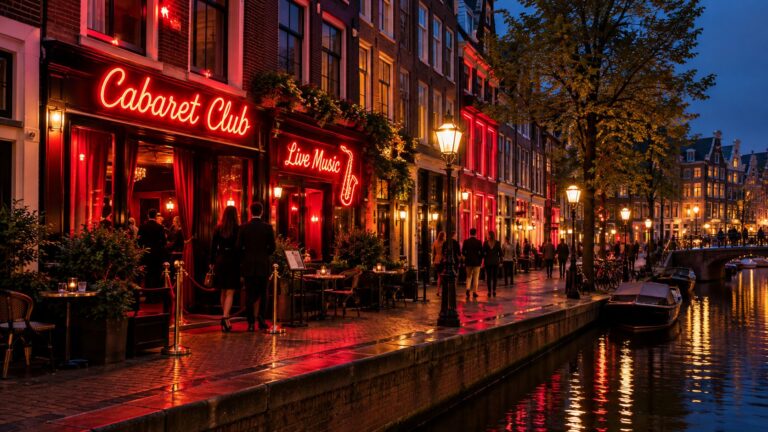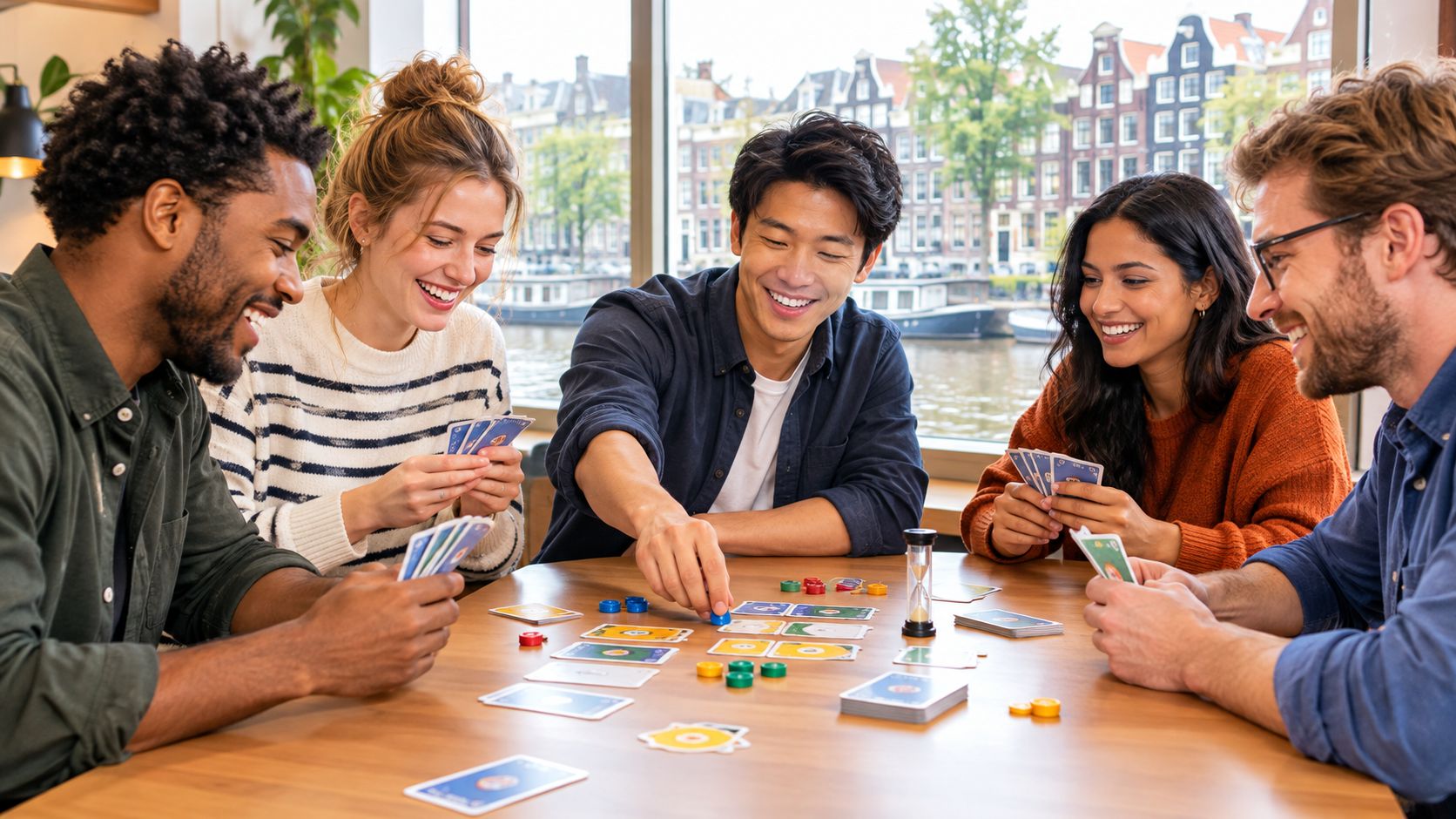
A team of twelve arrives in Amsterdam on a Thursday evening with a booked table, a vague plan, and a bar full of noise. Half the group sits in silence while the other half talks shop. A well-chosen party game can get people mixing quickly, but only if it suits the group, the setting, and the people taking part.
Amsterdam adds practical constraints that office-game lists often miss. A game that works around a quiet meeting-room table may fall flat in a crowded bar, and a narrow canal boat has little room for running about or spreading out cards. Crawl routes also mean the group needs activities that can start and stop without holding up the night.
The ideas below are designed for Amsterdam bars, canal boats, and the walks between venues. Each comes with a way to play, a realistic use case, and adjustments for noise, comfort, and participation. The aim isn't to make every guest compete. It's to give colleagues an easy reason to talk, share a laugh, and enjoy the city together.
Table of Contents
- 1. Amsterdam Bar Crawl Scavenger Hunt
- 2. Amsterdam Trivia Pub Quiz for Teams
- 3. Two Truths and a Lie Icebreaker Circle
- 4. Speed Networking Over Drinks
- 5. Bar Games Challenge Between Teams
- 6. Canal Cruise Photo or Trivia Challenge
- 7. Dutch Phrase Bingo
- 8. Blind Beer Tasting Challenge
- How the eight company party games compare
- Pick Two Games, Not Eight
1. Amsterdam Bar Crawl Scavenger Hunt
A scavenger hunt gives a group a shared mission between venues, rather than leaving everyone to manage a busy crawl in separate conversations. Split colleagues into small, mixed teams and give each one a short list of photo or observation tasks tied to the route. The challenges can be as simple as spotting a distinctive bar sign, finding a canal view, or learning how to say a Dutch phrase.
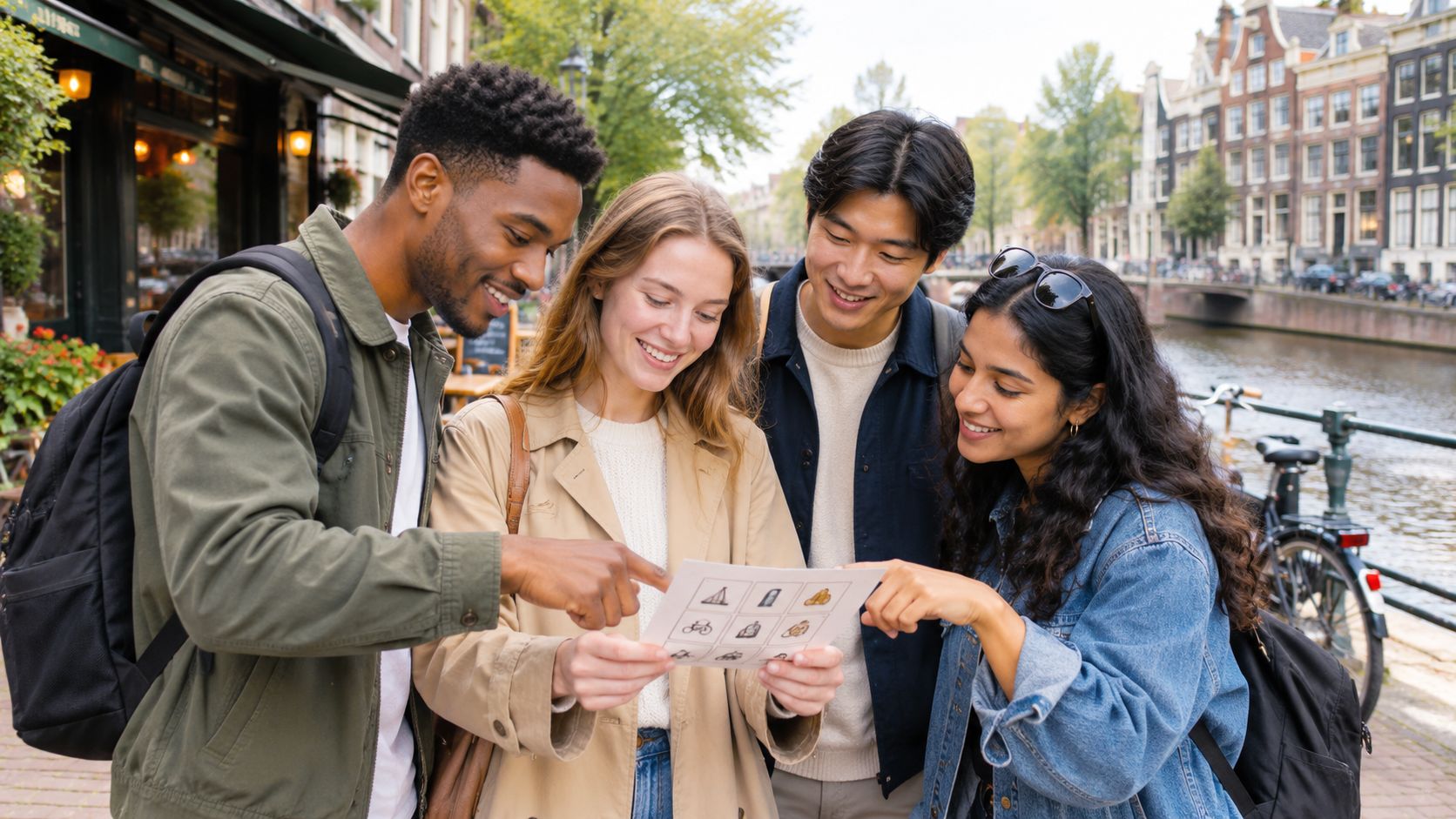
A marketing team of twelve could split into three groups and collect Dutch-themed clues around Leidseplein. One team might photograph an interesting sign, another might find a bar with a canal view, and a third might ask a willing staff member for a local recommendation. Keep the list to eight to ten tasks so the hunt fits between stops instead of taking over the evening.
Route rule: Challenges should reward noticing the city and working together, not bothering strangers or delaying the group.
Avoid any task involving sex workers or the windows in the Red Light District. Photographing workers is prohibited and can lead to serious trouble. Don't make drinking a condition of completing a task, either. Alcohol can be part of the night, but nobody should be pressured to drink more than they're comfortable with.
Give each team one captain to keep the checklist and confirm completions. If the hunt uses QR codes, these QR hunt printing tips can help with preparing the materials. For route planning and practical crawl advice, see tips for navigating an Amsterdam pub crawl. This format works especially well when a host already guides the group between venues, because the game adds purpose to the walk without replacing the night out.
2. Amsterdam Trivia Pub Quiz for Teams
Trivia is a reliable choice when a group wants to sit down, regroup, and talk without asking anyone to perform. It suits a fixed bar or pub stop better than a moving crawl. In a loud venue, keep questions short, let teams write answers on paper or submit them on a phone, and check with the venue in advance about music volume or a quieter corner.
A useful quiz mixes subjects so one person's specialist knowledge doesn't decide every round. Try Amsterdam history, Dutch culture, city geography, and light company in-jokes. A visiting finance team, for example, could answer a few canal questions before moving on to a round about its own product history. Include easy questions early, so teams can join the competition before the tricky ones arrive.
The rules need to be clear even when the bar isn't quiet. Assign one host to read each question, allow a short discussion, and set a consistent time to submit answers. If teams have to shout over music to be heard, switch to written answers rather than raising the volume.
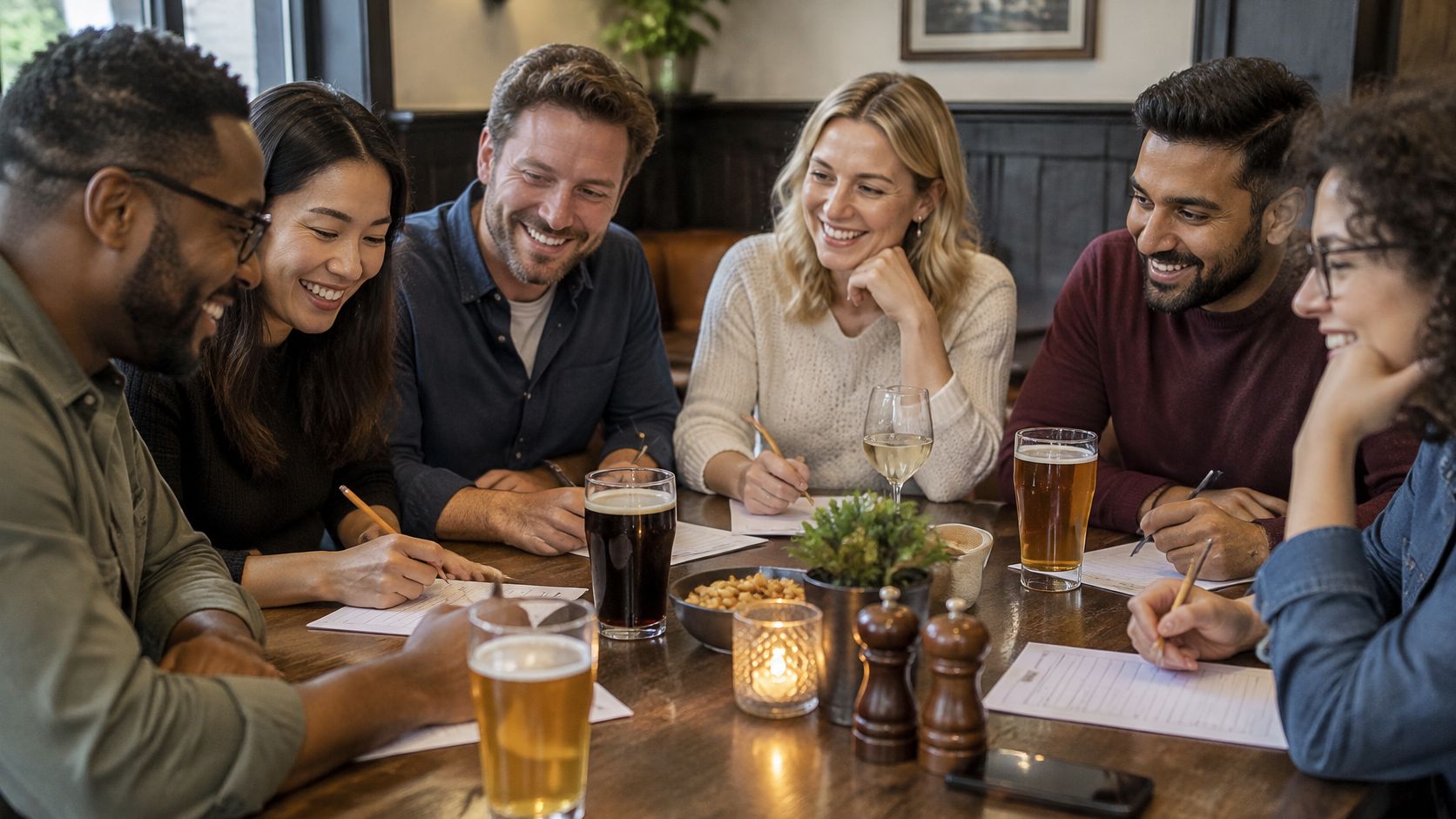
“Proost” and “dank je wel” are easy Dutch phrases to fold into a round, and they give international guests something useful to try during the night.
A small prize can give teams a reason to focus, but avoid making a drink the only reward. Offer a non-alcoholic option, a shared snack, or a playful team title. Keep the quiz short enough to leave time for conversation after the final answer. Trivia works best as one stop in a larger evening, not as a long seated event that keeps a group from enjoying the city.
3. Two Truths and a Lie Icebreaker Circle
Two Truths and a Lie works best early in the evening, before the group gets too distracted by bar noise or drinks. Each person shares two true facts and one invented statement. The rest of the group guesses which one is false. The format is simple, needs no equipment, and can help colleagues who haven't met find a quick point of connection.
For a new team meeting over a welcome drink, one person might say they've lived in three countries, can make fresh pasta, and have never been on a bicycle. The group guesses the lie, then moves on to the next person. A host should start with a light example and keep the pace brisk, especially if the whole group is taking a turn.
The game can also work in a boat's seating area, where the group is together but has limited room to move. It's a better fit for conversation than a physical challenge. On a canal boat, however, engine noise and nearby conversations can make it hard to hear a long explanation, so keep each person's statements brief.
- Set a safe boundary: Ask for harmless facts, not sensitive details about relationships, health, money, or work conflicts.
- Make passing acceptable: Guests should be able to skip their turn without having to explain why.
- Keep the circle small: If the group is large, split into tables or teams so each round doesn't become a long wait.
The main trade-off is that this game puts each participant briefly in the spotlight. It shouldn't be the only way to join in. Let people listen, guess, or pass, and keep the tone playful rather than turning the activity into an interview. It works best with colleagues who are comfortable sharing a small personal detail, and less well as a surprise activity for a group that has just met.
4. Speed Networking Over Drinks
Speed networking gives a professional group a reason to meet beyond the colleagues they already know. Set up pairs, give each pair a conversation prompt, and ask participants to change partners when the host signals. The structure helps with cross-team introductions, but only if the setting lets people hear one another.
A quiet room or reserved table is a better fit than a busy bar. In a loud venue, people end up repeating questions or abandoning the conversation halfway through. Before choosing the location, check whether it has enough seating and whether the group can hear a simple announcement to rotate.
Five minutes per conversation is a practical starting point for a structured social round, but the host should adjust the pace to the group and schedule. Prompts can focus on work preferences or easy city topics: “What makes a good team handover?” or “What's one place in Amsterdam you'd show a visitor?” Participants should be free to skip any prompt they don't like.
Keep the rotation about conversation, not consumption. Nobody should have to finish a drink before moving to the next partner.
A tech company on an Amsterdam offsite could hold the activity in a quieter space before heading to a canal cruise. A conference group could use it to make introductions before a more relaxed drink together. Either way, pair speed networking with an open social activity afterward. The format creates an introduction, but it shouldn't dictate the rest of the evening. A good host leaves room for people to continue conversations naturally or take a break.
5. Bar Games Challenge Between Teams
Bar games turn a stop into a shared activity without requiring the whole group to focus on a host. Depending on what a venue has available, teams can play darts, shuffleboard, table football, cards, or another quick game. The key is to check the setup before the event. Not every bar has the same games, and a game that needs a dedicated table can be awkward on a busy night.
Say an office group wants to mix departments before moving on to another venue. Assign mixed teams, agree on a simple match format, and rotate players so the same two confident competitors don't take every turn. A card game can suit a quieter table; darts may need more space and a clear area around the throw line. Choose based on the venue, not on a generic list of party activities.
Set the scoring before play starts. A timed challenge might use points for accuracy, completion, or team wins, but don't switch the basis halfway through. A simple approach is to award five points for first place, three for second, and one for third, following the scoring example in this guide to running short “minute-to-win-it” challenges.
- Check the venue first: Confirm which games are available and whether the group can reserve space.
- Offer more than one way to join: A guest who doesn't want to play can keep score or cheer on a team.
- Keep drinking separate from points: Darts, cards, and shuffleboard should never depend on finishing a drink.
In the Netherlands, the legal drinking age is 18. Venues may ask for ID, so guests should bring it, and organisers shouldn't make alcohol a requirement for taking part. Bar games are strongest as short, optional rounds between conversations, not as a tournament that keeps everyone waiting for a turn.
6. Canal Cruise Photo or Trivia Challenge
A canal boat creates a shared setting for a game because the group stays together while the city passes by. Choose an activity that works from a seat: a short Amsterdam trivia round, a landmark photo challenge, or a guess-the-bridge prompt. Avoid games that need space to run, large props, or people moving quickly around the boat.
A corporate group could split into teams and take photos of features along the route, then compare their finds near the end of the cruise. Another group might run a quick question round about Amsterdam's bridges and canals. Before preparing clues, check with the crew about the route so the questions and photo prompts match what guests are likely to see.
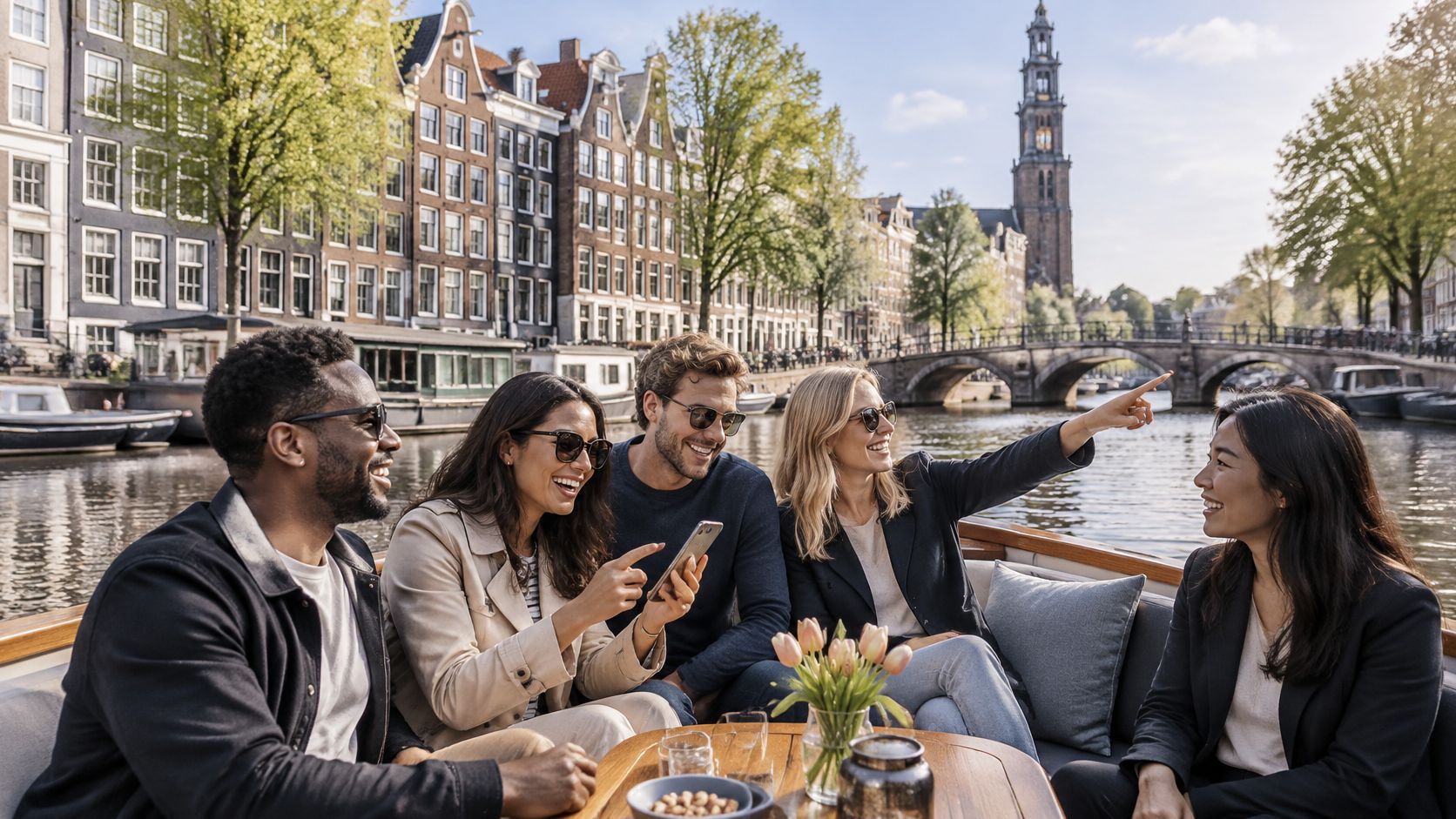
Keep the game brief and make participation optional. Some guests will prefer to talk, enjoy the view, or relax. A boat is a contained environment, so a loud host or a game with complicated rules can quickly dominate the whole experience. Use a clear explanation and a quiet way to submit answers, such as showing a photo to the host or writing a guess on a card.
Ultimate Party Amsterdam lists a private booze cruise on an electric boat as one possible setting for a group activity. The group provides the game, while the boat provides the shared backdrop. For private arrangements, the Nightlife Concierge team can be asked whether a charter suits the plan. Details depend on the booking, so confirm the route, timing, and activity arrangements before building a game around them.
7. Dutch Phrase Bingo
Dutch Phrase Bingo is a gentle way to bring local language into a company night without turning anyone into a performer. Make cards with useful phrases such as proost, lekker, gezellig, dank je wel, and tot ziens. Players mark a phrase when they hear someone say it, or when they use it themselves.
An international team could play during a welcome drink or along a crawl route. Before starting, say each phrase aloud so guests know what they're listening for. Explain the meaning briefly, then let people use the words when they feel comfortable. Dutch speakers may switch to English during a conversation, so no one should feel they have to keep the game going by forcing a phrase into every exchange.
Human bingo traditionally uses a grid of personal or experience-based prompts, with players finding colleagues who match each description. One guide describes the format for groups of 30 to 300, with 20 to 30 minutes of preparation for printing cards, making it a possible template for adapting bingo to a large event (corporate human bingo guidance). For a phrase version, the mechanic can be simpler: listen for the words during natural conversation rather than asking strangers to prove anything.
Keep the cards broad and easy to use. A line can reward the first team to complete it, but the prize shouldn't depend on speaking Dutch fluently or buying a drink. Phrase bingo also offers a natural opening for conversation about local customs, such as ordering bitterballen or splitting a bill. That makes it more memorable than a list of vocabulary words alone.
8. Blind Beer Tasting Challenge
A blind tasting gives beer-loving colleagues something to discuss beyond the usual order. The host labels samples with numbers, keeps the answer key hidden, and asks teams to guess a style or identify which sample is which. Pilsner, amber ale, and Dutch lager are possible categories, depending on what the venue can provide.
Keep portions small, and ask the venue in advance whether it can supply tasting glasses. A quiet bar or reserved table works better than a crowded stop where participants can't compare flavours or hear the questions. A marketing team, for example, could taste a pilsner and a lager and agree on one answer per team rather than having each person compete alone.
A tasting is still alcohol-centred, so it won't suit every group. Provide a soft-drink alternative and make it equally valid to take part without tasting beer. Don't use speed or volume as a scoring method. The point is to notice flavours and talk about the guesses, not to encourage anyone to drink more.
- Number the samples: Hide labels and keep the answer key with the host.
- Explain the scoring: Decide whether teams score for the correct style, brand, or both.
- Offer a non-alcoholic lane: Guests who don't drink can judge aroma, guess ingredients, or join a separate soft-drink round.
The legal drinking age in the Netherlands is 18, and venues may check ID. For ideas on local styles and what to look for, consult this guide to Amsterdam beers. A blind tasting is best for a group that already enjoys beer and wants a slower, more conversational activity. It's a poor fit if the plan depends on every colleague drinking alcohol.
How the eight company party games compare
| Item | Best group size | Time needed | Setup or equipment | Best for |
|---|---|---|---|---|
| Amsterdam Bar Crawl Scavenger Hunt | Teams of 3–5 | One venue-to-venue segment | Shared checklist and team captain | Mixing colleagues and keeping energy up |
| Amsterdam Trivia Pub Quiz for Teams | Teams of 4–6 | Short quiz rounds | Questions, answer sheets or shared chat | A seated group activity with local trivia |
| Two Truths and a Lie Icebreaker Circle | 6–15 people | 2–3 minutes per person | No equipment needed | Helping people get to know each other |
| Speed Networking Over Drinks | Pairs; flexible group size | 5–7 minutes per pairing | Conversation prompts and a bell or chime | Connecting colleagues across teams |
| Bar Games Challenge Between Teams | Teams of 2–4 | 5–10 minutes per match | Venue games and a simple score bracket | Friendly competition between venues |
| Canal Cruise Photo or Trivia Challenge | 10 or more people | Short activity during the cruise | Photo list, trivia questions or landmark prompts | A scenic shared activity on a canal cruise |
| Dutch Phrase Bingo | Flexible group size | 15–20 minutes | Bingo cards with Dutch phrases | Learning useful Dutch in a relaxed setting |
| Blind Beer Tasting Challenge | Small teams | One tasting round | Small beer samples and numbered labels | Beer fans who enjoy a relaxed competition |
Pick Two Games, Not Eight
Most groups lose the evening by trying to run too many activities. A game needs time to explain, start, and settle into a rhythm. Stack one after another and the night starts to feel like a schedule people have to complete, rather than a chance to spend time together.
Choose one structured activity for the start and one flexible game for the middle. Two Truths and a Lie can help a new group get talking before the first venue. A scavenger hunt can bring colleagues together as they walk between stops. If the group prefers to stay seated, a short pub quiz may fit better than a route-based challenge.
Match each game to the actual setting. In a loud bar, use visual prompts, paper answers, or a game that doesn't require long explanations. On a canal boat, choose something guests can play from their seats. Between crawl stops, keep challenges brief and easy to pause. Don't plan a game that needs every person to hear a host over music, move through a tight space, or leave their drink unattended.
The people in the group matter just as much as the venue. Use mixed teams so colleagues don't stay with their usual department, and give each game more than one way to participate. Guests might play, keep score, take photos, or watch. Avoid public pressure, forced drinking, and prompts that ask people to reveal private details. A good activity opens a door to conversation; it doesn't make participation a test.
Before the night, settle the basics: who will explain the rules, what materials are needed, how teams will be mixed, and what happens if the activity runs long. Check the route and venue arrangements rather than assuming a bar has a quiet corner or the boat will pass a particular landmark. Keep the plan flexible enough to stop when the group is ready to move on.
For an evening planned around Amsterdam nightlife, Ultimate Party Amsterdam offers guided pub crawls, canal booze cruises, and concierge support for private arrangements. Ask about the available options before locking in a schedule, then pick games that complement the route instead of competing with it. The strongest company party game ideas make the city part of the experience while leaving enough room for people to enjoy one another's company.
Ultimate Party Amsterdam offers guided pub crawls and canal booze cruises that can give a company group a shared setting for games and conversation. Visit Ultimate Party Amsterdam to explore the experiences and ask about options for planning a group night in the city.
🍻
Experience it Yourself
Skip the planning — join Amsterdam's biggest pub crawl and get 6 bars, free drinks and VIP club entry for €20.