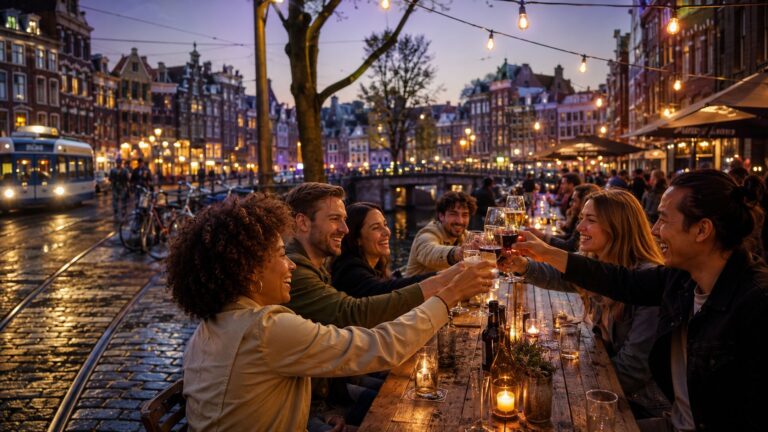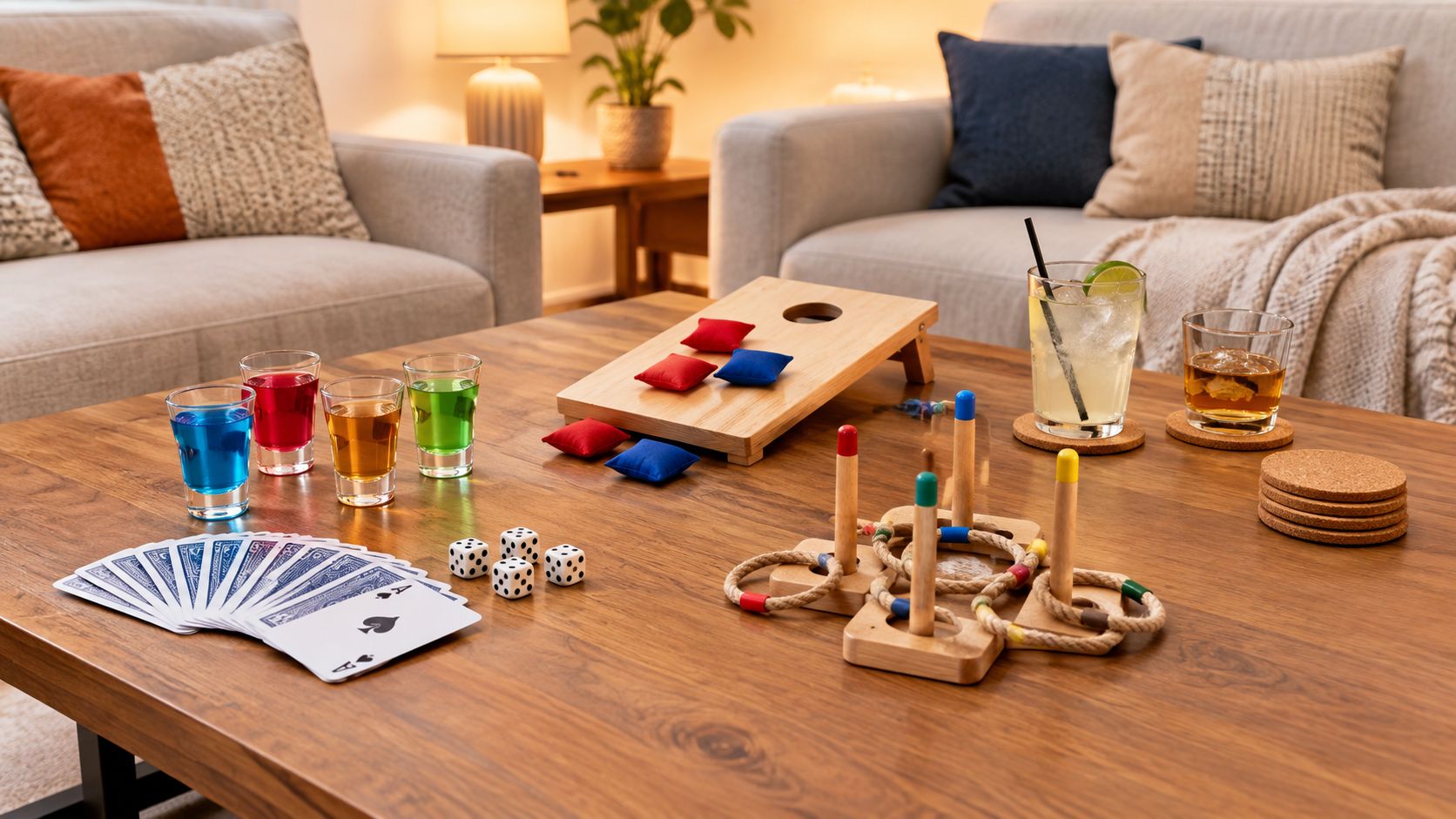
An international group in Amsterdam has finished dinner, the conversation is good, but nobody wants to commit to a full night out yet. The living room has enough space for a card game, the kitchen table can handle a few cups, and the group wants the easy social energy of a bar without queues, loud music, or pressure to keep drinking. That's where the right bar games at home earn their place.
The best choice depends on the room, the group's chemistry, the pace people want, and how comfortable everyone feels with attention or competition. The eight games below move from relaxed conversation starters to fast team contests, with materials, player guidance, rules, non-alcoholic variations, consent-aware boundaries, and practical hosting notes for each. Alcohol should never be mandatory. A smaller pour, a soft drink, water, or a no-penalty alternative should always count.
A compact setup can borrow ideas from this Monopack ltd bar setup without trying to recreate a commercial venue. If the group later wants hosts, local routes, and a more structured night, Ultimate Party Amsterdam can be a natural next step through a pub crawl or canal booze cruise.
Table of Contents
- 1. Beer Pong
- 2. Kings Cup
- 3. Flip Cup
- 4. Never Have I Ever
- 5. Drunk Jenga
- 6. Quarters or Coins
- 7. Two Truths and a Lie Drinking Edition
- 8. Spin the Bottle Drinking Version
- Bar Games at Home: 8-Game Comparison
- Choose Your Pace, Then Plan the Night
1. Beer Pong
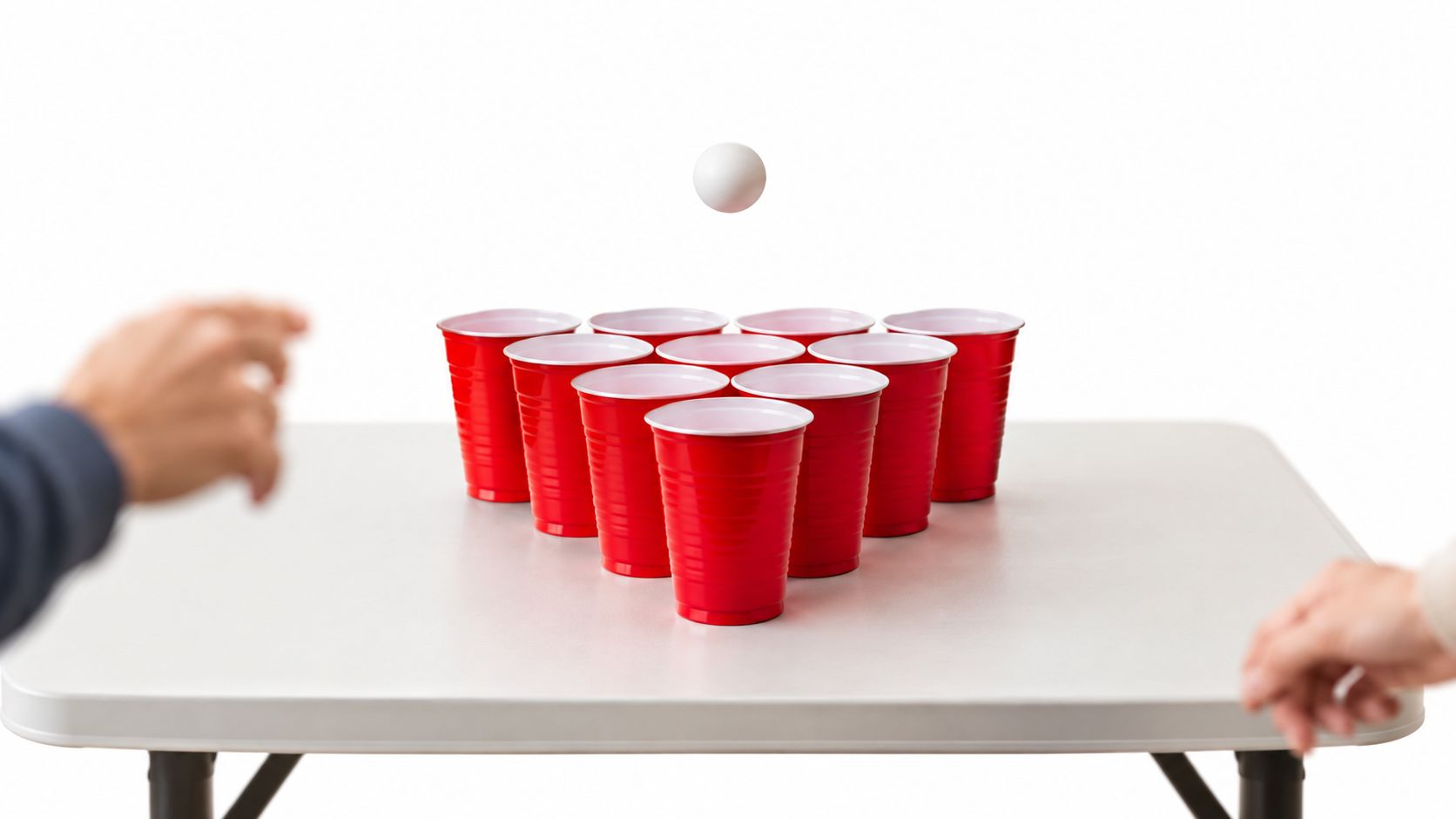
Beer pong creates immediate team energy without needing a complicated explanation. Two teams face each other across a table and throw ping pong balls toward cups arranged at the opposite end. In the standard setup, two teams of two use 10 cups in a triangle on each side. A successful shot means the defending team drinks from that cup and removes it, although house rules should decide how rebounds, re-racks, and bounced shots work before play begins. A practical beer pong guide describes both the familiar 10-cup format and smaller six-cup variations.
A sturdy folding table matters more than decorative glassware. A wobbling surface changes the bounce and turns a skill game into an argument, so plastic cups, spare balls, paper towels, and a water jug should sit nearby. Four players gives the game its cleanest rhythm, while larger groups can rotate teammates rather than crowding around the table.
Practical rule: Agree on whether a cup contains alcohol, water, or a non-alcoholic drink before the first throw. The competition works even when the cups are only targets.
Make the competition fair
Teams of two or three usually keep everyone involved. Pair a confident thrower with someone less experienced instead of letting the strongest players dominate one side. A first round without penalties helps international groups learn the house rules, especially when people know different versions from student housing, hostels, or parties in different countries.
The main trade-off is pace. Beer pong is social and spectator-friendly, but a long elimination format can leave half the room waiting. Use fewer cups after the opening round, or run short matches while the rest of the group chats. Keep drinks separate from the target cups if hygiene or spills are a concern.
For the morning after, groups can keep Amsterdam hangover planning practical by setting out food, water, and a clear stopping point before the game starts. If the room becomes too competitive, switch to a points-only version and let the winning team choose the next playlist.
2. Kings Cup
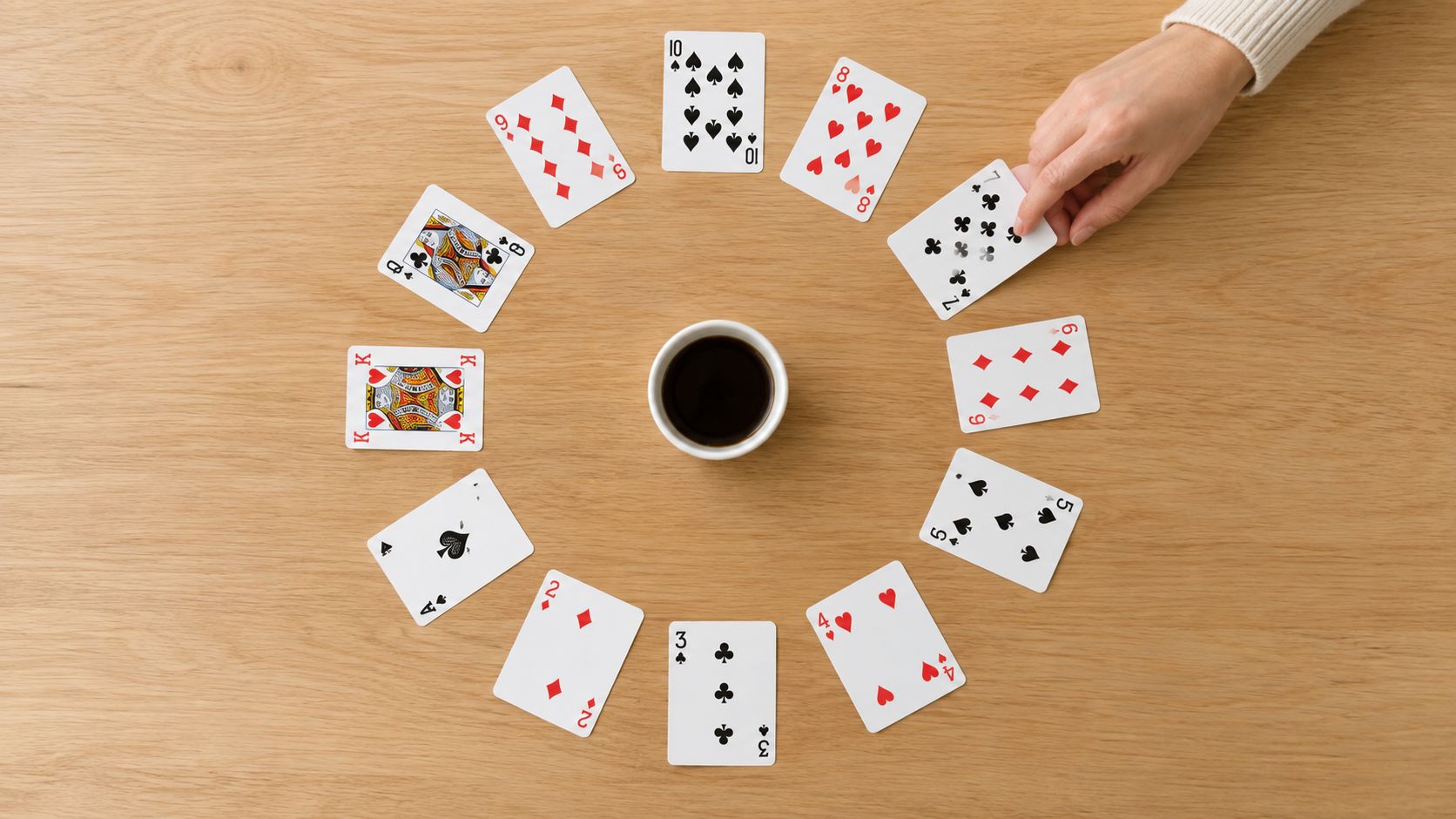
Kings Cup suits a group that wants conversation, improvisation, and a little chaos without moving around the room. Players sit in a circle with a deck of cards around a central cup. Each person draws in turn, and the group follows the rule assigned to that card. A visible rules sheet prevents arguments, especially when guests have learned different versions while travelling.
Common assignments include 2 for “you,” 3 for “me,” 4 for “floor,” 7 for “heaven,” 8 for “mate,” 9 for “rhyme,” 10 for “drink,” jack for questions, queen for categories, and king for the central cup. The exact rules are house rules, not universal law. A standard drinking-game drink is generally understood as one normal sip rather than a chug, and house rules should be agreed before play because they override the default set. The basic drinking-game guidance supports that approach.
A smaller central cup keeps the final king from becoming excessive. It also makes the game easier to convert into a soft-drink, water, or points-based format.
Keep the rules welcoming
Kings Cup works best when the first round stays simple. Rules that require memory, rhymes, or quick responses can be added later, but too many instructions at the start slow down the group and make new players feel exposed. One person can act as a referee, though that role should be light rather than controlling.
Players should be allowed to pass on any rule involving personal disclosure, physical contact, or a drink. A card can mean “take a sip,” “choose someone to answer a funny question,” or “add a point to the group total.” That flexibility makes the game suitable for mixed groups, including guests who don't drink or who prefer to stay in control of their pace.
The game often works as a pre-event activity for international travellers because it gives people an easy reason to speak. The same principle appears in planning a relaxed Amsterdam bachelorette party, where a clear structure can help guests with different personalities join in without forcing instant intimacy. Once the circle becomes repetitive, stop rather than stretching the game until the energy drops.
3. Flip Cup
Flip Cup is the choice for a room that needs momentum. Two teams line up on opposite sides of a table, each with a cup. The first player drinks, places the cup at the table edge, and tries to flip it upside down using the fingers. Only after that player succeeds can the next teammate begin.
The familiar version is quick, physical, and noisy. It rewards coordination more than experience, but it also creates spills, pressure, and rapid drinking. A non-alcoholic version can use water, juice, or a small amount of any drink, with the winning team determined solely by successful flips.
Protect the pace
Fill cups lightly enough to avoid unnecessary spills, and practise the flip motion before starting a competitive round. A neutral referee should judge whether a cup has landed completely upside down, since borderline calls can sour the mood faster than a missed shot. Teams should be balanced so one side doesn't contain every fast or experienced player.
Three or four rounds are enough for most home sessions. Beyond that, the relay can become repetitive and the drinking pace may become uncomfortable. Offer a “flip only” round, where players touch the cup to their lips without drinking, or let anyone substitute a water cup without explaining the choice.
A fast game should create movement, not pressure. Anyone can leave the line, rejoin later, or take a referee role.
The physical setup matters in an Amsterdam apartment. Protect the floor, move fragile objects away from the table, and warn downstairs neighbours if the room is likely to get loud. Flip Cup is excellent for a large pre-party group that needs a shared activity, but it's a poor choice when guests are still getting acquainted or when the furniture can't handle spills.
4. Never Have I Ever
Never Have I Ever is the easiest conversation starter when guests arrive at different times. Everyone sits in a circle. One person names something they have never done, and anyone who has done it takes a sip or marks a point. The useful part is the story that follows, not the drinking penalty.
Use prompts about travel, food, awkward public moments, and harmless mistakes. “Never have I ever missed a train in another country” gives people a safe opening to laugh and explain. Avoid sexual, medical, financial, traumatic, or highly personal questions, especially with international guests who have only just met.
Keep disclosure voluntary
Say “Pass is fine” before the first round, then follow that rule yourself. A player can pass, use water or a soft drink, or mark a point instead of drinking. No one should have to explain a choice or prove that a prompt applies.
This game creates gentle, conversation-led energy. It works well for couples, solo travellers, and a small group sharing a room before heading out in Amsterdam. A large circle slows the pace and leaves quieter guests waiting, so split into smaller groups or set a loose speaking limit. Do not interrupt someone who is telling a good story.
Rotate the starting player and invite explanations only when the person wants to share. Keep prompts broad enough for different backgrounds, and let guests write or suggest alternatives if the host's list feels too personal. Stop while stories remain fresh. If the group wants faster competition, choose a different game rather than forcing this one to become a drinking challenge.
For solo travellers joining a social night, tips for making friends on an Amsterdam pub crawl supports the same practical principle: low-friction prompts work better than forced introductions. At home, use the game to open conversation, then let ordinary discussion take over. Move to a hosted Amsterdam experience when the group wants a larger social mix, a planned route, or less responsibility for coordinating the next venue.
5. Drunk Jenga
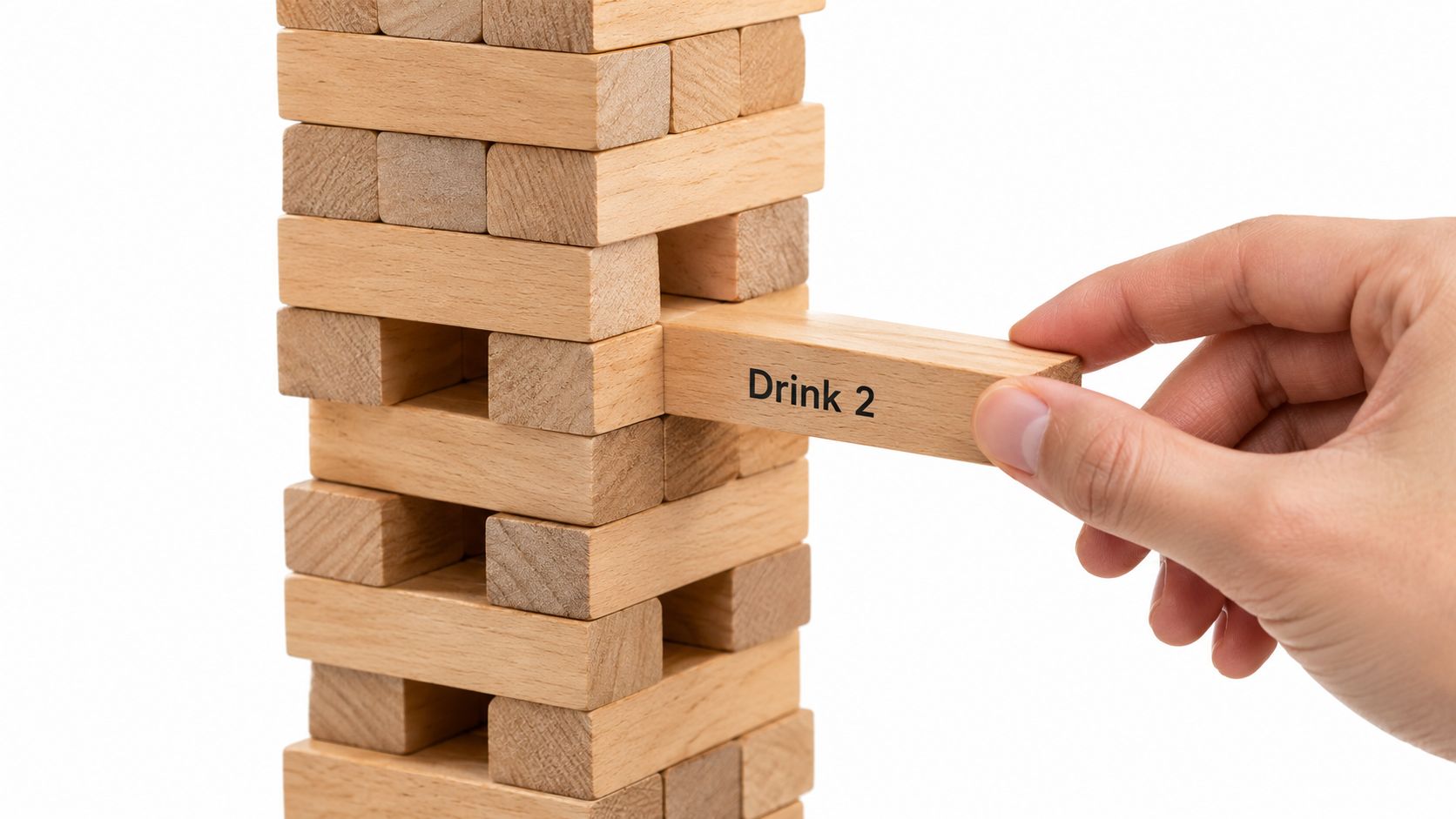
Drunk Jenga works for a smaller circle that enjoys suspense but doesn't need constant noise. Players remove a wooden block from the tower, follow the instruction written on it, and place the block on top. The tower grows less stable with every turn, while the prompts create the social layer.
A good home set mixes drinking prompts with storytelling, group actions, harmless dares, and questions. “Tell a travel disaster,” “choose the next song,” or “everyone changes seats” gives the game variety without making alcohol the central mechanism. A block can also instruct the player to take water, skip a turn, or nominate someone for a non-drinking challenge.
Write rules for the actual group
Permanent marker works well for a homemade set, but the instructions should be written for the people in the room rather than copied from a random party list. Avoid anything that demands nudity, unwanted contact, humiliation, or rapid consumption. Guests should be able to decline a block without needing to justify the decision.
A tower on a stable table is essential. Keep it away from glasses, phones, and the edge of a coffee table. The game can end naturally when the tower falls, which makes it easier to stop than games that depend on a fixed number of rounds.
The trade-off is that Jenga creates concentrated attention. That helps a small group bond, but shy guests may feel watched when they draw a provocative block. Use a “replace the block” option and let players write new prompts during the evening. A mixed group usually gets more enjoyment from clever storytelling than from increasingly extreme penalties.
6. Quarters or Coins
Quarters, or a local coin equivalent, is a compact precision game for a kitchen table. A player bounces a coin off the table into a cup or bowl in the centre. A successful shot can mean taking a sip, assigning a point, or choosing the next player, depending on the rules.
Start with a larger bowl or cup so beginners can learn the bounce. Once the group understands the motion, use a smaller plastic cup and mark a throwing line. The surface should be flat and stable, with enough clearance for a coin to ricochet without hitting glassware.
Build suspense without penalties
The game becomes more entertaining when success is uncommon, but a failed shot shouldn't automatically mean a large drink. A miss can just pass the turn, add a point to a running score, or trigger a funny question. Agree on whether the coin must bounce once, whether direct shots count, and how rollbacks work before anyone starts.
Keep spare coins nearby because they disappear under furniture. Plastic cups are safer than glass, especially when the group is playing near a crowded table. The game also works well as a background activity, with people joining for a few attempts rather than committing to a full tournament.
Quarters is best for a small competitive circle or as a reset between louder activities. It doesn't create as much conversation as Never Have I Ever, and it won't energise a large room like Flip Cup. Its strength is the quiet tension of a nearly successful shot, followed by an easy laugh when the coin bounces away.
7. Two Truths and a Lie Drinking Edition
Two Truths and a Lie works best when a group needs conversation before competition. Each player shares three statements about themselves, with two true and one false. Everyone votes on the lie, then the player can reveal a short explanation. An incorrect guess may mean a sip, a point loss, or a playful challenge, but water, points, and observation should remain equal options.
The host should demonstrate the format with plausible, low-risk statements. A travel mishap, unusual food preference, or surprising skill gives others something to discuss without demanding private information. Simultaneous voting keeps one confident guest from shaping the answer before quieter players have chosen.
Keep the social deduction kind
A convincing lie should create curiosity, not embarrassment. Guests can use simple facts if they prefer to disclose less, and nobody should be pressed to explain a personal statement. Travel, Amsterdam food, music, and childhood hobbies make useful themes for players who need a prompt.
Give larger groups separate circles so every person gets a turn. After each reveal, ask why the false statement sounded believable. That question often produces the game's best stories, while the penalty stays secondary. Non-alcoholic players can vote, keep score, or drink water. Dares are optional and unnecessary.
This format suits backpackers, mixed friend groups, and corporate teams that want an icebreaker with more substance than a shouting contest. It also works well before a hosted Amsterdam night out, especially when newcomers need a reason to learn names and personalities. Advice for solo travellers meeting people on a pub crawl reflects the value of giving strangers an easy starting point.
Use it as the final icebreaker before leaving home. Guests head out knowing two facts and one story about each person, which makes the first stop feel less anonymous. Move to a hosted experience when the room wants louder team play, clearer pacing, or a setting that can manage a larger group.
8. Spin the Bottle Drinking Version
Spin the Bottle can be harmless, funny, or quite uncomfortable, depending on the rules. The safer drinking version uses a plastic bottle and lets the person it points to choose between a sip, a question, or a light challenge. Kissing is never an assumed part of the game.
The host should explain the options before the first spin. Challenges can involve choosing a song, telling a short story, doing an impression, or swapping seats. Avoid dares that involve unwanted contact, public embarrassment, private information, or pressure to drink. Anyone can pass immediately, and the group should accept that without teasing.
Make consent part of the format
Mixed groups benefit from gender-neutral challenges and a clear choice between participation and observation. A player who doesn't want the bottle pointed at them can sit out the round or act as the spinner. The game works best when the bottle creates a prompt, not a social obligation.
Use a stable surface with enough room for the bottle to stop safely. A crowded coffee table full of drinks makes the game awkward and increases the risk of spills. If the group is already loud or intoxicated, replace the drinking element with points or questions, because chance-based contact can become harder to manage as the night progresses.
Spin the Bottle is useful for a playful group that already trusts one another. It isn't the right opener for strangers, a professional gathering, or anyone who looks uneasy. Stop the game immediately if genuine discomfort appears, then move to a neutral activity that restores conversation.
Bar Games at Home: 8-Game Comparison
| Game | Implementation complexity | Resource requirements | Expected outcomes | Ideal use cases | Key advantages |
|---|---|---|---|---|---|
| Beer Pong | Low, simple rules, basic setup | Table (long), cups, ping‑pong balls, drinks | Team competition, steady pacing, social interaction | Groups of 4–8 at home with 1.5+ hours | Low cost, easy to learn, highly adaptable |
| Kings Cup (Circle of Death) | Low–Medium, many house rules possible | Deck of cards, central cup, drinks | Unpredictable penalties, creative rules, variable pacing | 3–8 players, casual home sessions 45–120 min | Highly customizable, minimal equipment |
| Flip Cup | Low, straightforward relay mechanics | Sturdy table, cups, drinks | High‑energy competition, quick rounds, spectator engagement | 4–12 players, active groups, 30–60 min | Fast rounds, strong team bonding |
| Never Have I Ever | Very low, verbal turn‑based | None beyond drinks and seating | Personal stories, social bonding, relaxed pace | 3–15+ players, relaxed gatherings, 30–120 min | Inclusive, fosters conversation, no prep |
| Drunk Jenga | Medium, requires prep and rule writing | Jenga or wooden blocks, markers, drinks | Suspenseful play, dares/story prompts, tower tension | 2–8 players, 30–60 min, groups liking dares | Customizable, tactile engagement, memorable moments |
| Quarters (or Coins) | Low–Medium, skill‑based play | Coins, cup, flat stable table | Precision competition, slower pace, spectator focus | 2–6 players, 15–45 min, skill‑oriented groups | Very low cost, portable, appeals to competitive players |
| Two Truths and a Lie (Drinking) | Very low, turn‑based social deduction | None beyond drinks and seating | Storytelling, group insight, moderate pacing | 3–12 players, icebreakers or small groups, 45–120 min | Great icebreaker, builds rapport, no equipment |
| Spin the Bottle (Drinking Version) | Very low, chance‑based | Bottle, drinks, seating space | Random pairings, surprise moments, variable comfort | 4–12 players, casual parties, 30–60 min | Easy setup, high unpredictability, flexible rules |
Choose Your Pace, Then Plan the Night
The best game isn't necessarily the most famous one. It's the format that matches the group's energy and the room's limits.
Conversation-led games suit mixed groups, solo travellers, and guests meeting for the first time. Never Have I Ever and Two Truths and a Lie give people a reason to speak, but they should include passes and non-alcoholic options. Kings Cup can fill the same role when the group enjoys improvised rules, although too many rules will slow the evening down.
Table games work better for smaller competitive circles. Beer Pong creates a clear contest and gives spectators something to watch. Quarters offers a quieter skill challenge, while Drunk Jenga concentrates attention on one player at a time. These games need stable surfaces, protected floors, and enough space to keep drinks away from the action.
High-energy team games should appear when the room needs momentum, not as an automatic opening move. Flip Cup gets people standing and cheering, but the rapid pace calls for smaller pours, water breaks, and a firm limit on rounds. Spin the Bottle can add playful unpredictability for a trusted group, but it needs the clearest consent rules of the list.
Home drinking is often paired with food, screens, conversation, and games rather than treated as a standalone activity, according to research on drinking contexts published through the National Library of Medicine. That observation supports a practical hosting choice: the game should serve the evening, not become the entire evening. A group that wants to talk may prefer one short round followed by food. A group that needs an energy lift may use a team game, then move on before the room gets too loud.
Water, food, smaller pours, soft drinks, and a clear stop time are part of the setup, not an afterthought.
For a group staying in Amsterdam, moving from a home game into nightlife should be optional. A hosted pub crawl can help travellers who want a planned route and social structure, while a shared or private canal booze cruise may suit a group that prefers the city's water and a contained experience. Ultimate Party Amsterdam also offers concierge help for private arrangements, which can be useful when a celebration involves more logistics than a living room can handle.
The practical choice is simple. Start with the group's pace, protect everyone's comfort, and switch activities before enthusiasm turns into pressure. A good home bar-game night doesn't need the most rules or the strongest drinks. It needs a format that lets people participate, talk, and leave the table feeling better than when they sat down.
For a hosted Amsterdam night, Ultimate Party Amsterdam offers guided pub crawls, shared and private canal booze cruises, and concierge support for private arrangements. Groups can use the home games as a relaxed warm-up, then visit Ultimate Party Amsterdam to choose an experience that fits the way they want to explore the city.
🍻
Experience it Yourself
Skip the planning — join Amsterdam's biggest pub crawl and get 6 bars, free drinks and VIP club entry for €20.