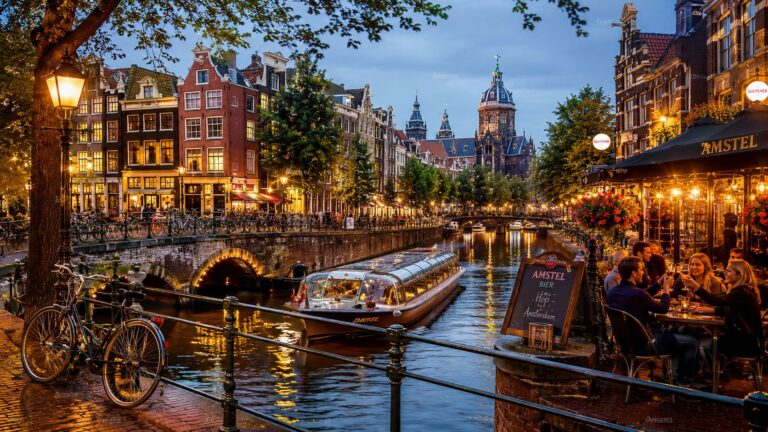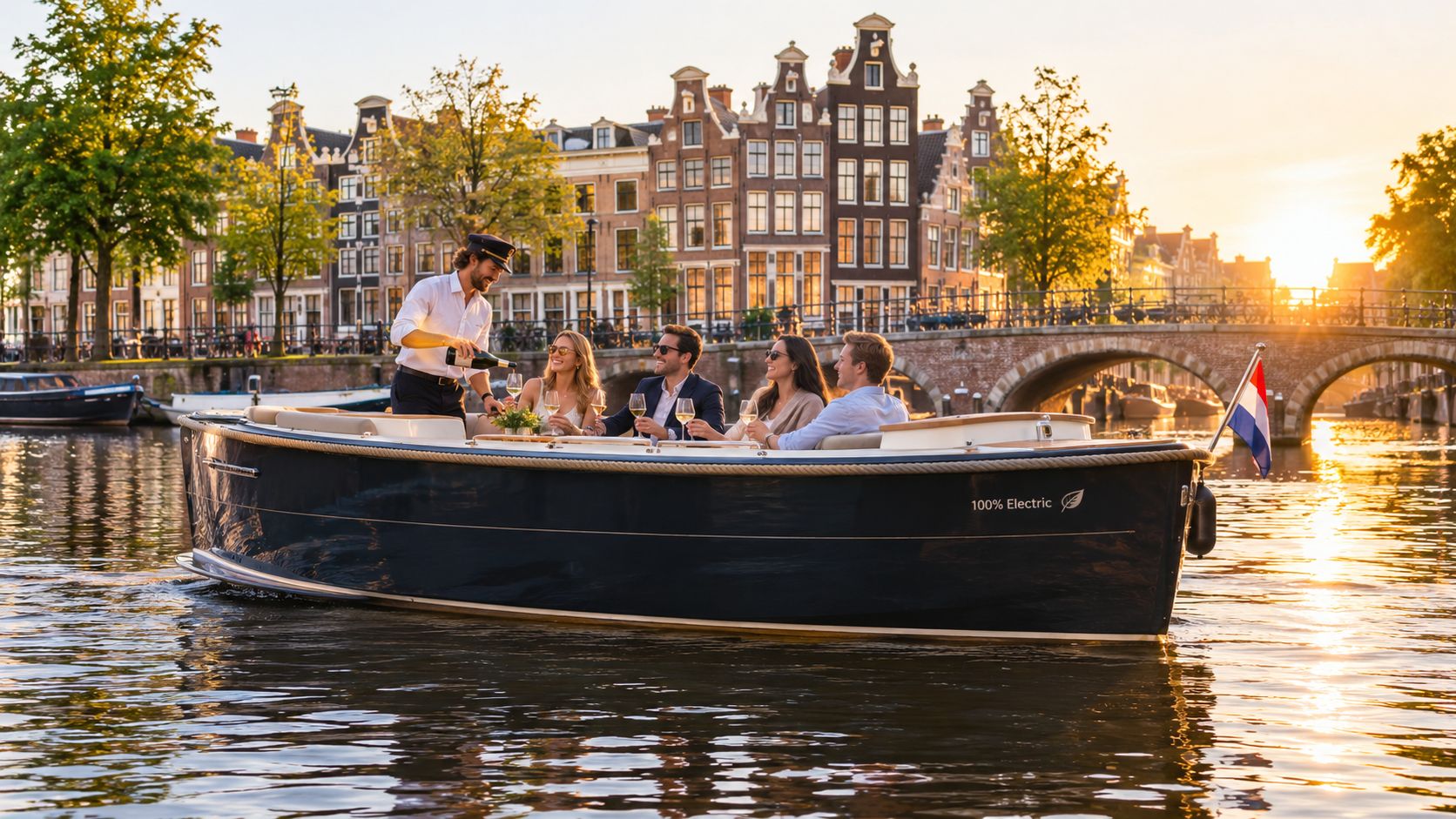
A private boat trip in Amsterdam usually starts the same way. A group gathers at a central pier, someone checks who's late, the skipper waits with the route already in mind, and a drink lands in hand before the boat even clears the berth. That first minute tells you almost everything about the booking, whether the group wants a polished social hour, a moving pre-party, or just a calm way to see the canals without being packed in with strangers.
The phrase private boat trip Amsterdam covers a lot more than a pretty cruise photo. It can mean a licensed private charter for friends, a nightlife add-on before a pub crawl, a corporate welcome hour, or a compact celebration that needs to stay comfortable, legal, and on time. The difference between a smooth night and a messy one usually comes down to planning, not luck.
Table of Contents
- A First Hour on the Amsterdam Canals
- Why the Canal Belt Shapes Every Private Route
- Picking the Right Time, Day and Duration
- Matching Boat Format to Group Size and Vibe
- What an Open Bar, Crew and Inclusions Really Cover
- Electric Boats, the 2025 Zero-Emission Zone and What to Verify
- Building the Night Around the Cruise
- Booking Checklist and Common Planning Mistakes
A First Hour on the Amsterdam Canals
The best private departures feel organised without feeling rigid. Guests step aboard, coats go down, the host checks the mood of the group, and the boat leaves on a route that fits the crowd rather than the other way around. That matters because the hour passes fast, and a good charter is really a series of small decisions, where to board, when to leave, how loud the music should be, and whether the group wants sightseeing, socialising, or both.
What the booking really is
A private canal trip is not the same thing as a sightseeing boat with empty seats. It is a reserved boat for one group, usually with a skipper and sometimes a host, running on a schedule that has to work within Amsterdam's canal rules and bridge-heavy layout. For a group researching a private boat trip Amsterdam, the practical question is simple, does the charter fit the group size, energy, and night plan without forcing compromises later.
That also explains why these bookings are rarely just about drifting past the gables. They are social sessions with logistics attached, and the logistics matter because the group is on a moving vessel in a dense historic centre. If the timing is wrong, the boat can feel cramped. If the format is wrong, the drinks or music setup can feel off. If the route is careless, the view can be repetitive even though Amsterdam itself is anything but.
Practical rule: the right private charter should feel like the group's own room on the water, not a generic cruise with a private label on top.
Why the Canal Belt Shapes Every Private Route
Amsterdam's canal trip works because the city was built around water, not beside it. The oldest surviving canals date to the late medieval period, with the Oudezijds Voorburgwal commonly dated to 1385, and the canal ring around the Herengracht, Keizersgracht, and Prinsengracht grew during the major urban expansion that began in 1613. In 1662, the principal canals were extended into the semicircular layout people recognise today, and that shape still decides how a private route feels on the water. Amsterdam's canal history and UNESCO status
Heritage is not just scenery
The historic canal district was added to the UNESCO World Heritage List on 1 August 2017, recognising it as a seventeenth-century planned port city and a major achievement in urban design. That matters to guests because a private cruise is movement through a protected urban environment where façades, bridges, and sightlines all affect the experience. It also matters operationally, because operators have to balance access with preservation, which is why route choices in the central ring often feel curated rather than improvised.
The core value lies in density. The canal belt compresses roughly 80 bridges into 12.5 kilometres, so a 60-minute route can still pass a surprising number of distinct views without leaving the centre. The same waterway network also sees heavy use, with over 3.25 million annual canal-boat passengers in the city centre Amsterdam visitor facts and figures. That does not make the canals less enjoyable, it just means the route has to work with traffic, bridges, and timing.
A strong route does not need distance. It needs a sequence of views that keeps changing before the group gets bored.
What that means when evaluating a route
The best route proposals usually mention bridges, timing, and the parts of the ring that fit the group mood. Weak proposals lean on vague promises and ignore the canal layout entirely. If a charter claims to be private but cannot explain where it will cruise, the planning is thin.
Picking the Right Time, Day and Duration
The wrong time slot can make a private charter feel cramped, rushed, or oddly flat. The right one gives the group enough room to settle in, talk, and enjoy the canal views without wasting the boat on a dead stretch of the evening. A 60-minute trip can work very well for a focused social window, but only if the timing matches the mood.
How Amsterdam changes across the day
An early departure usually suits groups that want conversation and photos. Light is kinder, the pace feels calmer, and there is less pressure on the rest of the evening. Late afternoon brings a better balance of atmosphere and daylight, while sunset and evening suit groups that want the city lights and a stronger sense of occasion.
Weekday afternoons and weekend slots do not behave the same. On busier evenings, the canals feel more active, routes can tighten, and the boat operator has less room to improvise. The city centre sees heavy canal traffic, so a good departure time is less about convenience and more about choosing a window that still gives the group the experience it expects.
A private cruise also needs to sit cleanly inside the rest of the night. Where the cruise sits in the evening is covered in the sequencing section below, here the question is purely which slot fits the group's energy.
| Time slot | Typical atmosphere | Best for | Watch out for |
|---|---|---|---|
| Early afternoon | Quieter, lighter, more practical | Mixed-age groups, relaxed sightseeing, corporate outings | Can feel too calm for party groups |
| Late afternoon | Balanced, social, good light | Friend groups, pre-dinner plans, photo-heavy trips | Weekend congestion can tighten routes |
| Sunset and evening | Most atmospheric, more energetic | Birthdays, hen and stag groups, nightlife warm-up | Less forgiving if the group runs late |
The day matters as much as the hour
Weekdays usually reward groups that want a cleaner, less hurried feel. Weekends bring more energy, but they also leave less margin if people are late or the plan changes. King's Day is a different category altogether, because route restrictions, boat-length limits, and crowded waterways change what is realistic.
A booking that works on a normal Saturday can fail on a high-demand event day if the operator has not adjusted the plan. That is why the best question is not just “what time is available?”, but “what time still works once the rest of the city has its own rhythm?”
Matching Boat Format to Group Size and Vibe
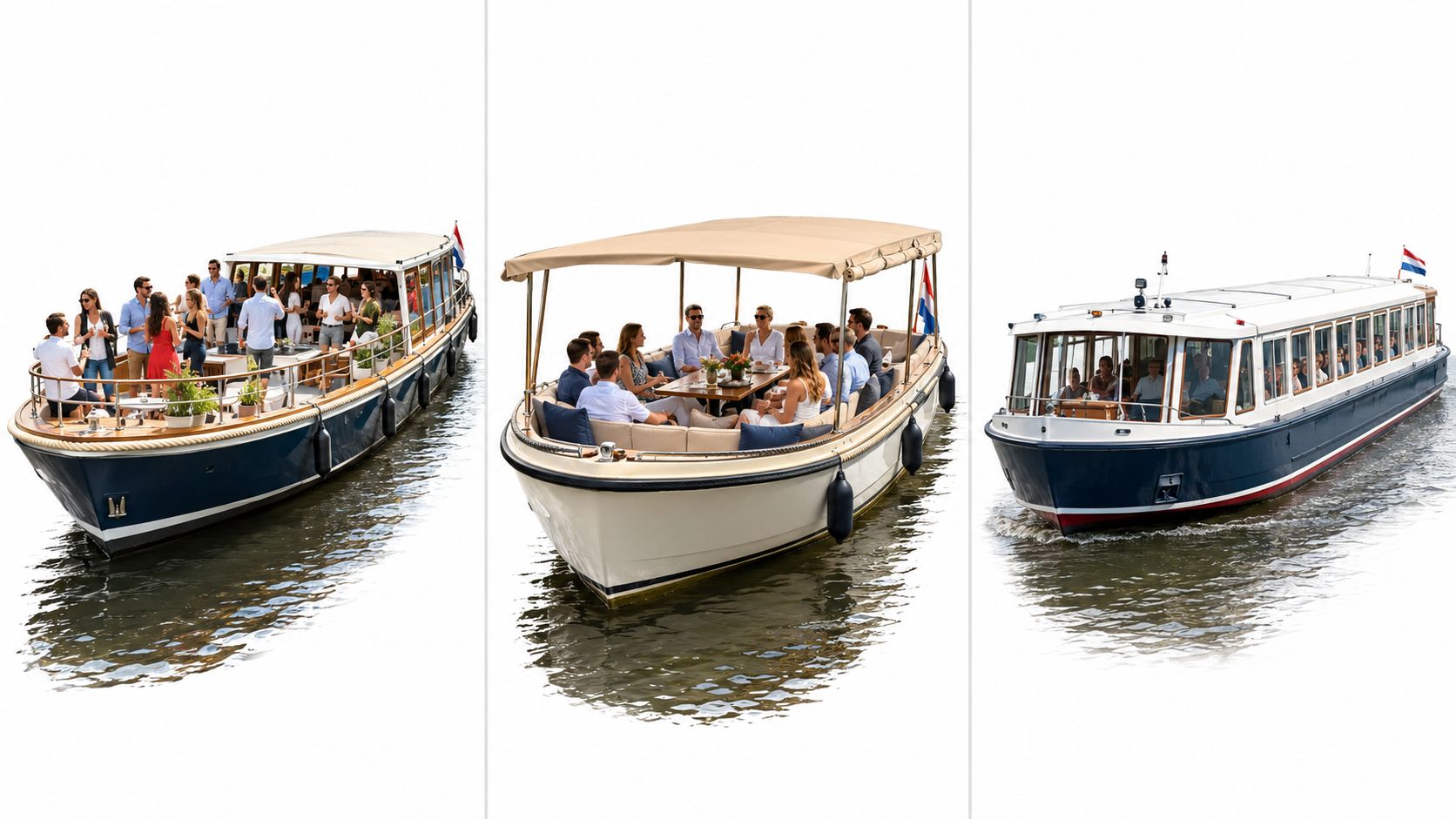
A private boat trip in Amsterdam works best when the boat fits the group, not just the date. A quiet shared cruise, a small private charter, and a larger licensed passenger vessel all create a different pace on the water, and the legal threshold matters too. Under local regulation, pleasure craft in the city centre are limited to 12 passengers plus a skipper, and carrying passengers commercially requires an appropriate operating licence safe boating rules.
Private or shared
A shared cruise suits groups that care more about price than privacy and are fine mixing with other guests. A private charter suits a fixed guest list and gives the group control over music, conversation, and how social the boat feels. A group of 10 can stay on a single private charter. A group of 14 needs either two boats or a licensed passenger vessel, because once the headcount crosses the city limit, the boat category has to match the legal setup.
That threshold also changes the experience on board. On a smaller private boat, people usually talk more because the space is tight and the atmosphere feels immediate. On a larger licensed vessel, there is more room to spread out, but the group can lose some of the close-knit feel that makes a charter work. The better choice is the one that fits the mood you want, not the one that just sounds bigger.
Good planning rule: book for the actual behaviour of the group, not the number on the invite.
Reading the listing correctly
A proper listing should say whether the experience is fully private or semi-private, whether the boat category is licensed for the group size, and whether the format is built for socialising or sightseeing. If that detail is missing, ask before paying a deposit. A few minutes of clarification is cheaper than finding out at the pier that the boat is not set up for the group you brought.
For groups that want a clearer nightlife structure, a hosted shared format can still make sense before or after a private charter. A shared booze cruise gives that middle ground when the group wants movement, drinks, and a social crowd without committing to a full private booking. The key question is which part of the night should feel intimate, and which part should feel more social.
What an Open Bar, Crew and Inclusions Really Cover
A private cruise page can look complete and still leave important terms vague. “Open bar” can mean a few different setups depending on the boat and operator, and crew support can range from a skipper-only arrangement to a more guided host-led trip that keeps drinks and group flow under control. The question is simple, what do you get once the boat leaves the pier?
Ask what the package contains
Before paying a deposit, get the basics in plain language.
- Crew structure: Who is on board, and whether the boat has only a skipper or also a host.
- Bar contents: What the bar serves, and whether it is an open Dutch bar, a limited drinks list, or another setup.
- Guest behaviour rules: Whether the group can bring extra bottles, or whether everything must stay inside the package.
- Weather handling: What happens if the forecast changes, since a canal boat trip still depends on the weather.
- Rescheduling terms: How flexible the operator is if the group needs a different departure slot.
- Departure logistics: Where boarding happens, and how strict the timing is.
Those details matter because pricing pages can look similar at first glance. Two boats can both be called a private charter, but one may include better hosting, clearer boarding logistics, and a much cleaner alcohol policy for the group.
A practical benchmark for comparison
Ultimate Party Amsterdam's Private Booze Cruise is presented as a 60-minute private canal charter on a luxury electric boat with an open Dutch bar, which makes it a useful reference point when comparing package structure. That is the level of detail a booking page should give without hesitation. Crew duties, bar coverage, and which items count as an upgrade should all be spelled out before money changes hands.
If the group is booking for a celebration, the cost is often the wrong assumption, not the add-on itself. Clear terms upfront are cheaper than sorting out disappointment on the pier.
Electric Boats, the 2025 Zero-Emission Zone and What to Verify
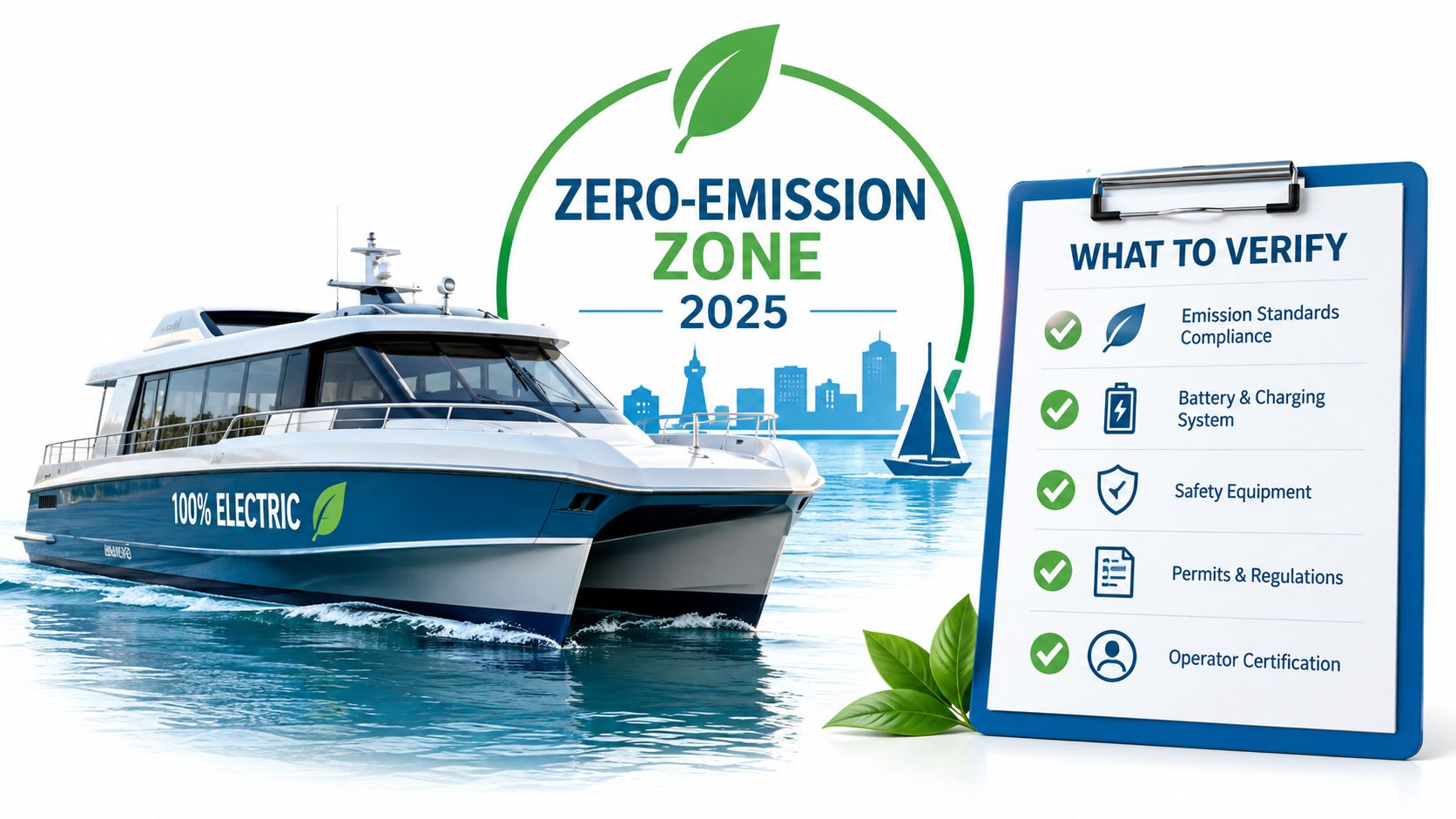
The phrase electric boat gets thrown around so often in Amsterdam that it has become almost meaningless unless the operator is specific. From 1 April 2025, pleasure craft in Amsterdam's city-centre zone, including the Singelgracht, must generally be electric, hydrogen-powered, or human-powered, while petrol and diesel boats are restricted to specified through-routes unless transitional permissions apply Amsterdam canal rules. That means propulsion is no longer a casual selling point, it is part of the operating reality.
What to verify before booking
A serious booking conversation should cover the vessel category, the propulsion type, and whether the planned route stays inside the zone rules. If the boat can leave the zone, ask what happens then. If the battery is low or the weather changes, ask whether the operator reroutes, delays, or swaps vessels. Those details matter because a label like “eco-friendly” says very little about how the trip will run.
The other important question is comfort. Electric propulsion usually helps with local exhaust and noise, which is valuable on a canal route where the group wants to talk and enjoy the city, but that does not make every boat equally resilient in poor weather or equally suited to longer routing decisions. The route, capacity, charging arrangement, and backup plan all shape the actual experience.
Sustainability claims need precision
An electric vessel is not automatically the same thing as a fully sustainable trip in every sense. Battery production, electricity sourcing, and passenger density all affect the bigger picture. For corporate groups and environmentally conscious visitors, the best operators are the ones that explain what is genuinely zero-emission in use and what still depends on operational choices. Broad labels are cheap. Specifics are useful.
If a boat page says “electric” but can't explain the route, backup plan, or cruising limits, the claim is doing marketing work that the booking team still has to verify.
Building the Night Around the Cruise
A private cruise works best as the centre of the night, not the whole night. In Amsterdam, the strongest evenings usually have a clear start, a social stretch on the water, and one final stop everyone can reach together. Drop the boat into the schedule without structure, and the group often loses momentum.
A cleaner sequence for group nights
A workable order is pub crawl, boat, then club or late bar. That sequence gives the group a reset between venues, a chance to regroup, and a quieter stretch before the night gets louder again. For a wider view of the city's evening flow, see this guide to Amsterdam nightlife, then place the canal hour inside that broader plan.
For ideas on what comes after the boat, see this guide to Amsterdam nightlife beyond the bars, late-night eats and entertainment. A hosted crawl through the Red Light District or Leidseplein also fits well after a 60-minute charter, because the host can manage regrouping between venues while the boat keeps the group together for the first part of the night.
King's Day and route discipline
Special event days need tighter planning. Boats up to 10 metres may sail through Amsterdam's canals, while longer boats are restricted from named waterways including the Zoutkeetsgracht, Prinsengracht, Rokin, Conkouburgwal and Oudezijds Voorburgwal during King's Day King's Day rules. The evening should be built around what is possible on the day, not around a generic route idea.
That matters even more when the cruise is only one part of a bigger night. Transport, timing, and venue access all shape how smoothly the group moves from one stop to the next. A well-run evening is rarely the one with the most stops. It is the one where nobody has to guess what comes next.
Booking Checklist and Common Planning Mistakes
A booking goes better when the hard questions are answered before money changes hands. For a private boat trip Amsterdam, check the vessel type, propulsion, guest limit, boarding point, bar setup, and weather policy. If the night is a celebration, confirm whether the cruise is private or shared, because that affects the pace, privacy, and how much control you have on board.
The checklist that avoids most problems
- Vessel and propulsion: Confirm whether the boat is electric, hydrogen-powered, or otherwise allowed on the planned route.
- Guest count: Make sure the group stays within the 12 passengers plus skipper limit, or book a licensed passenger vessel.
- Departure logistics: Confirm the pier, arrival time, and who meets the group.
- Inclusions: Ask exactly what the open bar, crew, and onboard setup include.
- Weather and rerouting: Get clarity on what happens if conditions change.
- Cancellation terms: Read the timing and flexibility before you pay.
A frequent mistake is choosing a boat that looks right in photos but does not fit the group size or the social goal. Another is assuming a “private” listing automatically means flexible routing or better service. The operator still has to work within canal rules, bridge density, vessel limits, and the practical constraints of moving a group through the city centre.
For celebrations, the night should be treated as one connected plan. Good hen party planning tips focus on keeping the schedule simple enough that the group stays together instead of splitting into loose subgroups.
If you are comparing formats, the Shared Booze Cruise gives one point of reference, while the private format benchmarked earlier shows what changes once the boat is reserved for one group only. Ultimate Party Amsterdam can also help when the cruise is only one part of the night, especially if transport and reservations need to sit around the boat rather than compete with it.
The best booking is the one that matches the group's size, timing, and tolerance for planning friction.
🍻
Experience it Yourself
Skip the planning — join Amsterdam's biggest pub crawl and get 6 bars, free drinks and VIP club entry for €20.