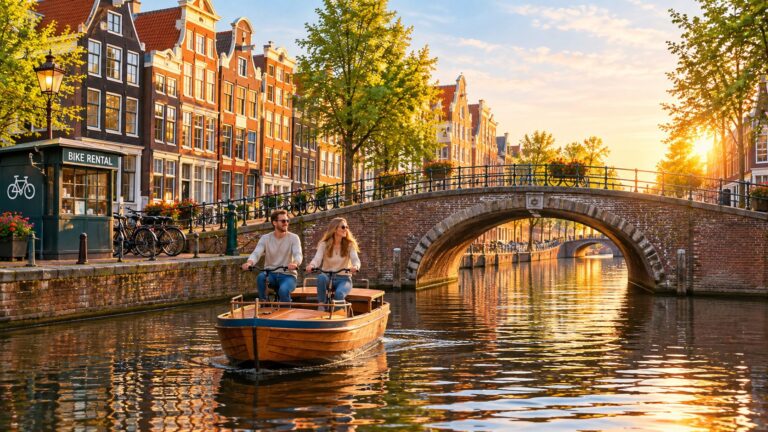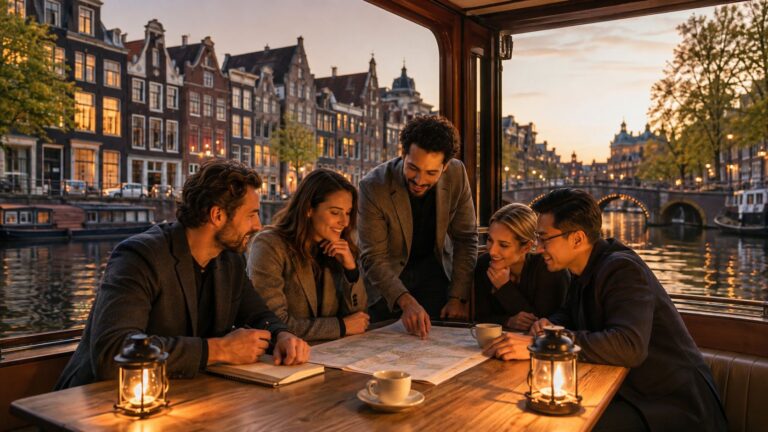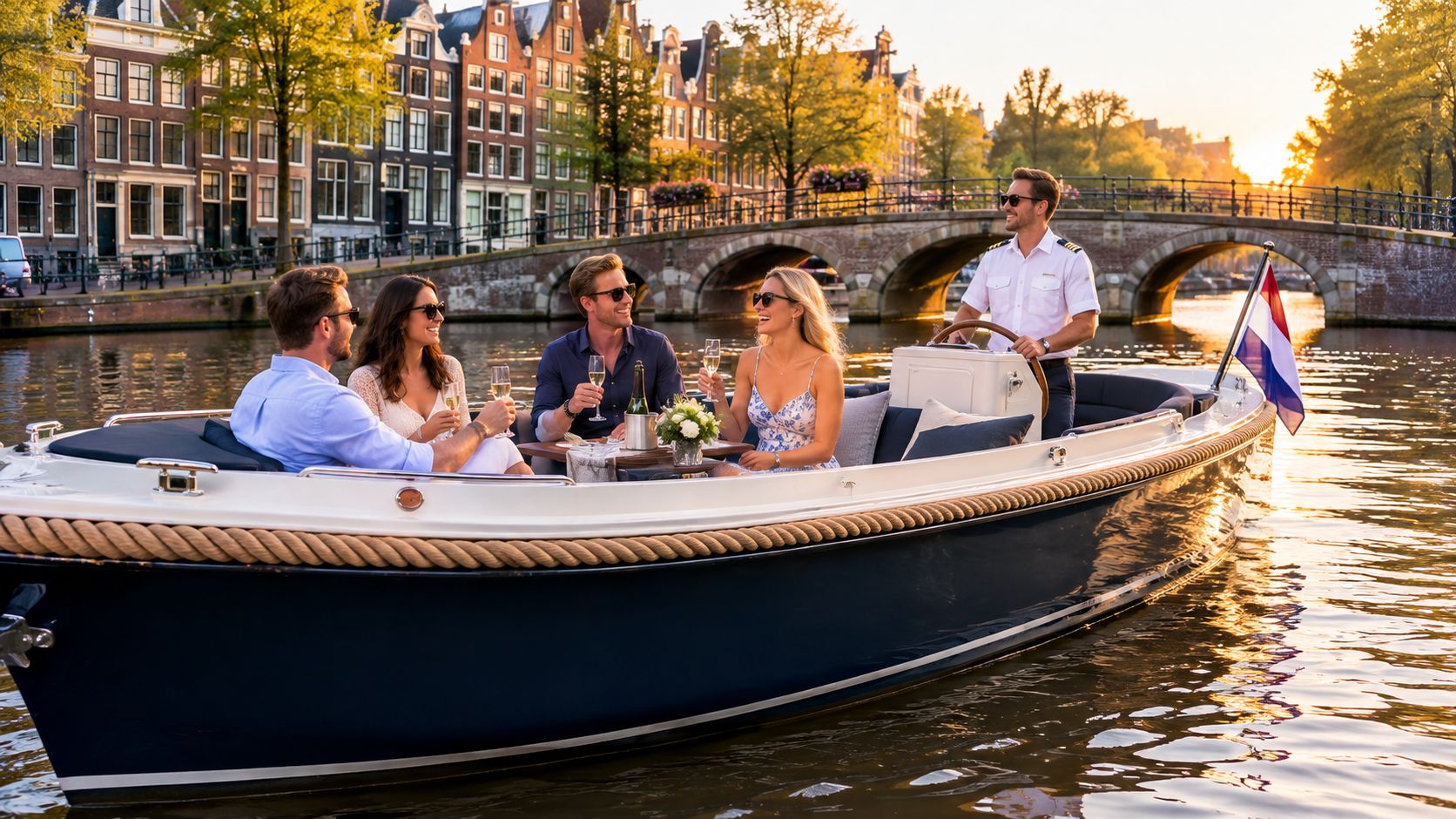
The group chat has settled on a private boat, but the organizer still has several tabs open and no clear answer about what's included. For private canal tours in Amsterdam, the useful comparison isn't which listing has the prettiest bridge photograph. It's which boat, boarding arrangement, drinks package, and operating conditions fit the group's evening.
Table of Contents
- The Group Booking That Started on the Wrong Canal
- What Makes Amsterdam's Canals a Private Tour Setting
- The Main Types of Private Canal Tours and Who Each Suits
- What Actually Changes the Experience On Board
- How Ultimate Party Amsterdam's Private Booze Cruise Works
- Rules and Practical Realities Most Listings Skip
- Before You Book and Common Questions
The Group Booking That Started on the Wrong Canal
Consider a birthday group arriving in Amsterdam with one free evening and a loose plan for drinks on the water. Someone has saved a boat photograph. Someone else has booked dinner. Nobody has checked whether the cruise departs near the restaurant, whether the whole vessel is private, or whether the advertised bar includes the drinks the group expects.
This is a planning scenario, not a customer case study. It illustrates a straightforward problem: a boat can look right online and still be wrong for the occasion.
Amsterdam's sightseeing fleet includes around 200 tour boats carrying more than 3 million passengers annually, with some estimates exceeding 3.25 million, according to the Amsterdam canal tourism overview. That scale makes a precise booking description more useful than another scenic photograph.
Start with the evening, not the boat
The organizer should establish whether the group wants conversation, sightseeing, or a celebration before comparing listings. A birthday toast with friends requires a different balance of commentary and hosting from an architecture-focused afternoon.
The practical shortlist should answer:
- Privacy: Does the booking reserve the entire vessel, or only places on a shared departure?
- Coordination: Can everyone reach the confirmed boarding point without disrupting dinner plans?
- Expectations: Is the priority scenery, drinks, guided interpretation, or time together?
- Suitability: Can the operator confirm a vessel that accommodates the actual guest list?
Celebration details should follow those decisions, not replace them. For wedding groups organizing keepsakes alongside the itinerary, California Cowboy's resource on personalized gifts for wedding crews is a separate planning reference. Gifts and matching outfits won't resolve an unsuitable boarding arrangement.
Organizer's rule: Confirm the operational details before collecting money from the group.
A private booze cruise is one possible answer, not the automatic answer. A sightseeing charter may suit a quieter celebration better, while a shared cruise may suit travelers who actively want company. The right booking starts with an honest description of the group, not the broad label “private boat.”
What Makes Amsterdam's Canals a Private Tour Setting
Amsterdam's waterways aren't a purpose-built leisure circuit. The canal system developed to support a growing city, with water management, defense, freight, and passenger movement shaping its original use.
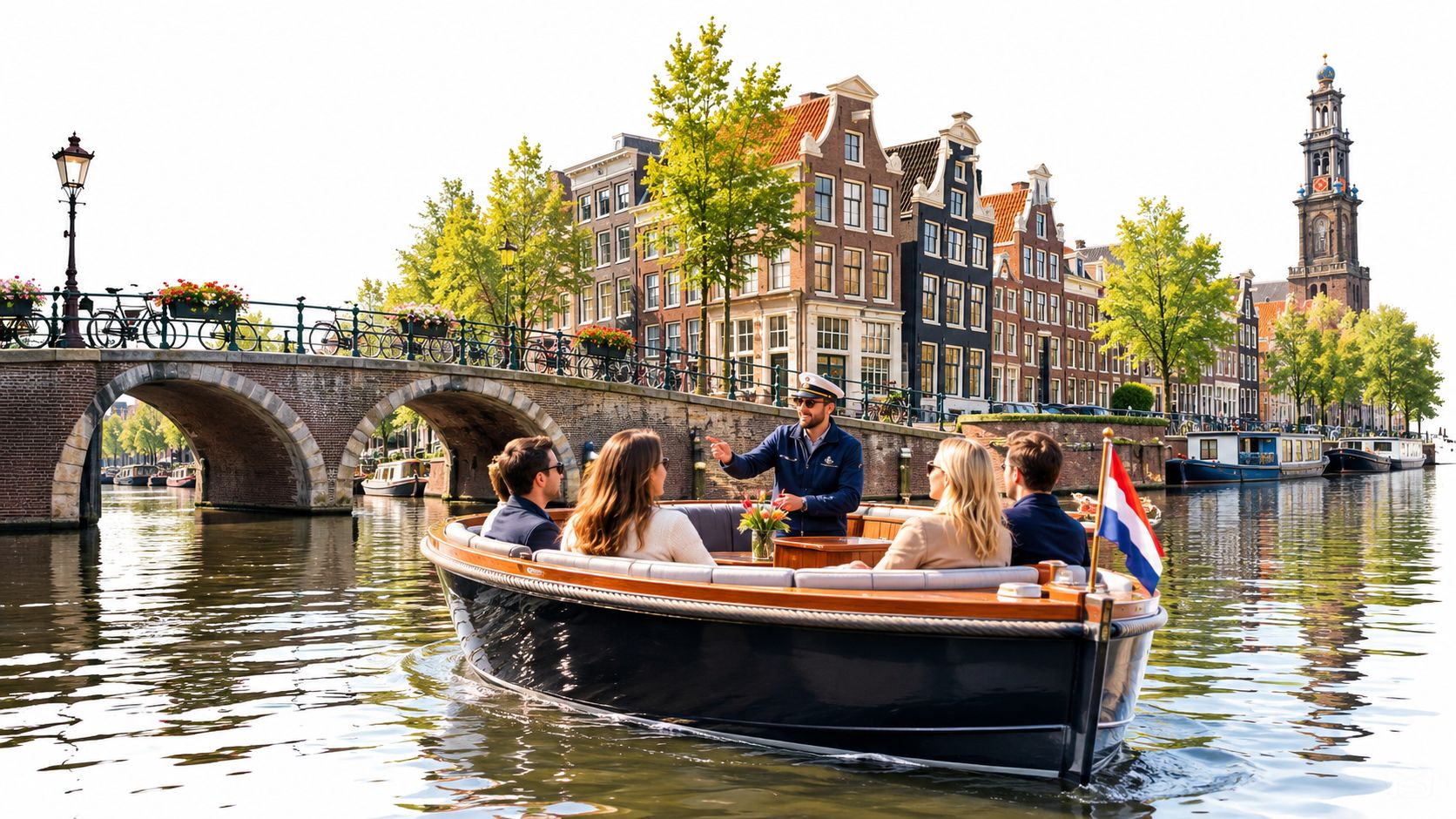
The network contains roughly 165 canals extending about 100 kilometers, alongside approximately 90 islands and more than 1,200 bridges. The central belt developed during the late sixteenth- and seventeenth-century expansion, principally around the Singel, Herengracht, Keizersgracht, and Prinsengracht; the seventeenth-century ring received UNESCO World Heritage recognition in August 2010, as detailed in this history of Amsterdam's canals.
A route is an operating decision
That heritage setting is the attraction, but its physical layout also limits the itinerary. Bridge clearance, turning space, vessel dimensions, and congestion belong in route planning. A request to include a particular canal should therefore be a question for the operator, not an assumption based on a map.
Amsterdam's normal canal speed limit is 6 km/h, with 7.5 km/h allowed on specified wider waterways, including parts of the Amstel, Oosterdok, Nieuwe Herengracht, and Kostverlorenvaart, under the city's safe-boating rules. A short charter should be planned around atmosphere and nearby scenery, not an ambitious cross-city transfer.
The useful route questions are practical:
- Departure and return: Are both locations confirmed, or is a different finishing point only a request?
- Priority sights: Which requested waterways are feasible for the assigned boat?
- Timing: Does the proposed itinerary leave room for normal operating delays?
Private doesn't mean unrestricted
A private vessel gives the group its own social space. It doesn't create permission to ignore navigation restrictions, and it doesn't automatically provide complete control over the route.
The distinction from a shared sightseeing vessel is therefore more about how the group uses the experience than access to exclusive scenery. Friends can concentrate on their own conversation rather than the expectations of unrelated passengers. Travelers seeking detailed history should still confirm that commentary is part of the booking.
Passenger-category rules also affect which vessel can be assigned. Those checks belong alongside route planning, before the group becomes attached to a particular boat photograph.
The Main Types of Private Canal Tours and Who Each Suits
The word private describes exclusivity, not the character of the cruise. It doesn't establish whether the skipper delivers commentary, whether drinks are included, or whether the atmosphere is quiet.
The most reliable comparison starts with the occasion. Operators should be able to explain what a listed experience prioritizes without relying on words such as “luxury” or “unforgettable.”
Sightseeing and celebration charters
A private sightseeing charter suits travelers whose main interest is the city. The deciding question is whether guided interpretation is included and how it's delivered. An attractive route isn't a substitute for knowledgeable commentary when architecture and history are the point of the booking.
A celebration-focused cruise puts the group's interaction first. Birthdays, reunion trips, and wedding weekends can suit this format when the organizer wants everyone together rather than splitting between activities.
For hen-party organizers, the broader Amsterdam bachelorette party planning guide can help place the cruise within a workable itinerary. The recommendation is to give the boat a clear role in the evening rather than treating it as something to squeeze between unrelated reservations.
| Format | Strongest fit | Deciding question |
|---|---|---|
| Sightseeing charter | Guests interested in the city | Is live commentary included? |
| Celebration cruise | Friends marking an occasion | Which drinks and hosting arrangements are included? |
| Party-oriented charter | A group seeking a lively social setting | What atmosphere is permitted on board? |
| Corporate charter | Colleagues or clients needing private time together | Can the setup support conversation and the planned purpose? |
Party energy and professional groups
A party-oriented listing needs especially careful reading. The organizer should distinguish between a sociable drinks cruise and an expectation of a floating nightclub. Music permissions need explicit confirmation, not interpretation from promotional photographs.
Corporate groups need a different check. A private boat may work well for informal introductions, but a planned speech or presentation requires confirmation of suitable space and permitted equipment. Privacy alone doesn't establish meeting facilities.
Match the experience to the least flexible requirement, whether that's detailed commentary, accessible boarding, or uninterrupted conversation.
Group suitability should come from the operator's confirmed capacity and layout, not generic advice about what “usually fits.” A vessel with enough permitted places can still be a poor match for the group's preferred atmosphere. The organizer should describe the occasion plainly and ask what the proposed boat can deliver.
What Actually Changes the Experience On Board
A listing's strongest adjective is rarely its most useful detail. Luxury, hosted, and flexible all need translation into something the organizer can verify.
The useful description names the vessel, seating arrangement, propulsion, weather provisions, drinks terms, and boarding location. If those details remain vague, the group still doesn't know what it's booking.
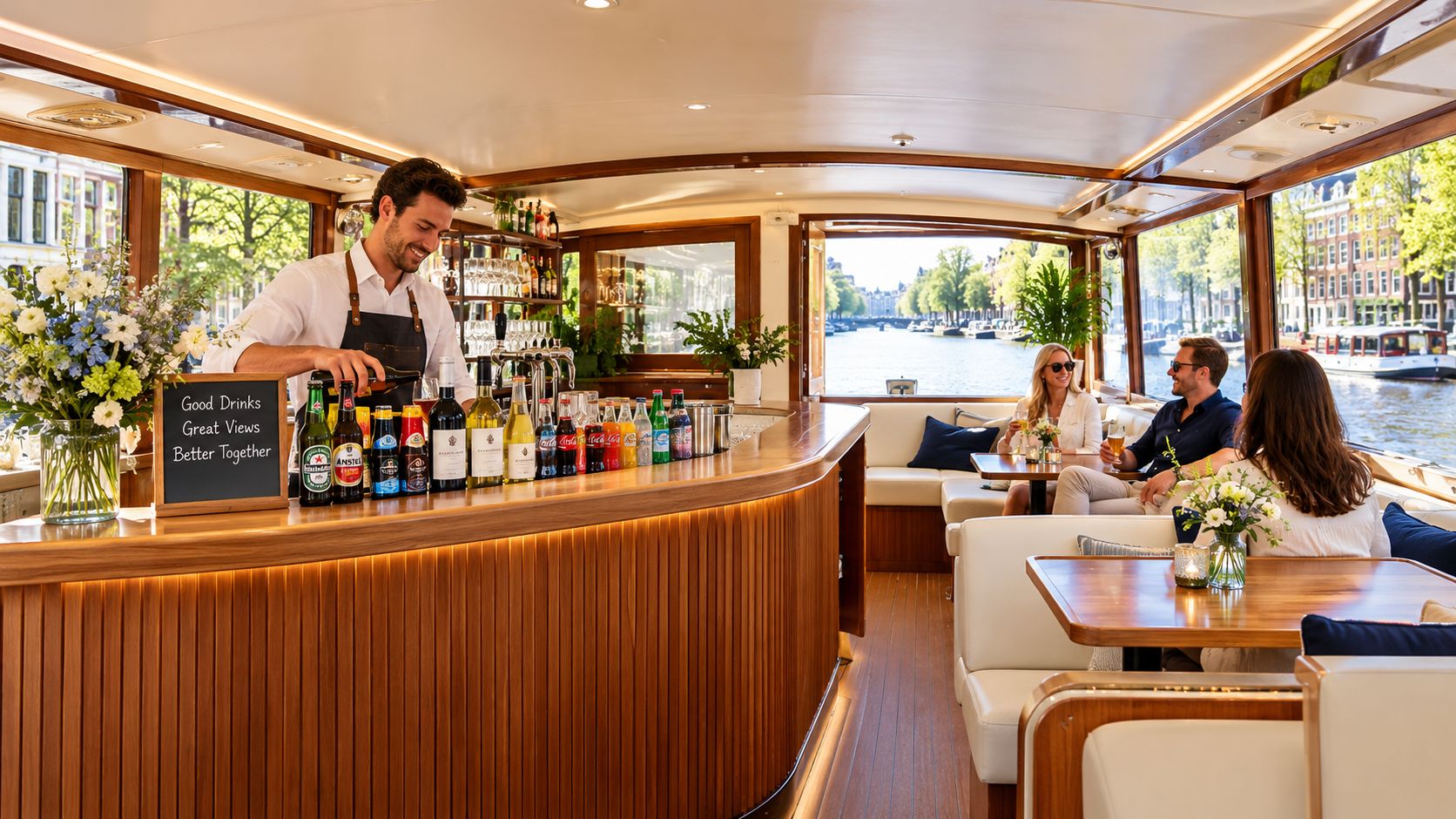
How Private Canal Tour Variables Change the Experience
| Variable | What It Controls | What to Ask |
|---|---|---|
| Vessel and layout | Seating, shelter, and movement | Which exact boat is assigned, and what happens in poor weather? |
| Propulsion | The onboard sound environment | Is the boat fully electric? |
| Bar arrangement | Available drinks and service | What does the open bar include, and what is excluded? |
| Bring-your-own policy | Outside drinks and handling | Are outside drinks permitted, and under what conditions? |
| Route flexibility | Scope for requested waterways | Is the itinerary fixed, suggested, or adjustable? |
| Boarding point | The group's arrival plan | What is the precise meeting location? |
| Hosting | Commentary, service, and interaction | Who handles drinks and guest questions? |
An open Dutch bar shouldn't be interpreted as every drink a guest might order elsewhere. The organizer should obtain the actual selection and service terms. Likewise, a bring-your-own arrangement shouldn't be assumed to include refrigeration, glassware, or disposal.
The same precision applies to hosting. A skipper's navigation role and a host's guest-service role are different responsibilities. A listing should establish the crew arrangement rather than leave the group to infer it from a photograph of drinks being served.
Read promises as questions
“Flexible route” is a good example. It could describe a route adjusted to operating conditions, or it could mean the operator accepts preferences before departure. Neither necessarily means passengers can direct the skipper throughout the cruise.
Weather needs the same treatment. A photograph taken on a sunny afternoon says nothing about shelter, cancellation terms, or the assigned vessel's configuration.
- Obtain written details: Save the vessel description and agreed inclusions with the booking confirmation.
- Separate requests from commitments: A preferred route or finishing point isn't confirmed merely because it appeared in an enquiry.
- Check exclusions: Food, decorations, outside drinks, and special arrangements need their own answers.
A useful comparison measures what each operator commits to providing. It doesn't award extra value to a longer list of adjectives. For group organizers, a precise confirmation is more valuable than a persuasive description that leaves every important detail open.
How Ultimate Party Amsterdam's Private Booze Cruise Works
Ultimate Party Amsterdam's Private Booze Cruise is a private charter on an electric boat with an open Dutch bar. Read operationally, that description settles three questions a group organizer should ask any operator: the propulsion type, the drinks arrangement, and exclusive use of the vessel. It leaves the rest open, and the open items are the ones that cause day-of problems.
The Private Booze Cruise experience runs for 60 minutes, with unlimited beer, wine, and soft drinks served during the cruise and a professional crew on board. Because the boat is electric, it is eligible for the 2025 emissions-free zone covered in the next section, so the central canals are available to it. The organizer should still confirm the assigned vessel and boarding point in writing, since an operator running more than one boat can swap vessels between booking and departure.
What the private format is for
The case for this format is keeping the group together in its own space. Birthday groups, stag and hen parties, friends on a city break, and corporate teams all benefit from that arrangement as a social anchor.
It suits some occasions better than others. A guest expecting continuous architectural commentary should look at a sightseeing product or get commentary confirmed in writing. A group expecting a particular playlist should ask about the audio policy, since amplified music on the canals sits under municipal noise rules regardless of what the booking implies.
The word "private" says nothing about licensed capacity. Ask for the passenger maximum on the assigned vessel and count the group against it, including anyone likely to join late.
The Shared Booze Cruise is a separate format on a shared electric boat with the same drinks arrangement. The key distinction is exclusive use versus sharing with other passengers.
| Choice | Reason to consider it |
|---|---|
| Private Booze Cruise | The group wants its own space and a celebration-focused booking |
| Shared Booze Cruise | Travelers are comfortable joining others rather than reserving the vessel |
| Sightseeing-focused charter | Historical interpretation matters more than the drinks-led format |
Keep the booking boundaries clear
An open Dutch bar covers beer, wine, and soft drinks for the duration of the cruise. Cocktails, premium spirits, food, decorations, and onward nightlife arrangements are separate questions, and silence on the listing is not an answer.
Electric propulsion settles zone eligibility. It does not settle seating layout, shelter, toilets, or boarding access, and those remain vessel-specific checks worth one message to the operator.
Booking boundary: A cruise inclusion applies to the cruise. Dinner, later venues, and special requests need separate confirmation.
For a group with dinner afterward, confirm the finishing point before reserving the restaurant. For colleagues, the test is whether the format supports relaxed conversation. For a birthday, the test is whether the proposed arrangements suit the guest of honor, not whether the listing sounds extravagant enough.
Rules and Practical Realities Most Listings Skip
Passenger count is a vessel-category question, not a seating preference. A pleasure craft may carry no more than 12 passengers plus one skipper; groups above that passenger threshold need an appropriately licensed vessel and qualified skipper. Amsterdam also requires a binnenhavengeldvignet or doorvaartvignet for relevant boating or mooring activity, with route-specific provisions explained in the municipal boating rules.

Eligibility comes before atmosphere
The city introduced its central emissions-free zone for pleasure craft on 1 April 2025, including the Singelgracht. Electric and hydrogen boats can enter, while some other vessels depend on transitional arrangements under the municipality's vessel emissions-zone rules. The organizer should ask whether the assigned vessel is eligible for the promised itinerary, not whether it's described as greener.
Excessive noise and amplified music are prohibited under the safe-boating rules cited earlier. A private booking doesn't override them.
- Access: Obtain written confirmation of steps, gangway arrangements, wheelchair dimensions, transfer requirements, and companion seating.
- Facilities: Confirm a toilet on the actual assigned vessel, not merely somewhere in the fleet.
- Audio: Establish the permitted setup before anyone plans around a playlist.
Published canal-cruise accessibility and facilities guidance illustrates why advance confirmation matters. Private doesn't automatically mean accessible.
The onward plan deserves equal attention. The guide to Amsterdam nightlife areas can help organizers choose a sensible next district once the disembarkation point is confirmed.
Before You Book and Common Questions
The organizer's final check should cover guest count and licensing, vessel eligibility, accessibility, toilet availability, audio permissions, boarding location, and the intended atmosphere. Every important request should appear in the written confirmation.
Questions worth settling early
How long is the cruise? The private product's duration is stated above; the organizer should distinguish sailing time from arrival instructions.
What does open bar mean? The named drinks are included. Other selections require confirmation.
Are drinks unlimited? The described cruise includes unlimited listed drinks during the experience, not unrelated extras.
When is private preferable? Exclusive group time favors private hire. Travelers seeking company may prefer shared departures.
Budget-conscious organizers can also consult the guide to experiencing Amsterdam nightlife on a budget. The recommendation is simple: choose the drinks-led charter for a social gathering, and a sightseeing format when interpretation matters most.
Ultimate Party Amsterdam offers private and shared canal booze cruises alongside Amsterdam pub crawls. Groups considering a private celebration on the water can visit Ultimate Party Amsterdam with their guest count, preferred date, and access requirements to check the suitable booking arrangements.
🍻
Experience it Yourself
Skip the planning — join Amsterdam's biggest pub crawl and get 6 bars, free drinks and VIP club entry for €20.