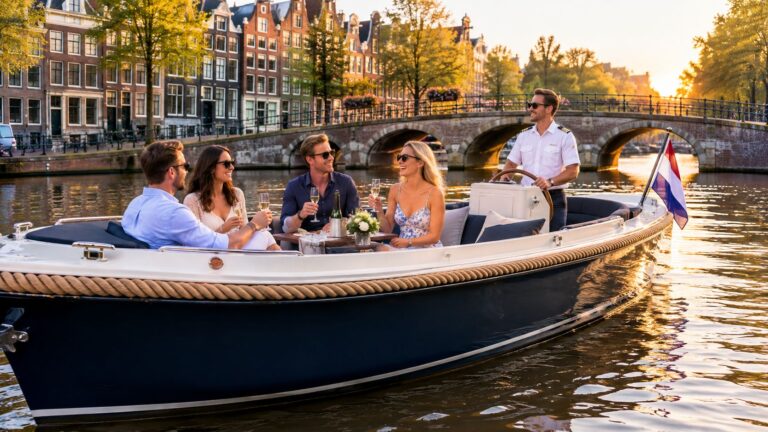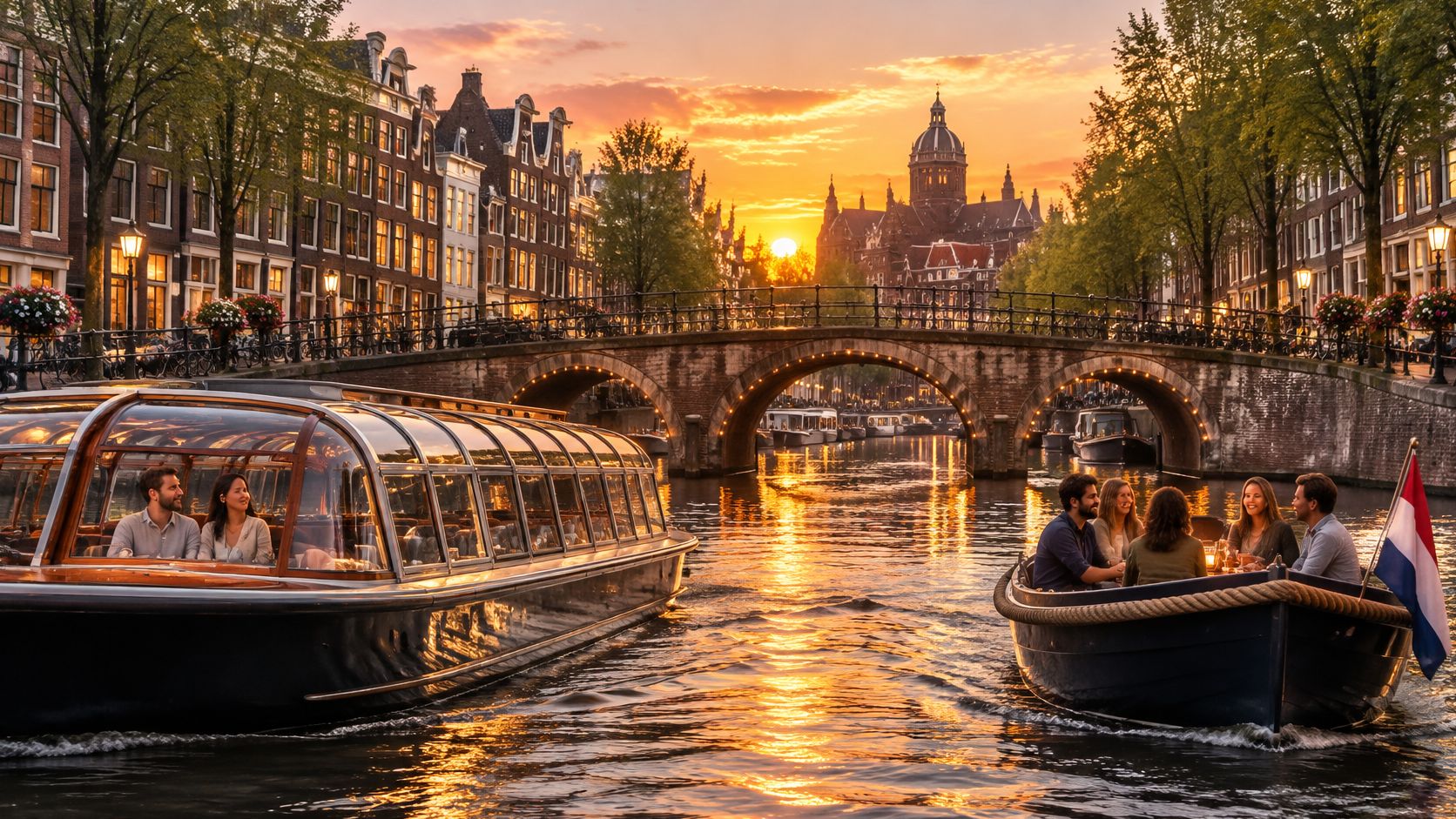
A group stands on a bridge at dusk, scrolling through canal tours in Amsterdam while dinner reservations and evening plans compete for attention. Some want photographs of canal houses; others want drinks and a boat where conversation comes easily. The useful question isn't which cruise looks cheapest. It's what the group wants to happen once everyone's on board.
Table of Contents
- Canal Tour Formats at a Glance
- How Long a Canal Cruise Lasts and Where It Goes
- Drinks, Noise and Comfort on the Water
- Shared Booze Cruise or Private Charter
- Which Canal Tour Fits Your Trip
- Questions to Ask Before You Book a Canal Tour
- Choose Your Canal Cruise and Book With Confidence
Canal Tour Formats at a Glance
The main choice is between sightseeing, socialising and privacy. A sightseeing boat can be the right purchase for architecture and commentary but the wrong setting for a celebration. A booze cruise makes more sense when spending time together is the point, rather than hearing an uninterrupted explanation of every building.
Routes can overlap, so a landmark list alone doesn't tell the full story. The more revealing details are the duration, seating arrangement, other passengers and service format.
| Format | Typical length | Booking style | Best for |
|---|---|---|---|
| Sightseeing cruise | Confirm the duration on each operator's listing | Fixed departures from many operators | Families, older visitors and first-time sightseers |
| Shared booze cruise (Ultimate Party Amsterdam) | One hour, per listing | Shared boat with other groups | Solo travellers, pairs and friends who want to meet people |
| Private booze cruise (Ultimate Party Amsterdam) | 60 minutes, per listing | Private booking for the group | Celebrations, small private parties and corporate outings |
| Private charter from another operator | Duration agreed in the charter booking | Private booking with operator-specific terms | Groups seeking control over route and timing, subject to agreement |
Read the format before comparing the price
The shared and private booze cruise listings describe different social arrangements, not just different ticket prices. Shared means other guests join the experience. Private means the booking is for the group alone, but it doesn't automatically mean unrestricted music, a custom itinerary or flexible boarding.
For the listed booze cruises, the current product page should remain the source of truth for drinks, group limits and departure times. A description saved in a group chat might not contain the full booking conditions.
Sightseeing cruises shouldn't be treated as a standard-length product. Their duration, commentary and boat configuration need checking individually. Daylight is a sensible choice for visitors whose priority is examining façades and taking photographs, while an evening social cruise suits groups that want the boat itself to be part of the night out.
Practical rule: Choose the purpose first, then compare boats that serve that purpose. A cheaper ticket for the wrong atmosphere isn't good value.
A private charter deserves particular care. Groups seeking control should ask what the operator can actually agree to, rather than assuming private hire means choosing any route or departure time. The strongest comparison is between written booking terms, not between promotional photographs.
How Long a Canal Cruise Lasts and Where It Goes
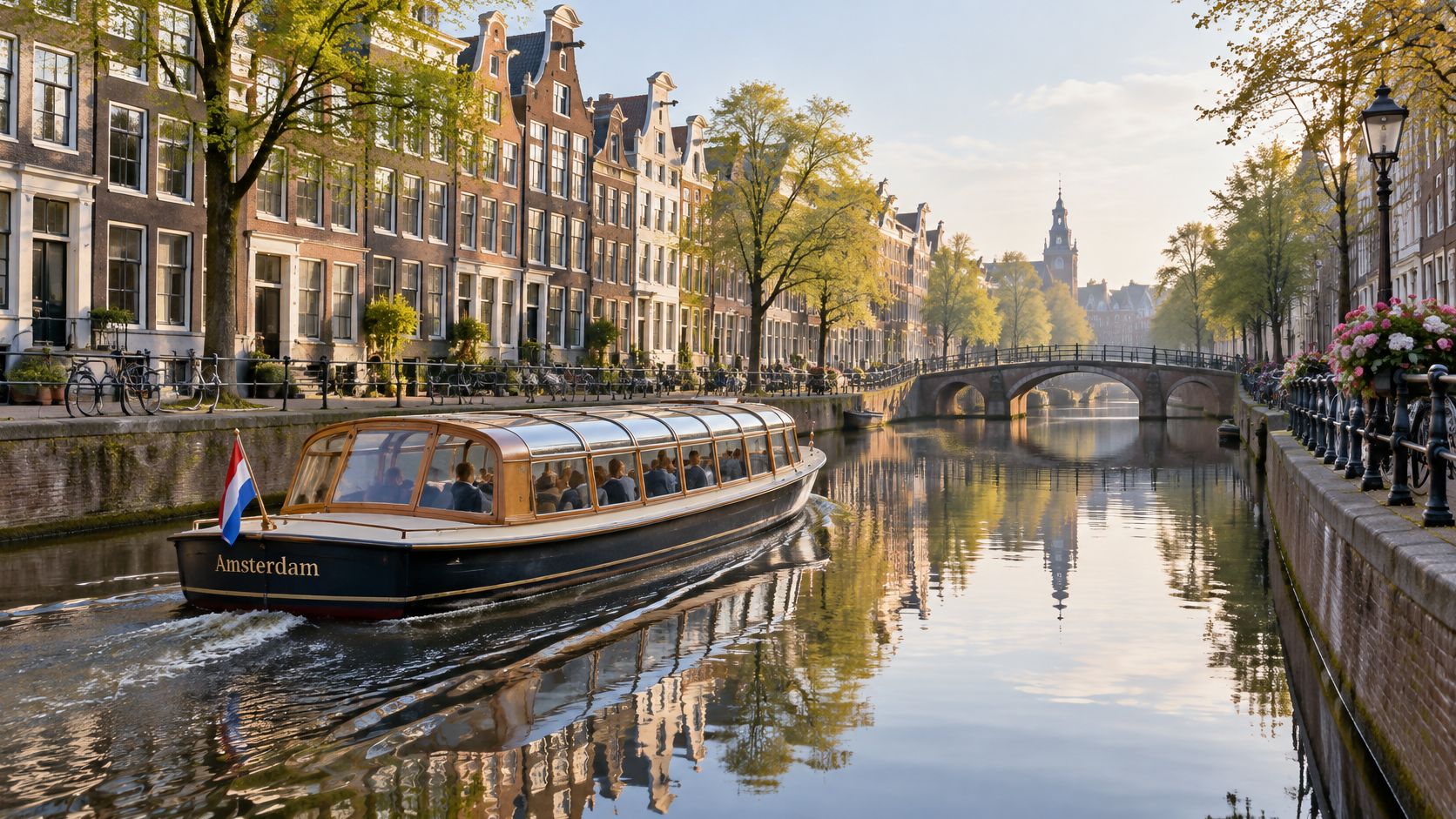
A canal cruise isn't a shortcut to seeing the whole city. Boats move through a working waterway, with bridges, junctions and other traffic shaping the pace. A compact itinerary can still feel satisfying, provided nobody expects a cross-city highlights sprint.
The City of Amsterdam's safe-boating guidance sets a 6 km/h maximum on central canals, with 7.5 km/h permitted only on specified waterways, including the Kostverlorenvaart, Oosterdok, Nieuwe Herengracht and the Amstel toward Ouderkerk aan de Amstel. The same guidance requires boaters to keep right, give priority to vessels approaching from the right, and slow near bridges or when passing other boats.
A compact route can be the right route
Those operating conditions have practical consequences. Views arrive gradually, and a skipper can't promise uninterrupted movement through every junction. Passing beneath a bridge or waiting for another vessel is part of travelling through the canals, not evidence that the cruise is going wrong.
A short sailing therefore works best as a focused experience of the canal environment. It gives the group time to settle, look around and talk without spending the whole evening on an activity. It doesn't replace exploring neighbourhoods on foot.
Boarding and disembarking also take time around the sailing. The important booking question is whether the advertised duration describes time underway or the complete experience. Guests shouldn't assume that arriving at the advertised departure time leaves time to find the correct dock and organise the group.
Build the evening around actual meeting points
Consider a group combining a cruise with a pub crawl. The practical task is to locate the boat's departure point, confirm its return point and check the walking route to the next meeting place. A familiar neighbourhood name isn't precise enough when several waterside boarding locations are nearby.
- Before departure: Arrange a group meeting point on land, then allow time to reach the correct boarding location together.
- After the cruise: Leave space for disembarking and walking rather than scheduling the next activity against the advertised finish.
- For route priorities: Ask whether a particular canal is expected, possible or guaranteed in the booking terms.
A boat trip should be booked as an experience, not treated as transport to the next nightlife stop.
The right pace depends on the evening's purpose. For a social group, slow movement creates room for conversation. For visitors with a long sightseeing checklist, a short cruise is better treated as an introduction than a complete city tour.
Drinks, Noise and Comfort on the Water
Two assumptions cause avoidable disappointment: that every canal boat is loud, and that every drink is included. Neither should be inferred from the phrase “party boat”. Propulsion, music policy and drink service are separate details.
Since 1 January 2025, passenger vessels on Amsterdam's inland waterways must operate emissions-free, while the central zone covering the Singelgracht applied to pleasure craft from 1 April 2025, according to the municipality's vessel emissions rules. Permitted propulsion includes electric, hydrogen and human-powered boats, plus hybrids operating without emissions; petrol and diesel operation requires an applicable transitional arrangement.
Municipal analysis estimates that electric propulsion can reduce boat noise by roughly 10 dB compared with petrol or diesel engines, according to Amsterdam's emissions-free boating impact assessment. That makes propulsion a useful question for groups that want conversation, although a quieter engine doesn't guarantee quiet passengers or low music volume.
Read the drinks line literally
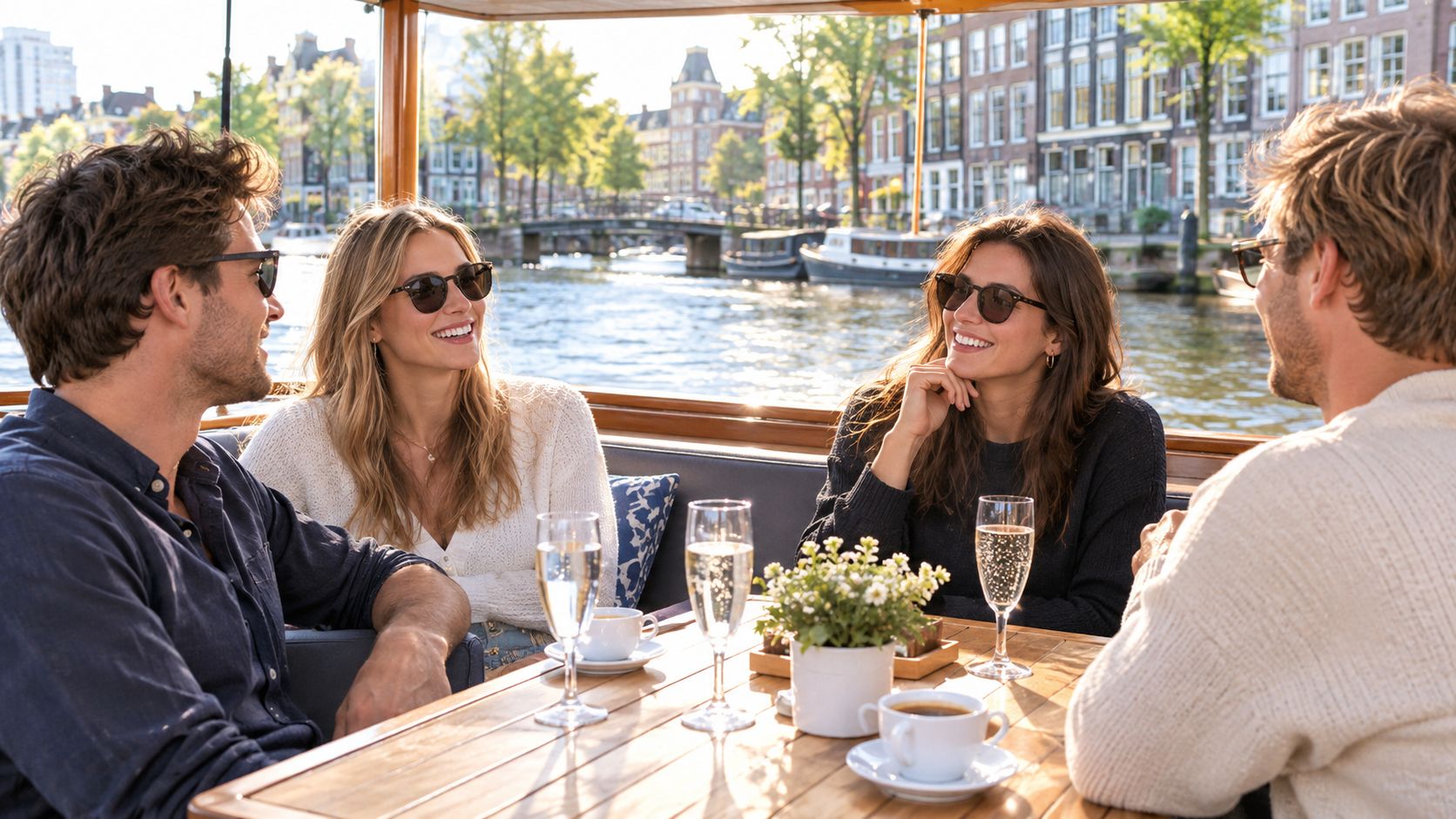
The shared booze cruise's stated drinks are beer, wine and soft drinks; the private format describes an open Dutch bar. Current listings should settle the exact selection and service terms. Neither phrase should be stretched into an assumption about cocktails, premium spirits or particular brands.
Sightseeing bookings may offer paid drinks, included refreshments or no drink service. Guests should ask rather than treating the presence of a bar in a photograph as proof of an inclusion.
For visitors interested in local styles, the guide to Amsterdam beers and drinking local offers useful background. It isn't a substitute for the actual onboard menu.
Comfort matters more after departure
A pleasant seat at the dock can feel different once the boat is exposed to evening wind. Before booking, groups should establish the practical details:
- Weather protection: Ask whether the boat is open, covered or fitted with shelter, and what happens in poor weather.
- Access: Confirm step-on height, handholds and seating with the operator when a guest has mobility needs.
- Facilities: Check toilet availability rather than assuming every vessel has one.
- Sound: Ask what music is permitted and whether the group controls it.
Responsible drinking means eating beforehand, pacing drinks and leaving room for water. Canal-front homes aren't a nightclub backdrop, so voices and music need to remain considerate of residents as well as other passengers.
Shared Booze Cruise or Private Charter
The decision starts with the people attending, the amount of control required and the organiser's willingness to coordinate details. A shared booking removes some planning decisions but introduces unfamiliar passengers. A private booking keeps the social setting within the group, while giving the organiser more responsibility for gathering preferences and confirming arrangements.
The shared booze cruise listing is the relevant starting point for guests considering the join-in format. The private option should be assessed against its own terms, not treated as an upgraded version with every possible extra included.
| Criterion | Shared booze cruise | Private booze cruise |
|---|---|---|
| Group size fit | Mixed groups joining a shared boat; confirm maximum capacity on the listing | The booking group only; confirm maximum capacity with the operator |
| Drinks | Check listing for beer, wine and soft drink terms | Check listing for bar terms |
| Privacy | Shared with other guests | The booking group only |
| Timing | Fixed departure per listing | The booked 60-minute slot, per listing |
| Set-up effort | Book and join the departure | Book, then coordinate timing and requested extras with the operator |
| Price basis | Compare the listed price per head | Compare the listed price per head at the confirmed group size |
Privacy isn't the same as customisation
A private booze cruise is useful when the group wants to stay together without sharing the boat with strangers. That can matter for a celebration, a reunion or colleagues who prefer their own conversation.
A fully customized charter is a different proposition. Changes to route, duration, catering or departure arrangements need explicit agreement, and availability shouldn't be assumed. Private occupancy alone doesn't establish permission for decorations, amplified music or bringing drinks aboard.
The organiser should send a concise request describing what matters. A preferred atmosphere is more useful than an instruction to make the trip special: relaxed conversation, a celebratory drinks setting or a route-led sightseeing experience all require different decisions.
Compare the total commitment
The fair comparison uses the actual attending group, not the optimistic headcount from the first message. If a private quote is a total boat price, divide it by confirmed attendees. If a listing already quotes per person, use that figure directly rather than dividing it again.
Booking judgement: A private boat that looks economical with everyone attending can become a different purchase after several guests withdraw.
Small, mixed groups that welcome introductions should start with the shared format. A known group celebrating together should price the private option first, then decide whether the extra privacy justifies the commitment. Neither choice is automatically better; each solves a different social problem.
Which Canal Tour Fits Your Trip
A useful recommendation starts with a realistic evening, not a demographic label. Age alone doesn't reveal whether someone wants commentary, new company or space with friends.
A solo traveller and a couple need different things
A solo traveller arrives for a short city break and wants an activity that doesn't require organising strangers beforehand. A shared booze cruise offers a defined social setting, with the option to make separate plans afterwards. Conversation is possible, but nobody should book on the assumption that fellow passengers will become a ready-made nightlife group.
Common mistake: Choosing a commentary-led sightseeing boat while expecting a social evening.
A couple wants time together after walking around the city. Daytime sightseeing is the clearer choice if architecture and photographs are the priority; a private drinks cruise may suit an evening focused on conversation, subject to the booking's group and pricing terms. Privacy can be worthwhile, but it shouldn't be confused with guaranteed silence or a bespoke romantic package.
Common mistake: Paying for a party atmosphere when the actual goal is uninterrupted time together.
Celebrations need a shared plan
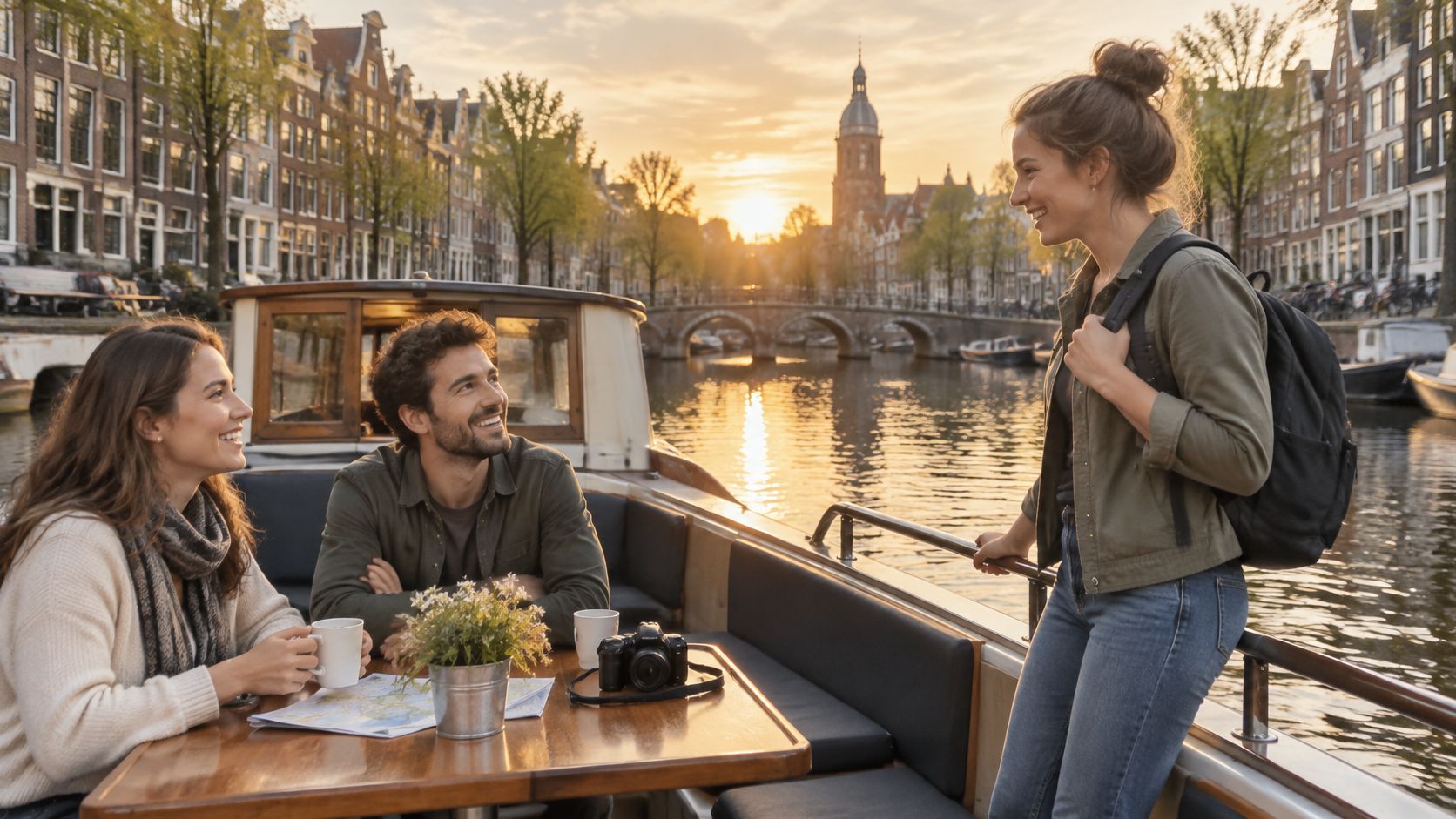
A hen or stag organiser has a group chat full of suggestions and an itinerary with very little breathing room. A private booze cruise is a sensible starting point because the attendees already know the occasion and can keep the experience within their group. The organiser should confirm conduct rules and any proposed accessories before paying.
The guide to planning an Amsterdam bachelorette party can help place the cruise within the wider celebration.
Common mistake: Booking sightseeing because it fits an empty itinerary slot, then expecting the skipper to turn it into a party.
For a corporate team or private celebration, the private format also makes sense when the host wants colleagues or guests to talk among themselves. Requested extras need an agreed scope and a named organiser.
Common mistake: Choosing a join-in party cruise for an event that needs a controlled atmosphere.
Budget and family decisions need honesty
Students planning an evening together should compare the confirmed per-head cost, then consider whether everyone truly wants a drinks-focused activity. Non-drinkers shouldn't disappear from the decision just because the package includes alcohol.
Common mistake: Buying a sightseeing ticket solely on price when the group wants a social drinks experience.
A family travelling with children should start with daytime sightseeing, then confirm the operator's minors policy, boarding access and suitable seating. Older relatives may value easy boarding and shelter more than an open deck.
Common mistake: Assuming a booze cruise is a family sightseeing trip with optional beer.
Questions to Ask Before You Book a Canal Tour
“Amsterdam canal cruise” covers commercial passenger boats, private pleasure craft, historic vessels and other boat categories. A houseboat pictured beside a departure point doesn't establish anything about the vessel being booked. The useful details concern the actual boat and its operating arrangements.
Le Figaro's explanation of Amsterdam's 2025 boating framework distinguishes commercial and recreational vessels, with temporary exemptions for some multi-year permits and historic museum boats, alongside exceptions for major navigation routes. Visitors therefore need a boat-specific answer rather than assuming every craft falls under identical conditions.
Get answers that apply to the booking
Confirm the propulsion type. Ask which vessel is expected and whether it operates emissions-free during the trip. A generic fleet description doesn't necessarily identify the booked boat.
Establish the route's scope. Ask whether the itinerary stays on the central canals and what circumstances could change it. A promotional photograph isn't a route guarantee.
Check duration and last boarding time. Record both, along with the precise departure location. This separates the sailing schedule from the time guests must be ready on land.
Clarify drinks and late arrival. Ask what's included, whether limits apply and what happens if guests arrive late. Those details affect both value and the organiser's contingency plan.
Verify shared or private occupancy and capacity. Confirm the maximum permitted booking size before collecting money. A private reservation still has a capacity limit.
Discuss access in practical terms. Step-on height, seating and wheelchair access require specific answers. The word accessible alone doesn't explain how a guest boards.
Read the cancellation terms attached to the product. Keep the booking confirmation rather than relying on a policy seen elsewhere on the website. Different experiences may have different conditions.
Save the day-of contact route. Store the provided email address, messaging contact or other stated channel on the organiser's phone. A contact method is only useful if it can be found quickly.
Keep the answers in one place
A short booking note is more useful than scattered screenshots across several chats. It should identify the organiser, meeting location, attendance deadline and confirmed terms.
Guests should receive the operational details, not every planning message. Sensitive access requirements are better discussed directly with the operator, with only the necessary arrival information shared with the wider group.
Choose Your Canal Cruise and Book With Confidence
Choose sightseeing for daytime views, a shared booze cruise for a social evening, and a private booze cruise or charter when the group wants its own boat and an agreed slot. The strongest booking is the one that matches the group's purpose without relying on unconfirmed extras.
Turn the shortlist into a booking
Start with the confirmed headcount, preferred date and a realistic arrival time. The arrival calculation should include the journey from the previous stop, not just the distance from the hotel. A group finishing dinner elsewhere needs a plan based on that restaurant's location.
Open the relevant listing and check current availability, price basis and drink terms. Compare like with like: total group cost against total group cost, or per-person cost against per-person cost. Requested additions belong in the comparison only after the operator confirms their price and availability.
Before payment, the organiser should complete a final review:
- Unanswered questions: Resolve missing route, access or service details rather than treating silence as agreement.
- Attendance uncertainty: Establish who's committed before accepting a private booking's financial obligations.
- Confirmation details: Check the date, product and guest count on the completed reservation.
- Changes: Request adjustments early, especially when they affect the vessel, schedule or agreed arrangements.
Make the handover simple
After booking, save the confirmation and contact route, then send guests a concise arrival message. That message should make clear where to meet and when everyone needs to be ready.
The group doesn't need an elaborate itinerary to enjoy the canals. It needs the right format, clear expectations and enough room in the evening to avoid rushing between activities.
Ultimate Party Amsterdam offers shared and private canal booze cruises alongside guided Amsterdam pub crawls, giving visitors options for the water and the rest of the evening. Visit Ultimate Party Amsterdam to compare current cruise listings, confirm the terms that matter to the group and book an available departure.
🍻
Experience it Yourself
Skip the planning — join Amsterdam's biggest pub crawl and get 6 bars, free drinks and VIP club entry for €20.