You're standing at Alexanderplatz or Berlin Hauptbahnhof, tired, slightly time-pressed, and staring at a wall of tour flyers. The big question is simple, does the Berlin Hop On Off Bus help, or are you better off buying a BVG ticket and doing the city on foot?
The honest answer is that the sightseeing bus is an orientation tool, not a magic shortcut. It works best when the goal is to see Berlin's headline landmarks with minimal planning, then decide what deserves more time later. It's much less useful if the day is already built around slow wandering, tight budgeting, or regular public transport confidence.
The first thing worth knowing is that Berlin's sightseeing bus idea has real historical weight. Berlin's first post-reunification route linking East and West was bus line 100, launched on 26 November 1990, and travel coverage later described it as a de facto sightseeing route from Zoologischer Garten to Alexanderplatz past landmarks like the Reichstag and Brandenburg Gate on a single fare of €2.90 (Travelbook on Berlin bus 100). That history matters because it explains Berlin's mindset. This city has long used buses as a way to see the center, not just to cross it.
Table of Contents
- Is the Berlin Hop On Off Bus Right for Your Trip
- How the Berlin Hop On Off Bus Works
- Main Operators, Routes and Frequencies
- Ticket Types, Prices and Bus-and-Boat Combos
- Boarding the Bus Step by Step
- What the Berlin Hop On Off Bus Does Well and Where It Falls Short
- Comparing the Bus With BVG, Walking and Bike Rental
- Practical Tips and When to Book Your Ticket
Is the Berlin Hop On Off Bus Right for Your Trip
A first-time visitor at Alexanderplatz or Hauptbahnhof needs to decide one thing fast, whether to buy convenience or save money. The Berlin hop on off bus is worth it when the trip is short, the energy is low, or the traveler wants a broad first look at the city without decoding the transport map. It is not the default answer for everyone, and that's the right way to think about it.
What the ticket buys is simple. It gives access to a looped sightseeing route that passes major central sights, then lets the rider get off, explore, and reboard later on the same validity window. Berlin's sightseeing sector is built around 24-hour and 48-hour tickets, with typical prices around €26–40 for a day ticket and €35–50 for two days, according to independent Berlin tourism guidance (Berlin hop-on hop-off guide).
That already tells the story. The bus is best for short-stay visitors, families who want a low-effort overview, and travelers who like a structured day with easy landmark access. It is weaker for confident walkers, repeat visitors, and anyone who plans to use Berlin like a local.
Practical rule: if the day is about “seeing the city once well,” the bus makes sense. If the day is about “moving through Berlin cheaply and independently,” the bus is usually the wrong tool.
Berlin's hop-on hop-off setup is also designed around landmark density, not long-form transit. A tourism listing describes the buses as barrier-free and low-emission, and says the pure bus tour lasts about 2 hours on one line and about 45 minutes on another, while bus-and-boat products are sold on 24-hour and 48-hour validity windows (Berlin.de tourism listing). That makes the product feel like curated sightseeing, not ordinary city mobility.
How the Berlin Hop On Off Bus Works
A first ride is straightforward if you use the official stops. Check the route map, board there, and show a ticket or QR code to the driver or staff. From there, the bus follows a fixed circuit, so you can stay onboard for the full loop or get off at a landmark and rejoin later at the next official stop.
Berlin runs this as a set of timed sightseeing routes, not one city-wide service. A documented operator lists a Classic Route every 20 minutes from 9:30 am to 4:00 pm, while another route runs every 40 minutes. Another Berlin schedule shows Red Route service every 20-30 minutes and Blue Route service every 60 minutes, with full-loop travel times of about 2 hours and 1 hour respectively (Introducing Berlin sightseeing bus). That spread matters in practice. Short headways keep the day flexible, while slower loops can waste time when traffic is bad or you miss a departure.
What the ticket usually covers
Most tickets cover one or two color-coded routes inside a 24, 48, or 72-hour window, depending on the operator and ticket type. Attraction entry is separate. You still need to step off at official stops, because drivers do not pick people up mid-route.
Tickets must be shown at official stops, and the system rewards planning over improvised boarding at random corners.
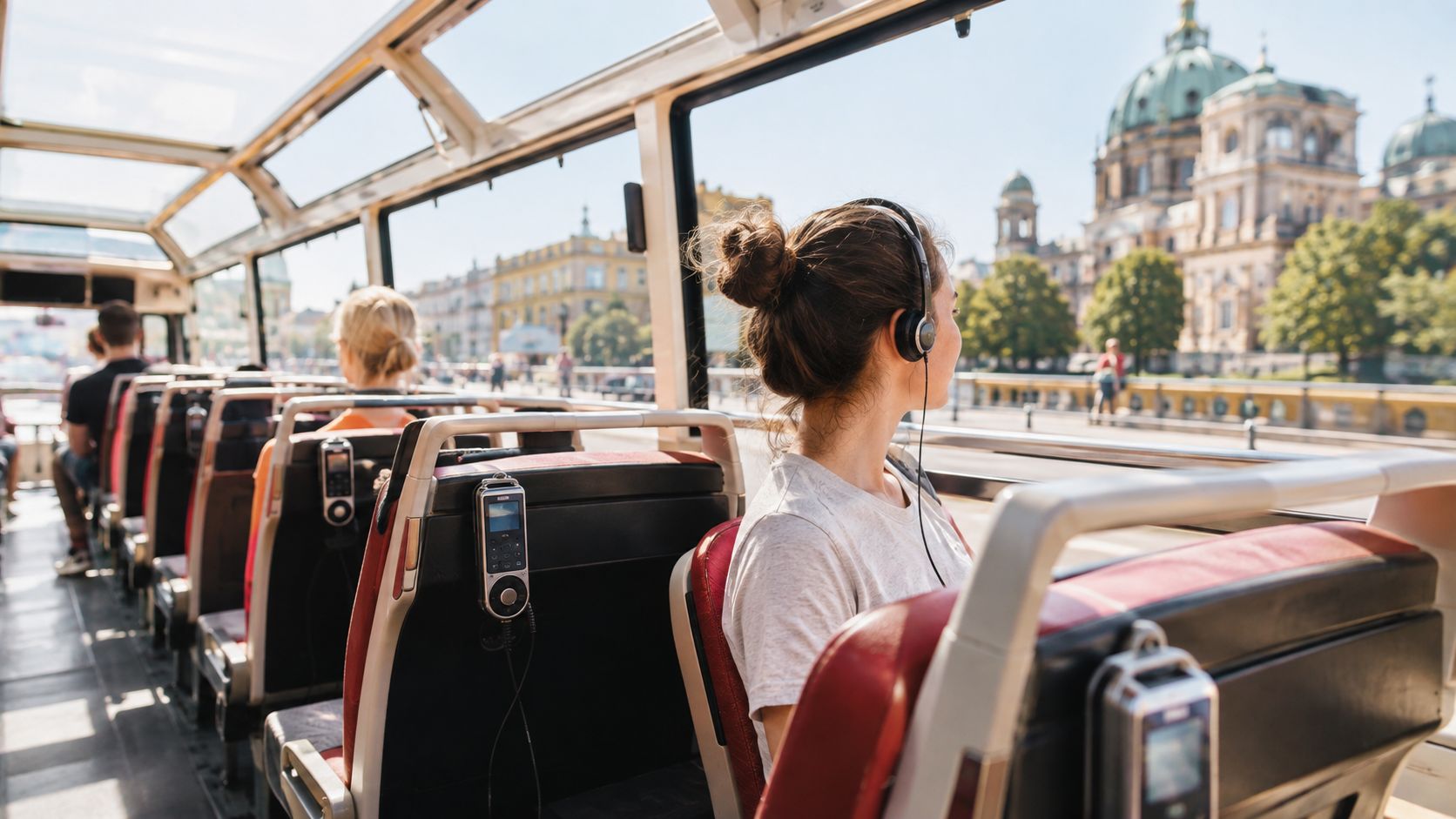
Audio commentary usually comes through headphones, an app, or onboard audio. That helps first-timers more than any map app does, because it ties the landmarks together while you ride. The value is context before the rest of the day starts. For visitors who want a clear overview without building a full transit plan, that is the point.
Main Operators, Routes and Frequencies
Berlin's sightseeing bus market is not one single product. It's a set of fixed route networks, and the practical differences come down to stop count, frequency, and how close the bus gets to the sights that matter most. The best choice depends on whether the day centers on Mitte, the western boulevard, or the eastern river corridor.
One useful way to read the market is through route density. Berlin hop-on hop-off offerings commonly bundle maps with 20 stops across 2 routes or 25 stops across 2 routes, depending on the operator and ticket type (Big Bus route map). A Berlin city-tour PDF also shows Tour A at roughly every 15 minutes and Tour B at roughly every 30 minutes, while another listing shows Line 1 every 30 minutes and Line 2 every 60 minutes (Berlin city-tour PDF). In other words, “hop on hop off” in Berlin never means one standard wait time.
What that means in practice
The practical winner is usually the route that cuts the most walking from the day's plan. If the traveler wants the western stretch and broad central highlights, the higher-frequency loop is usually the cleaner choice. If the traveler wants the East Side Gallery or a second district line, the lower-frequency route may still be worth it, but only with proper timing.
A Berlin listing for City Sightseeing says the green and beige buses run every 10 minutes in summer and every 15 to 20 minutes in winter, with stops at places such as Park Inn, Brandenburg Gate, Tauentzienstrasse 16, Hauptbahnhof, and Neptunbrunnen (VisitBerlin City Sightseeing). That is the kind of detail that matters. Frequent service near the center is useful, but only if the traveler's plan is built around those central stops.
| Berlin Hop On Off Bus Operators Compared | Routes | Approx. Stops | Frequency | Notable Sights Covered |
|---|---|---|---|---|
| Fixed-loop sightseeing service | 2 routes | 20 to 25 total | 10 to 60 minutes depending on route and season | Central landmarks, eastern stops, and major city-center corridors |
The takeaway is plain. Berlin sightseeing buses are built for route choice, not brand loyalty. Pick the loop that matches the landmarks already on the day's list.
Ticket Types, Prices and Bus-and-Boat Combos
The best ticket is the one that matches the actual length of the stay, not the fantasy version where every landmark gets a full stop. Berlin's market is built around 24-hour and 48-hour tickets, with independent guides saying these usually sit around €26–40 and €35–50 respectively (Berlin hop-on hop-off guide). That price band is broad because operators package things differently, but the pattern is consistent.
A few Berlin listings also show the logic behind combined products. One official listing explains that combined bus-and-boat tours use timed departure windows, with departures from Moltkebrücke every 30 minutes, first departure at 10:00 and last departure at 17:00 (Berlin.de combined bus and boat PDF). Another listing says combined bus-and-boat products are sold on 24-hour and 48-hour windows (Berlin.de tourism listing). That means the boat leg is not a casual add-on. It's part of a timed sightseeing system.
How to choose the duration
A 24-hour ticket is enough for a short first look and a tight itinerary. A 48-hour ticket only pays off if the traveler wants to spread the sightseeing across two calmer days or revisit stops without rushing. Anything longer only makes sense when the operator's route structure is the core of the trip.
Best booking habit: buy the shortest pass that still covers the real pace of the day. Stretching a ticket because it sounds efficient usually leads to paying for unused hours.
| Berlin hop-on hop-off ticket tiers compared | Duration | Approx. Adult Price | Bus-and-Boat Option |
|---|---|---|---|
| Day pass | 24 hours | €26–40 | Available on some products |
| Two-day pass | 48 hours | €35–50 | Available on some products |
| Extended pass | 72 hours | Varies by operator | Sometimes bundled, but not always the best value |
The boat combo is worth it when the traveler wants a river perspective and has enough time to use both parts properly. It's weaker when the boat leg is included mainly because the package looks more complete on paper.
Boarding the Bus Step by Step
The easiest boarding experience comes from treating the first stop like a timed handoff. Check the route map before you leave, arrive a little early, and watch the bus movement if live tracking is available. On a busy day, that saves more time than any on-the-spot improvising.
The key difference is where you board and how long you wait once you start using the bus as a transfer tool. Stops like Alexanderplatz usually turn into longer pauses because they draw heavier passenger traffic and more people boarding or changing sides of the route. Brandenburg Gate tends to move faster, especially when travelers arrive with a clear plan and do not linger after photos. If you want the bus to carry you between sights, use the quieter stop to re-enter and avoid the crowded one unless it fits your route.
A practical sample works better than vague advice. Start at Alexanderplatz if you want the eastern landmarks first, ride to the East Side Gallery, then exit and stay on foot through the nearby river area before boarding again later. For the government quarter, step off near the Reichstag or Brandenburg Gate, do the short walk between them, then use the next departure only if your legs are already tired. That approach keeps the bus useful without wasting time on short hops that are faster on foot.
Treat the bus like a moving checkpoint. Decide the next stop before you sit down, keep your exit point in mind, and board again only when the route gives you a real shortcut.
A few small habits help. Keep bags light, open the QR code before you reach the door, and stay flexible about the upper deck because weather changes the ride fast. Pets and exact boarding rules vary by operator, so check the policy before you go.
What the Berlin Hop On Off Bus Does Well and Where It Falls Short
The strongest case for the Berlin Hop On Off Bus is simple, it gives a clean city overview with almost no planning burden. For a first-time visitor, the payoff is obvious. The route strings together landmark views, the audio adds context, and the ride saves the legs for the places that deserve a slower look.
The weaknesses are just as real. Recent user reviews describe 60-minute waits as “realistic” and complain about long delays and extra dwell time, while official FAQ content focuses more on convenience, ticket validity, and live tracking than on proving the bus is faster than transit or walking (Tripadvisor review page). That tells the truth better than the marketing does. If the plan depends on moving quickly between districts, the bus can feel slow.
Who should buy it
The bus makes sense for two-night visitors, families with tired kids, and travelers who don't want to spend mental energy on route planning. It also works for people who want the big landmarks in one sweep before deciding where to come back later.
Who should skip it
Longer-stay visitors who are comfortable reading a transit map should think twice. Berlin's regular buses and trains are often the smarter move if the stay is longer, because the sightseeing bus is paying for convenience, not for raw mobility. Walking also wins whenever the day stays inside Mitte and the next stop is close enough to reach faster on foot.
The biggest trap is buying a boat leg just because it's bundled. If the river segment isn't part of the day, it's dead weight. The sightseeing bus is good when it fits the schedule, and mediocre when it's forced to carry the whole trip.
Comparing the Bus With BVG, Walking and Bike Rental
The smartest comparison in Berlin is not between different sightseeing bus brands. It's between the sightseeing bus and the ways locals and confident visitors move around the city. A 24-hour sightseeing ticket buys convenience and narration. A BVG day ticket buys flexibility. Walking buys directness. A bike buys speed across short urban distances.
Berlin's bus history gives one practical example already mentioned above. The old bus 100 route became famous because it linked major sights across the center on a simple fare of €2.90 (Travelbook on bus 100). That's the mindset behind the cheaper transit alternative. It won't hand over commentary, but it does cover a scenic axis without the sightseeing markup.
A useful planning reference for visitors who think in riding time is the broader e-bike context. If a traveler is already considering active city movement in another destination, the UK EU e-bike rental guide is a practical way to compare what bike rental usually requires in terms of pacing, comfort, and route planning. In Berlin, the same principle applies, bikes are best when the rider can handle navigation and wants to keep moving instead of waiting.
| Hop-on hop-off bus vs BVG, walking, and bike rental in Berlin | Typical cost per day | Flexibility | Audio commentary | Best for |
|---|---|---|---|---|
| Sightseeing bus | Higher, ticket-based | Medium | Yes | Short stays and first-time overview |
| BVG day ticket | Lower | High | No | Budget travelers and repeat visitors |
| Walking | Free | Very high | No | Central areas and slow exploration |
| Bike rental | Moderate | High | No | Active travelers and longer urban routes |
For readers who plan active city time elsewhere too, the internal guide on bike rental in Amsterdam is a good reminder that urban cycling only works when the itinerary and stamina fit the ride.
The clear rule is this. Short stays favor the sightseeing bus. Repeat visitors and budget travelers should lean on BVG. Active travelers with two or more days should consider a bike.
Practical Tips and When to Book Your Ticket
Book the bus with the weather and your route in mind. Summer days fill up fastest, so booking online a day ahead is the safest move if you want a specific departure window. Same-day tickets are often available at major stops such as Alexanderplatz, Hauptbahnhof, and Kurfürstendamm, but that does not guarantee the next bus will fit a tight schedule.
For many visitors, the decision is simple. If you want a quick first look at the city, the sightseeing bus works. If you already know Berlin well, the BVG is usually the better buy. Walking beats both in the center, and a bike makes more sense only if you are comfortable covering more ground on your own.
A short checklist keeps the day practical:
- Check the route first: make sure the line covers the places you want to see.
- Confirm the validity window: 24, 48, or 72 hours changes how rushed the day feels.
- Look for extras before paying: some tickets include walking tours or river cruises, others do not.
- Use the upper deck only in good weather: the view is better, but rain makes it miserable.
- Book earlier for a fixed plan: if you need a certain stop or departure, do not leave it to chance.
Berlin rewards visitors who use the bus for orientation, skyline views, and easy landmark hops. Once that is done, get off and walk. The city is better that way.
🍻
Experience it Yourself
Skip the planning — join Amsterdam's biggest pub crawl and get 6 bars, free drinks and VIP club entry for €20.